

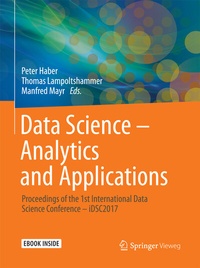
Data Science - Analytics and Applications
Description

The iDSC Proceedings reports on state-of-the-art results in Data Science research, development and business. Topics and content of the IDSC2017 proceedings are
Reasoning and Predictive Analytics
Data Analytics in Community Networks
Data Analytics through Sentiment Analysis
User/Customer-centric Data Analytics
Data Analytics in Industrial Application Scenarios
Advances in technology and changes in the business and social environment have led to an increasing flood of data, fueling both the need and the desire to generate value from these assets. The emerging field of Data Science is poised to deliver theoretical and practical solutions to the pressing issues of data-driven applications.
The 1st International Data Science Conference (iDSC2017 / http://www.idsc.at) organized by Salzburg University of Applied Sciences in cooperation with Information Professionals GmbH, established a new key Data Science event, by providing a forum for the international exchange of Data Science technologies and applications.
More details
Other editions
Additional editions
Persons
FH-Ass. Prof. DI (FH) DI Peter Haber is professor for analog and digital signal processing and responsible coordinator of system theory and electrical engineering at the University of Applied Sciences Salzburg. He has been working as a researcher and project manager in national and international research projects; managing and coordinating both national and international projects, such as the two Leonardo da Vinci EU projects POOL and P2B. He is a member of the international advisory boards for the ICERI, INTEND and EDULEARN conferences since 2009.
DI (FH) Dr. Thomas Lampoltshammer , M.A. MSc is currently working as a Senior Scientist at the Department for E-Governance and Administration at Danube University Krems/Austria in the fields of Security Studies and associated societal challenges. His research experience covers national and EU-funded projects in ICT-related topics, such as Geoinformatics, Semantics, Social Media, Legal Informatics, and Open Data. He has a strong background in the design and implementation of expert and decision-making systems, data analytics, as well as semantic-based reasoning.
FH-Prof. Ing. Mag. Dr. Manfred Mayr is professor for IT management and department head at Salzburg University of Applied Sciences. He is a lecturer at international conferences and author of various publications in the field of IT-management and business informatics. He was the responsible coordinator and project manager of the two international "EU-Leonardo Da Vinci research projects" "POOL Project Organization OnLine" and Pool2Business (P2B) and various other national projects.
The editors are the conference chairs of the International Data Science Conference.
