

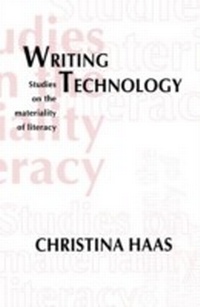
Writing Technology
Studies on the Materiality of Literacy
1st Edition
Published on 5. November 2013
304 pages
978-1-136-68754-9 (ISBN)
Description

Academic and practitioner journals in fields from electronics to business to language studies, as well as the popular press, have for over a decade been proclaiming the arrival of the "computer revolution" and making far-reaching claims about the impact of computers on modern western culture. Implicit in many arguments about the revolutionary power of computers is the assumption that communication, language, and words are intimately tied to culture -- that the computer's transformation of communication means a transformation, a revolutionizing, of culture. Moving from a vague sense that writing is profoundly different with different material and technological tools to an understanding of how such tools can and will change writing, writers, written forms, and writing's functions is not a simple matter. Further, the question of whether -- and how -- changes in individual writers' experiences with new technologies translate into large-scale, cultural "revolutions" remains unresolved.
This book is about the relationship of writing to its technologies. It uses history, theory and empirical research to argue that the effects of computer technologies on literacy are complex, always incomplete, and far from unitary -- despite a great deal of popular and even scholarly discourse about the inevitability of the computer revolution. The author argues that just as computers impact on discourse, discourse itself impacts technology and explains how technology is used in educational settings and beyond.
This book is about the relationship of writing to its technologies. It uses history, theory and empirical research to argue that the effects of computer technologies on literacy are complex, always incomplete, and far from unitary -- despite a great deal of popular and even scholarly discourse about the inevitability of the computer revolution. The author argues that just as computers impact on discourse, discourse itself impacts technology and explains how technology is used in educational settings and beyond.
Reviews / Votes
"The author suggests that writing and technology constitute one another in a symbiotic relation, and the book is a powerful attempt to analyse this complex relationship."-The National Literacy Trust's Guide to books on literacy published during 1995
An adequate theory of literacy, to be useful to all interested professionals, must itself be flexible enough to encompass the dynamic relationship between technology and literacy: multidirectional, multilayered, and composed of ever-changing agendas.
-Technical Communication, First Quarter 1997
"...Haas give us a clear view of how we might develop a more complicated approach to technology. Haas' book is replete with methods, scenarios, and examples of what it means for a discipline to think through technology."
-IEEE
"This is an absorbing book which addresses an issue of interest to a wide range of disciplines....This book will interest everybody concerned with understanding and theorizing the process of historical and cultural change in literate behaviours and offers researchers a sound model of research in the area of developing literacy competence."
-School Psychology International
"Recent years have seen countless studies and articles on the effects of word processing and computer technologies on writing and learning to write. Many of these articles have focused on narrow empirical questions concerning whether or not and how word processing helps students write and learn to write. What has been missing and what this proposal promises is a broad but focused cultural analysis of computer technologies. Prof. Haas' research makes salutary, ingenious use of Vygotsky's conceptual apparatus concerning thought and language to enlighten current deliberations of computer technologies and their effects on literacy development. Her project will be important to discourse theorists, educational researchers, and teachers of writing."
-Martin Nystrand
University of Wisconsin-Madison
"A stimulating exploration of the problems and possibilities for writing raised by new computer technologies....Writing Technology is an important study of the complex and changing relations among literacy, technology, and culturally situated cognition."
-Lester Faigley
The University of Texas at Austin
"...an excellent contribution to the studies of computers and to the field of technology studies in general....Starting with the 'technology question,' the book presents a well-supported argument whose implications extend well beyond simple accounts of writing tools. It should be read by anyone interested in writing, literacy, or technology studies."
-Chip Bruce
University of Illinois
More details
Language
English
Place of publication
London
United Kingdom
Publishing group
Taylor & Francis Ltd
Target group
Professional and scholarly
Product notice
Reflowable
File size
12,24 MB
ISBN-13
978-1-136-68754-9 (9781136687549)
Copyright in bibliographic data and cover images is held by Nielsen Book Services Limited or by the publishers or by their respective licensors: all rights reserved.
Schweitzer Classification
Other editions
Additional editions
Book
11/1995
1st Edition
Routledge
€208.10
Shipment within 10-20 days
Book
11/1995
1st Edition
Routledge
€61.70
Shipment within 10-20 days
Person
Cristina Haas, The Pennsylvania State University
Content
Contents: Preface. Part I: Writing in the Material World. The Technology Question. Technology Studies. Part II: The Role of Technology in the Cognition of Literacy. Reading On-Line. Materiality and Thinking: The Effects of Computer Technology on Writers' Planning. Text Sense and Writers' Materially Based Representations of Text. Part III: The Social and Cultural Construction of Literacy Tools. Social Dynamics, or Scientific Truth, or Sheer Human Cussedness: Design Decisions in the Evolution of a User Interface. Constructing Technology Through Discourse with Ann George. Part IV: Conclusions and Future Inquiry. Historicizing Technology. Theorizing Technology.
