

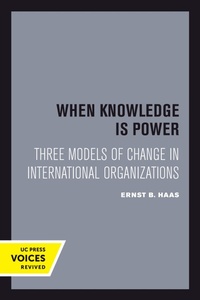
When Knowledge Is Power
Three Models of Change in International Organizations
1st Edition
Published on 28. June 2024
278 pages
978-0-520-37886-5 (ISBN)
Description

Do governments seeking to collaborate in such international organizations as the United Nations and the World Bank ever learn to improve the performance of those organizations? Can international organizations be improved by a deliberate institutional design that reflects lessons learned in peacekeeping, the protection of human rights, and environmentally sound economic development? In this incisive work, Ernst Haas examines these and other issues to delineate the conditions under which organizations change their methods for defining problems. Haas contends that international organizations change most effectively when they are able to redefine the causes underlying the problems to be addressed. He shows that such self-reflection is possible when the expert-generated knowledge about the problems can be made to mesh with the interests of hegemonic coalitions of member governments. But usually efforts to change organizations begin as adaptive practices that owe little to a systematic questioning of past behavior. Often organizations adapt and survive without fully satisfying most of their members, as has been the case with the United Nations since 1970. When Knowledge Is Power is a wide-ranging work that will elicit interest from political scientists, organization theorists, bureaucrats, and students of management and international administration. This title is part of UC Press's Voices Revived program, which commemorates University of California Press's mission to seek out and cultivate the brightest minds and give them voice, reach, and impact. Drawing on a backlist dating to 1893, Voices Revived makes high-quality, peer-reviewed scholarship accessible once again using print-on-demand technology. This title was originally published in 1990.
Many titles in the Voices Revived program are also newly available as ebooks, offered at a discounted price to support wider access to scholarly work.
Many titles in the Voices Revived program are also newly available as ebooks, offered at a discounted price to support wider access to scholarly work.
More details
Other editions
Additional editions
Book
06/2024
1st Edition
University of California Press
€99.04
Article not available at the moment
Book
04/2018
1st Edition
University of California Press
€42.09
Article not available at the moment
Person
Ernst B. Haas is Robson Research Professor of Government at the University of California, Berkeley and author of numerous books on international organizations.
Content
- Cover
- Series Editor
- Title Page
- Copyright
- Contents
- List of Illustrations
- Acknowledgments
- 1. Multilateralism, Knowledge, and Power
- The Argument Summarized
- A Typology Is Not a Theory
- Knowledge, Power, and Interest
- Why International Organizations Are Important as Innovators
- 2. International Organizations: Adapters or Learners
- International Organizations as Problem Solvers
- Consensual Knowledge
- Learning
- International Organizations as Satisficers
- Adaptation, Learning, and Institutional Constraints
- Epistemic Communities as Enemies of Habit-Driven Institutions
- Learning and Transideological Communication
- 3. Characteristics Shared by All International Organizations
- Models, Organizational Units, and Learning
- Behavioral Constants of All Public Organizations
- Situational Constants of All International Organizations
- 4. Characteristics That Differentiate International Organizations
- Identifying the Differences: A Descriptive Code
- Adaptation and Learning: An Analytic Code
- Predicting" Changed Behavior?
- Three Models of Organizational Change
- 5. Adaptation Through Incremental Growth
- The Incremental-Growth Model
- How to Identify the Incremental-Growth Model
- Conditions and Limitations of the Incremental-Growth Model
- 6. Adaptation Through Turbulent Nongrowth
- Turbulence and Turbulent Fields
- Turbulence and International Organizations
- How to Identify the Turbulent Nongrowth Model
- Conditions and Limitations of the Turbulent Nongrowth Model
- 7. Learning to Manage Interdependence
- Managed Interdependence: General Characteristics
- How to Identify the Managed-Interdependence Model
- Successful Organizational Learning: Case Studies
- Unsuccessful Organizational Learning: Case Studies
- 8. The Three Models of Change: A Comparison
- Regional Organizations
- When Can Managed Interdependence Take Over
- Is Learning to Manage Interdependence Morally Preferable to Adaptation
- Between Adaptation and Learning
- Institutions, Regimes, and Organization-Mediated Change
- 9. Can Better International Organizations Be Designed
- The Crisis of Multilateralism as the Occasion for Redesign
- The Normative Basis of Design
- Cognitive Evolution
- How to Manage Interdependence Better
- Notes
- Subject Index
- Index of Authors Cited
