

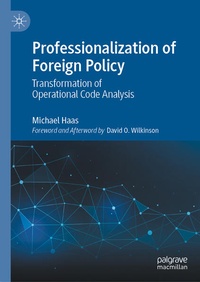
Professionalization of Foreign Policy
Description

This book identifies why presidents, prime ministers, and other leaders of countries often make blunders in foreign policy. Blunders have been recognized within the study of foreign policy, but no central methodology or theory has developed to provide a way to avoid future disasters. Options are often presented to leaders of countries by advisers who do not always assess which policies will best serve national interests. Presidents, prime ministers, and other leaders of countries then have their legacy judged accordingly.
Therefore, the book reviews existing efforts at developing theories of foreign policy to determine why they have failed. Instead of allowing a discipline with a lot of competing theories to continue to flounder, the book consolidates all approaches and develops a new professional format that will serve to professionalize foreign policy decision-making so that fewer key decisions are ever again considered blunders.
More details
Other editions
Additional editions
Person
Michael Haas is retired Professor of Political Science. He was nominated in 2010 for a Nobel Peace Prize. He previously taught at Loyola Marymount University, Northwestern University, Occidental College, Purdue University, the University of California (Riverside), the University of Hawai'i, the University of London, and five campuses of California State University.
Content
Part I: Approaches to the Study of Foreign Policy.- Chapter 1: Early Approaches to the Study of Foreign Policy.- Chapter 2: Pre-Theories of Decision-Making.- Chapter 3: Quantifying Alternative Pre-Theories.- Part II: Operational Code Analysis.- Chapter 4: Omnipresence of Codes.- Chapter 5: Developments and Problems in Operational Code Research.- Part III: Professionalization Through Options Analysis.- Chapter 6: Parameters of Decision-Making and Options Analysis.- Chapter 7: American Policies Toward Cambodia.- Chapter 8: American Policies Toward North Korea.- Chapter 9: American Policies Toward Ukraine.- Chapter 10: Implications for Foreign Policy Research.
