

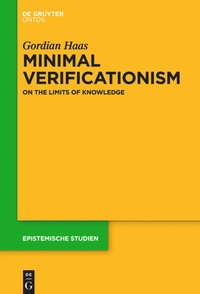
Minimal Verificationism
Description

Verificationism has been a hallmark of logical empiricism. According to this principle, a sentence is insignificant in a certain sense if its truth value cannot be determined. Although logical empiricists strove for decades to develop an adequate principle of verification, they failed to resolve its problems. This led to a general abandonment of the verificationist project in the early 1960s. In the last 50 years, this view has received tremendously bad press. Today it is mostly regarded as an outdated historical concept. Theories that have evolved since the abandonment of verificationism can, however, help overcome some of its key problems. More specifically, an adequate criterion of significance can be derived from a combination of modern theories of justification and belief revision, along with a formal semantics for counterfactuals. In view of these potential improvements, the abandonment of verificationism appears premature. Half a century following its decline, it might be about time to revisit this disreputable view. The author argues in favor of a weak form of verificationism. This approach could be referred to as minimal verificationism, as it involves a weakening of traditional verificationist principles in various respects while maintaining their core idea.
More details
Other editions
Additional editions
Person
Content
- Intro
- Contents
- Introduction: Does This Make Nonsense to You?
- 1 Some Historic Formulations and Their Problems
- 1.1 What about Analytic Sentences?
- 1.2 Conclusive Verifiability Within One's Lifetime
- 1.3 Conclusive Verifiability in Principle
- 1.4 Conclusive Falsifiability in Principle
- 1.5 Verifiability or Falsifiability
- 1.6 Empirical Import
- 1.7 Translatability
- 1.8 Summary
- 2 More Problems Lie Ahead
- 2.1 The Problem of Dispositional Terms Spreads Out
- 2.2 Another Problem: Particular Sentences
- 2.3 Yet Another Problem: The Duhem-Quine Thesis
- 2.4 And Another Problem: The Analytic/Synthetic Distinction
- 2.5 Summary
- 3 Toward a Solution to the Problems
- 3.1 Conditions of Adequacy
- 3.2 What You Can and What You Should Not Expect
- 3.3 Against Deductive Chauvinism
- 3.4 The Discovery of the Subject
- 3.5 Counterfactual Conditionals
- 3.6 Did We Throw Out the Baby With the Bathwater?
- 3.7 Summary
- 4 Minimal Verificationism
- 4.1 The Essence of Verificationism
- 4.2 Epistemic Accessibility as a Criterion of Significance
- 4.3 The Advantages of the New Criterion
- 4.4 O'Connor's Trick
- 4.5 The Choice of an Empirical Basis
- 4.6 What Does this Criterion Demarcate?
- 4.7 What Is Minimal about Minimal Verificationism?
- 4.8 Is Minimal Verificationism a Form of Verificationism at All?
- 4.9 Setting the Stage
- 4.10 Summary
- 5 Fallibilist Theories of Justification
- 5.1 Various Types of Theories of Justification
- 5.2 Lehrer's Theory of Justification
- 5.3 Formal Reconstruction of Lehrer's Theory
- 5.4 The Justification Operator
- 5.5 Consistency and Compatibility of the Justification Postulates
- 5.6 Summary
- 6 The Standard Theory of Belief Revision: AGM
- 6.1 Modeling Epistemic States
- 6.2 Axiomatic Characterization of Belief Changes
- 6.3 Construction of Belief Change Mechanisms
- 6.4 Objections to the AGM Theory
- 6.5 Summary
- 7 Combining Theories of Justification and Belief Revision: JuDAS
- 7.1 Modeling Epistemic States
- 7.2 Axiomatic Characterization of Belief Changes
- 7.3 Construction of Belief Change Mechanisms
- 7.4 Some Advantages of the JuDAS Theory
- 7.5 Summary
- 8 Lewis' Semantics for Counterfactuals
- 8.1 Varieties of Conditionals
- 8.2 Lewis' Analysis of Counterfactuals
- 8.3 Dispositional Terms Analyzed as Counterfactuals
- 8.4 Summary
- 9 Towards a Verifiability-Friendly Semantics for Counterfactuals
- 9.1 Objections to Lewis' Conception of Possible Worlds
- 9.2 Objection to Lewis' Conception of Similarity
- 9.3 The Ramsey Test as a Way Out?
- 9.4 Problems with the Ramsey Test and Prospected Solutions
- 9.5 Summary
- 10 (Non) Concluding Remarks
- 10.1 Is the Criterion of Epistemic Accessibility Epistemically Accessible?
- 10.2 Is Epistemic Accessibility a Matter of Degree?
- 10.3 Open Questions
- 10.4 Summary
- References
- Name Index
- Subject Index
