

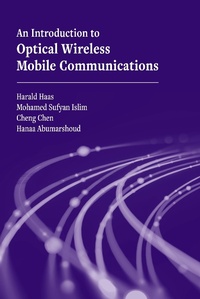
Introduction to Optical Wireless Mobile Communications
Published on 30. September 2021
364 pages
978-1-63081-656-8 (ISBN)
Description

The use of the optical spectrum for wireless communications has gained significant interest in recent years. Applications range from low-rate simplex transmission links using existing embedded CMOS cameras in smartphones, referred to as optical camera communications (OCC), mobile light fidelity (LiFi) networking in homes, offices, urban and sub-sea environments to free-space gigabit interconnects in data centers and point-to-point long-range wireless backhaul links outdoors and in space. This exciting book focuses on the use of optical wireless communications (OWC) for mobile use cases.The book discusses existing conventional radio frequency (RF)-based wireless access technology and presents the challenges that can impact the requirements of the future wave of new wireless services in the context of artificial intelligence (AI) driven autonomous systems and machine-type communications. The relationship between visible light communications (VLC) and light fidelity (LiFi), is explored, and the major advantages of VLC and LiFi such as security and data density, and discuss existing research challenges are also introduced.Channel modeling techniques are provided for mobile multiuser scenarios, and will introduce key building blocks to achieve LiFi cellular networks achieving orders of magnitude improvements of area spectral efficiency compared to state-of-the-art. Challenges that arise from moving from a static point-to-point visible light link to a LiFi network that is capable of serving hundreds of mobile and fixed nodes are discussed. An overview of recent standardization activities and the commercialization challenges of this disruptive technology is also provided.
More details
Other editions
Additional editions
Harald Haas | Mohammad Sufyan Islim | Cheng Chen
An Introduction to Optical Wireless Mobile Communications
Book
09/2021
Artech House Publishers
Unfortunately, price unknown
Available (delivery time upon request)
Content
- An Introduction to Optical Wireless Mobile Communications
- Contents
- 1 Introduction
- 1.1 Setting the Scene
- 1.2 Challenges in Optical Wireless Communication Networking
- 1.2.1 Devices and Components
- 1.2.2 Optical Front-End Systems
- 1.2.3 Channel Models
- 1.2.4 Data Transmission Techniques
- 1.2.5 Medium Access Control Protocols
- 1.2.6 Interference Mitigation and Mobility Support
- 1.2.7 Networking and Protocols
- 1.3 Book Overview
- 1.4 Book Structure
- References
- 2 A Brief History of Optical Wireless Communications
- 2.1 Introduction
- 2.2 A Brief History of Optics and Vision
- 2.3 History of Light from Newton to Einstein
- 2.4 History of Optical Wireless Communication Systems
- 2.5 Recent History of LED-Based Optical Wireless Communication
- 2.6 Development of Efficient Blue LED
- 2.7 Modern History of Visible Light Communications
- 2.8 Summary
- References
- 3 Emerging Technology in Optical Wireless Communications
- 3.1 Introduction
- 3.2 Free-Space Optical Communications
- 3.2.1 Fundamentals of FSO Communications
- 3.2.2 FSO Communications with MIMO Techniques
- 3.2.3 FSO Communications with Orbital Angular Momentum (OAM)
- 3.2.4 FSO Communications Based on a Kramers-Kronig (KK) Receiver
- 3.2.5 FSO Communications in UAV-Based Networks
- 3.3 UV Communications
- 3.3.1 UV State-of-the-Art Devices
- 3.3.2 UV Channel Modeling
- 3.3.3 Open Issues and Future Trends
- 3.4 Optical Camera Communications
- 3.4.1 Image Sensors
- 3.4.2 Principle of OCC
- 3.4.3 Applications
- 3.4.4 Challenges and Practical Considerations
- 3.5 Summary
- References
- 4 Applications and Future-Proofing Wireless Communications
- 4.1 Introduction
- 4.2 Artificial Intelligence and the Spectrum Crunch
- 4.2.1 The Role of Wireless Communications in Autonomous Systems
- 4.2.2 Network Traffic Trends
- 4.2.3 5G and Beyond
- 4.3 Li-Fi Motivations
- 4.3.1 Higher Bandwidth in Optical Spectrum
- 4.3.2 Extreme Densification to the Next Level
- 4.3.3 Physical Layer Security (PLS)
- 4.3.4 Other Advantages
- 4.4 Applications
- 4.4.1 Defense and Cybersecurity
- 4.4.2 Aerospace and Aeronautical Communications
- 4.4.3 Underwater Communications
- 4.4.4 Data-Driven Cities
- 4.4.5 Vehicular Communications
- 4.5 Li-Fi Misconceptions
- 4.5.1 Will Li-Fi Take over Wi-Fi?
- 4.5.2 Will Signal Blockage Cause Serious Link Disruption?
- 4.5.3 Is There an Approach to Realize a UL Connection?
- 4.5.4 Can This TechnologyWork Outdoors?
- 4.5.5 Can the Lights Be Dimmed While Transmitting?
- 4.5.6 Does Li-Fi Cause Light Flickers?
- 4.6 Summary
- References
- 5 Optical Wireless Communication Channel
- 5.1 Introduction
- 5.2 Channel Effects and Metrics
- 5.2.1 Channel Effects
- 5.2.2 Channel Metrics
- 5.2.3 Channel Decomposition
- 5.3 Front-End Channel
- 5.3.1 Exponential Function Approximation
- 5.3.2 First-Order Butterworth Filter Model
- 5.3.3 White LED Model
- 5.4 Optical Wireless Channel
- 5.4.1 LOS Channel
- 5.4.2 NLOS Channel
- 5.4.3 K-Factor
- 5.5 Deterministic NLOS Channel Simulation Approaches
- 5.5.1 Recursive Algorithm
- 5.5.2 Iterative Algorithm
- 5.5.3 DUSTIN Algorithm
- 5.5.4 Frequency-Domain Algorithm
- 5.5.5 Performance Evaluation
- 5.6 Monte Carlo NLOS Channel Simulation Approaches
- 5.6.1 Photon-Tracing Algorithm
- 5.6.2 Monte Carlo Ray-Shooting and Ray-Gathering Algorithms
- 5.6.3 Markov Chain Monte Carlo Algorithms
- 5.6.4 Performance Evaluation
- 5.7 Analytical NLOS Channel Modeling
- 5.7.1 Sphere-Integrating/Exponential-Decaying Model
- 5.7.2 Ceiling Bounce Model
- 5.7.3 Efficient Analytical Calculation Method
- 5.7.4 Performance Evaluation
- 5.8 Simulation Approach/Modeling Comparison
- 5.9 OWC Channel Characteristics
- 5.9.1 Optical Wireless Channel Characteristics
- 5.9.2 Including the Front-End Channel
- 5.10 Summary
- References
- 6 Enabling Technologies
- 6.1 Introduction
- 6.2 Front-End Devices and Systems
- 6.2.1 Transmitters
- 6.2.2 Receivers
- 6.3 Channel Noise
- 6.4 Modulation Techniques
- 6.4.1 Single-Carrier Modulation Techniques
- 6.4.2 OFDM-Based MCM
- 6.4.3 Multistream Unipolar OFDM
- 6.4.4 MCM Based on Other Transformations
- 6.4.5 Color-Based Transmission Techniques
- 6.5 MIMO Technologies
- 6.5.1 MIMO Systems in Li-Fi Networks
- 6.5.2 MIMO Functions
- 6.5.3 MIMO Channel Decorrelation
- 6.6 Summary
- References
- 7 Beyond the Physical Layer
- 7.1 Introduction
- 7.2 Integration of Li-Fi Within Heterogeneous Networks
- 7.3 Multiaccess Control
- 7.3.1 Time Division Multiple Access (TDMA)
- 7.3.2 Optical Orthogonal Frequency Division Multiple Access (O-OFDMA)
- 7.3.3 Optical Code Division Multiple Access (O-CDMA)
- 7.3.4 Optical Space Division Multiple Access (O-SDMA)
- 7.3.5 Carrier-Sense Multiple Access with Collision Avoidance (CSMA/CA)
- 7.3.6 Power-Domain Non-Orthogonal Multiple Access (NOMA)
- 7.4 Resource Allocation in Li-Fi Systems
- 7.5 Interference Management in Li-Fi
- 7.5.1 Interference Cancellation Techniques
- 7.5.2 Interference Avoidance Techniques
- 7.6 Handover and Mobility Support
- 7.6.1 Horizontal Handover (HHO)
- 7.6.2 Vertical Handover
- 7.7 Summary
- References
- 8 Standardization
- 8.1 Introduction
- 8.2 IEEE 802.15 Optical Wireless Communication Standards
- 8.2.1 Standard Development
- 8.2.2 Standard Features
- 8.2.3 Standard Specification
- 8.2.4 Standard Implementations
- 8.3 ITU-T G.9991 Standard
- 8.3.1 Standard Development
- 8.3.2 Standard Features and Specifications
- 8.3.3 Standard Implementations
- 8.4 IEEE 802.11bb Standard
- 8.4.1 Standard Development
- 8.4.2 Physical Layer Specifications
- 8.5 Summary
- References
- 9 Commercialization
- 9.1 Introduction
- 9.2 Li-Fi Market Potential and Opportunities
- 9.2.1 Market Overview
- 9.2.2 Key Trends and Drivers
- 9.2.3 Opportunities in 6G
- 9.3 Li-Fi Ecosystem
- 9.3.1 Li-Fi Consumer Product Provider
- 9.3.2 Lighting Infrastructure Provider
- 9.3.3 Chipset and Optical Component Providers
- 9.3.4 Utility and Application Providers
- 9.3.5 Research and Development Organization
- 9.3.6 End-Users
- 9.3.7 Establishing the Li-Fi Ecosystem
- 9.4 Use Cases
- 9.4.1 Indoor High-Speed Networking
- 9.4.2 Cyber Security and Defence
- 9.4.3 Industry, Aerospace, and Automotive
- 9.4.4 Smart Cities
- 9.4.5 Backhaul Solutions
- 9.4.6 Indoor Positioning
- 9.4.7 OCC Deployments
- 9.5 Commercialization Challenges
- 9.5.1 Optical Front Ends in Transmitters and Receivers
- 9.5.2 Integration to Mobile Devices
- 9.5.3 Lighting Considerations
- 9.6 Summary
- References
- 10 Summary and Outlook
- References
- Acronyms and Abbreviations
- About the Authors
- Index
