

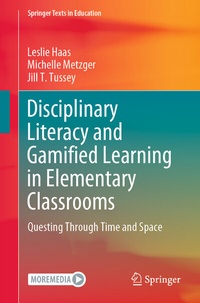
Disciplinary Literacy and Gamified Learning in Elementary Classrooms
Questing Through Time and Space
Published on 4. February 2022
XVIII, 173 pages
978-3-030-80349-0 (ISBN)
Description

This textbook provides real world examples of how disciplinary literacy can incorporate gamified learning opportunities in elementary classrooms (grades K-5 or ages 5-11). It also presents concrete examples of how to seamlessly integrate literacy within other subjects in engaging and unique ways. Furthermore, this text offers practical information related to pedagogy, content, and differentiation for each lesson. Preservice teachers, practicing teachers, instructional coaches, and administrators can benefit from this user-friendly text and its companion digital components, allowing for replication of lessons based on national standards, backed by best-practices, and supported by differentiated pedagogy.
This unique volume begins with engineering marvels that span across centuries and locations. The eight chapters focus on the following marvels in chronological order: Great Pyramid of Giza, Stonehenge, Leaning Tower of Pisa, Great Wall of China, Machu Picchu, Panama Canal, Golden Gate Bridge, and International Space Station. By focusing on these specific examples of human ingenuity, opportunities are created to delve into the historical and social aspects of each chapter's focus. There are also occasions to explore the artistic merit and the art created about and around each focus. Additional teaching opportunities lie in understanding the science, engineering, technology, and math embedded in all featured marvels.
Each chapter features an adventure roadmap in the form of a narrative quest set against the chapter's marvel that guides teachers and student players through embedded activities. Activities are designed for lower elementary school (grades K-2 or ages 5-8) and upper elementary school (grades 3-5 or ages 8-11). Instructional support for both novice and career teachers is provided through differentiation strategies, resource materials, and teaching tips.
This unique volume begins with engineering marvels that span across centuries and locations. The eight chapters focus on the following marvels in chronological order: Great Pyramid of Giza, Stonehenge, Leaning Tower of Pisa, Great Wall of China, Machu Picchu, Panama Canal, Golden Gate Bridge, and International Space Station. By focusing on these specific examples of human ingenuity, opportunities are created to delve into the historical and social aspects of each chapter's focus. There are also occasions to explore the artistic merit and the art created about and around each focus. Additional teaching opportunities lie in understanding the science, engineering, technology, and math embedded in all featured marvels.
Each chapter features an adventure roadmap in the form of a narrative quest set against the chapter's marvel that guides teachers and student players through embedded activities. Activities are designed for lower elementary school (grades K-2 or ages 5-8) and upper elementary school (grades 3-5 or ages 8-11). Instructional support for both novice and career teachers is provided through differentiation strategies, resource materials, and teaching tips.
Reviews / Votes
"The authors . provide pictures to showcase certain quests, as well as YouTube links to videos to further aid teachers. Elementary teachers could easily select all . activities for their students to complete. The tasks are also able to be modified to fit teacher needs. Each chapter includes new activities for each of the three quests so that teachers gain a wealth of knowledge about different strategies to help engage students in not only mathematics, but cross-disciplinary tasks." (Ann Wheeler, MAA Reviews, July 3, 2022)More details
Series
Edition
1st ed. 2021
Language
English
Place of publication
Cham
Switzerland
Publishing group
Springer International Publishing
Target group
Primary & secondary/elementary & high school
Product notice
Reflowable
Illustrations
XVIII, 173 p. 43 illus., 33 illus. in color.
File size
2,70 MB
ISBN-13
978-3-030-80349-0 (9783030803490)
DOI
10.1007/978-3-030-80349-0
Schweitzer Classification
Other editions
Additional editions
Leslie Haas | Michelle Metzger | Jill T. Tussey
Disciplinary Literacy and Gamified Learning in Elementary Classrooms
Questing Through Time and Space
Book
02/2022
Springer
€64.19
Shipment within 7-9 days
Persons
Dr. Haas' experience in literacy education includes teaching at the K-12, undergraduate, and graduate levels. Additional experiences include instructional coaching, professional development, curriculum design, and department administration. Opportunities in highly diverse settings have acted as both a catalyst and foundation for her focus on integrating and connecting literacy across disciplines through culturally and linguistically responsive instructional practices. She is particularly interested in technology-based literacy opportunities for underrepresented populations through engagement with popular culture, specifically online gaming and fanfiction.
Dr. Michelle Metzger's experiences include working as a classroom teacher, adjunct professor, professional development facilitator, research coordinator, and department chair. Her research interests include spatial thinking, problem solving, critical thinking, and STEM learning. As a National Ongoing Assessment Project Facilitator, Dr. Metzger believes in teaching math for understanding through modeling, which takes her to various places across the United States engaging teachers in deep mathematical thinking within a professional development setting. She believes students must hold math in their hands before they can hold it in their heads, hence the need for visualization and conceptual understanding.
Dr. Jill Tussey's career in literacy education has provided a variety of experiences in curriculum and instruction across K-12, undergraduate, and graduate courses. Her areas of interest include student engagement and motivation with targeted focus on digital literacy, poverty impacts, and social-emotional learning. Service leadership is important to Dr. Tussey and can be clearly seen in her current work as the Division Chair for Literacy, TESL, and Early Childhood at Buena Vista University. She has authored and edited books, chapters, and journal articles. Additionally, she has presented at local, state, national, and international settings over a variety of literacy topics.
Dr. Michelle Metzger's experiences include working as a classroom teacher, adjunct professor, professional development facilitator, research coordinator, and department chair. Her research interests include spatial thinking, problem solving, critical thinking, and STEM learning. As a National Ongoing Assessment Project Facilitator, Dr. Metzger believes in teaching math for understanding through modeling, which takes her to various places across the United States engaging teachers in deep mathematical thinking within a professional development setting. She believes students must hold math in their hands before they can hold it in their heads, hence the need for visualization and conceptual understanding.
Dr. Jill Tussey's career in literacy education has provided a variety of experiences in curriculum and instruction across K-12, undergraduate, and graduate courses. Her areas of interest include student engagement and motivation with targeted focus on digital literacy, poverty impacts, and social-emotional learning. Service leadership is important to Dr. Tussey and can be clearly seen in her current work as the Division Chair for Literacy, TESL, and Early Childhood at Buena Vista University. She has authored and edited books, chapters, and journal articles. Additionally, she has presented at local, state, national, and international settings over a variety of literacy topics.
Content
Getting Started.- The Great Pyramid of Giza.- Stonehenge.- The Leaning Tower of Pisa.- The Great Wall of China.- Machu Picchu.- The Panama Canal.- The Golden Gate Bridge.- The International Space Station.
