

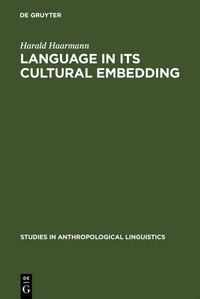
Language in Its Cultural Embedding
Explorations in the Relativity of Signs and Sign Systems
1st Edition
Published on 1. June 2011
XIII, 276 pages
978-3-11-086754-1 (ISBN)
Description

No detailed description available for "Language in Its Cultural Embedding".
More details
Series
Edition
Reprint 2011
Language
English
Place of publication
Berlin/Boston
Germany
Publishing group
de Gruyter Mouton
Target group
Professional and scholarly
US School Grade: College Graduate Student
Illustrations
31 Abbildungen, 35 s/w Tabellen
31 ill., 35 tbl.
File size
9,01 MB
ISBN-13
978-3-11-086754-1 (9783110867541)
Schweitzer Classification
Other editions
Additional editions
Harald Haarmann
Language in Its Cultural Embedding
Explorations in the Relativity of Signs and Sign Systems
Book
11/1990
1st Edition
De Gruyter Mouton
€169.95
Shipment within 7-9 days
Harald Haarmann
Language in Its Cultural Embedding
Explorations in the Relativity of Signs and Sign Systems
Book
01/1990
1st Edition
De Gruyter Mouton
€239.00
Article exhausted; check different version
Content
- Intro
- Preface
- Chapter 1. Reality, models of reality and sign systems: Interaction in a culture-related context
- Chapter 2. The microstructure of the linguistic sign and its relation to cultural settings: A componential analysis of the process of signification
- 1. The structure of the linguistic sign in onomatopoetic expressions (including interjections)
- 2. Variations of the linguistic sign involving concrete concepts
- 3. Variations of the linguistic sign involving abstract concepts
- 4. Variations of the linguistic sign involving names
- Chapter 3. Language as a sigmatic fixative of reality: Parameters of semiotic relativity
- 1. The semiotic nomenclature of demonstrative relations (including directional relations)
- 1.1 The marking of horizontal distance in systems of demonstrative relations
- 1.2. The marking of vertical distance in systems of demonstrative relations
- 1.3. The marking of space relations in demonstrative systems
- 1.4. The marking of motion in systems of demonstrative relations
- 1.5. The marking of the range of vision in systems of demonstrative relations
- 1.6. The marking of time relations in demonstrative systems
- 1.7. The marking of indefiniteness in systems of demonstrative relations
- 1.8. The marking of determinative relations in demonstrative systems
- 1.9. The marking of politeness in systems of demonstrative relations
- 1.10. The marking of emphatic connotations in systems of demonstrative relations
- 2. The semiotic nomenclature in relations of politeness and deference
- 2.1. The marking of politeness in the system of personal pronouns
- 2.2. The marking of politeness in the system of possessive pronouns
- 2.3. The marking of politeness in the system of demonstrative pronouns
- 2.4. The marking of politeness in the verbal system
- 2.5. The marking of politeness in the nominal system
- 2.6. The marking of politeness in lexical structures
- 3. The semitotic nomenclature in emotional and rational relations as a facet of mentality
- Chater 4. Language as a semiotic seismograph of acculturation: The problem of variability in sign systems
- 1. Borrowings in the lexical field of parts of the body
- 2. Borrowings in the system of numerals
- 3. Borrowings in the lexical field of color terminology
- 4. Borrowed expressions for natural phenomena as well as living things
- 5. Borrowed expressions for basic activities and qualities
- 6. Borrowings in the pronominal system
- Chapter 5. The world of signs and applied semiotics: An interpretative approach to ancient and modern cultures
- 1. The fixation and mnemotechnical recording of information on the basis of pictures, and without the participation of language
- 2. The fixation and mnemotechnical recording of information based on a diffuse correlation of pictorial symbols and linguistic signs
- 2.1. The catchword principle in writing and the Cretan hieroglyphs
- 2.2. The iconic materials of the hieroglyphs in relation to items and figurative motives of Minoan culture
- 2.3. The role of hieroglyphic writing as a sacred script in Minoan civilization
- 2.4. The reconstruction of a sacred text the contents of which is related to a funeral ritual
- 2.5. The ceremonial character of the Minoan funeral ritual as a communication with the ancestors
- 2.6. The archaeological evidence for the Minoan funeral ritual from Agia Triadha
- 3. The fixation and mnemotechnical recording of information based on pictures and on the written language as two independent semiotic systems
- Bibliography
- Subject index
- Index of names
