

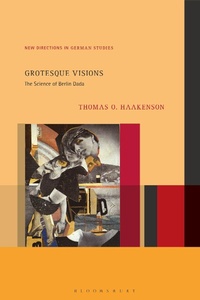
Grotesque Visions
The Science of Berlin Dada
1st Edition
Published on 6. May 2021
272 pages
978-1-5013-6991-9 (ISBN)
Description

Grotesque Visions focuses on the radical avant-garde interventions of Salomo Friedlaender (aka Mynona), Til Brugman, and Hannah Hoech as they challenged the questionable practices and evidentiary claims of late-19th- and early-20th-century science. Demonstrating the often excessive measures that pathologists, anthropologists, sexologists, and medical professionals went to present their research in a seemingly unambiguous way, this volume shows how Friedlaender/Mynona, Brugman, Hoech, and other Berlin-based artists used the artistic grotesque to criticize, satirize, and subvert a variety of forms of supposed scientific objectivity.
The volume concludes by examining the exhibition Grotesk!: 130 Jahre Kunst der Frechheit/Comic Grotesque: Wit and Mockery in German Arts, 1870-1940. In contrast to the ahistorical and amorphous concept informing the exhibition, Thomas O. Haakenson reveals a unique deployment of the artistic grotesque that targeted specific established and emerging scientific discourses at the turn of the last fin-de-siecle.
The volume concludes by examining the exhibition Grotesk!: 130 Jahre Kunst der Frechheit/Comic Grotesque: Wit and Mockery in German Arts, 1870-1940. In contrast to the ahistorical and amorphous concept informing the exhibition, Thomas O. Haakenson reveals a unique deployment of the artistic grotesque that targeted specific established and emerging scientific discourses at the turn of the last fin-de-siecle.
Reviews / Votes
Grotesque Visions: The Science of Berlin Dada is a much-needed contribution to the history and theory of the grotesque. Calling attention to historically specific ideas about the human body in early twentieth-century Germany, Thomas O. Haakenson not only describes the genesis of the grotesque at this particular time and place, he demonstrates its critical potential to intervene in the era's often misguided scientific activities. As science and anthropology increasingly implemented visual images to validate research and serve as legitimate evidence, the Dada grotesque-as Haakenson convincingly argues-pointedly questioned the importance of vision as constitutive of knowledge. * Maria Makela, Professor Emerita of Visual Studies, California College of the Arts, USA * Thomas Haakenson brings a rich blend of philosophy, literature, and the visual arts to bear on the 'grotesque,' an elusive but essential concept for understanding Berlin Dada art. This probing study engages often-overlooked philosophical critiques of empirical concepts of vision in the sciences to establish unexpected links between the Dada group and the advocacy of methods of 'learning to see.' In this context, Haakenson highlights the role of the imagination in the public scientific displays of specimens and photographs curated by anthropologist Rudolf Virchow and sexologist Magnus Hirschfeld. Weaving together ideas on perception and aesthetics ranging from Kant and Goethe through Benjamin to Crary and Adorno, Haakenson shows how the Dadaists' contributions remain timely for contemporary aesthetic theory. * Timothy O. Benson, Curator, Rifkind Center for German Expressionist Studies, Los Angeles County Museum of Art *More details
Series
Edition
1. Auflage
Language
English
Place of publication
New York
United States
Publishing group
Bloomsbury Publishing PLC (Digital)
Target group
Professional and scholarly
ISBN-13
978-1-5013-6991-9 (9781501369919)
Copyright in bibliographic data and cover images is held by Nielsen Book Services Limited or by the publishers or by their respective licensors: all rights reserved.
Schweitzer Classification
Other editions
Additional editions
Book
12/2022
Bloomsbury Academic USA
€55.89
Shipment within 15-20 days
Person
Thomas O. Haakenson is Associate Professor in Critical Studies and Visual Studies at California College of the Arts in San Francisco and Oakland, USA. He is coeditor of the book series Visual Cultures and German Contexts and has been published widely, including in New German Critique, Cabinet, Rutgers Art Review, German Studies Review, and the anthologies Legacies of Modernism, Spectacle, Representations of German Identity, as well as Memorialization in Germany Since 1945. He has received awards and fellowships from the United States Fulbright Program, the Social Science Research Council, the Max Planck Institute for the History of Science, the Deutscher Akademischer Austauschdienst, and the Berlin Program for Advanced German and European Studies.
Content
Acknowledgements
Note on Style and Sources
List of Figures
1. The Return of the Grotesque
2. The Science of Berlin Dada: Salomo Friedlaender, Walter Benjamin, and the Grotesque
3. The Architectonics of Public Science: "Learning to See" in Rudolf Virchow's Museum of Pathology
4. Sexuality ad oculos: Sigmund Freud and Magnus Hirschfeld Meet Til Brugman's "Celluloid Children"
5. The Optics of Evidence: Photography and Vision in Berlin Anthropology
6. Visual Objectivity Meets Impossible Object: Hannah Hoech "From an Ethnographic Museum" Photomontages
7. Learning to See Grotesquely
Coda: Toward a Critique of the Dogma of Visuality
Bibliography
Index
Note on Style and Sources
List of Figures
1. The Return of the Grotesque
2. The Science of Berlin Dada: Salomo Friedlaender, Walter Benjamin, and the Grotesque
3. The Architectonics of Public Science: "Learning to See" in Rudolf Virchow's Museum of Pathology
4. Sexuality ad oculos: Sigmund Freud and Magnus Hirschfeld Meet Til Brugman's "Celluloid Children"
5. The Optics of Evidence: Photography and Vision in Berlin Anthropology
6. Visual Objectivity Meets Impossible Object: Hannah Hoech "From an Ethnographic Museum" Photomontages
7. Learning to See Grotesquely
Coda: Toward a Critique of the Dogma of Visuality
Bibliography
Index
