

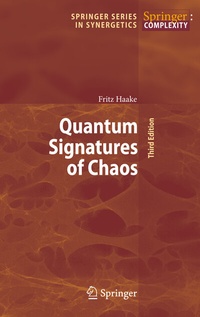
Quantum Signatures of Chaos
Description

Reviews / Votes
From the reviews of the third edition:
"The book can be recommended both as a textbook and a review of the subject. The rich set of references allows one to catch up with the current literature. Exercises facilitate the study and will be of use to the lecturer. It can be a base of a solid graduate theoretical course in quantum chaos." (Pure and Applied Geophysics, 160, 2003)
"In summary, this is definitely an essential reference book for the specialist. It will also ably serve someone entering the field for the first time who needs to learn the theoretical state of the art in detail." (G. Summy (University of Oxford), Contemporary Physics 2002, vol. 43, page 232)
"This book is about aspects of quantum chaos, with emphasis on energy-level statistics . and their relation to random matrix theory, including a self-contained introduction to the supersymmetric technique, as well as semiclassical periodic-orbit expansions. . Each chapter ends with a list of problems and references, which is helpful to the specialist and the beginner as well." (César R. de Oliveira, Mathematical Reviews, Issue 2011 d)
"This book is phenomenal and brings many topics Quantum Chaos who were treated in a sovereign manner by Fritz Haake. Thus I recommend this book for anyone who is interested in the study of the distribution of eigenvalues of generic operators, especially those related to quantum problems. It is an essential book for any researcher in Quantum Chaos, sometimes this book is known as the Quantum Chaos 'bible'." (Philosophy, Religion and Science Book Reviews, September, 2012)
"This by now classic text . witnesses both the rapid growth of a new field of 'quantum chaology' and its subsequent maturity period plus further developments. . Each chapter is accompanied by a selection of problems which both test and deepen the reader understanding of the material presented. The text is both an introduction and asurvey of the field of quantum chaos. References to original research papers direct the reader to more advanced discussion of topics that were outlined in the present text." (Piotr Garbaczewski, Zentralblatt MATH, Vol. 1209, 2011)
More details
Other editions
Additional editions
Content
4.1 Preliminaries
A wealth of empirical and numerical evidence suggests universality for local fluctuations in quantum energy or quasi-energy spectra of systems that display global chaos in their classical phase spaces. Exceptions apart, all such Hamiltonian matrices of sufficiently large dimension yield the same spectral fluctuations provided they have the same group of canonical transformations (see Chap. 2). In particular, the level spacing distribution P(S) generally takes the form characteristic of the universality class defined by the canonical group. Most notable among the exceptions barred by the term “untypical” are systems with “localization” that will be discussed in Chap. 7. Conversely, “generic” classically integrable systems with at least two degrees of freedom tend to display universal local fluctuations of yet another type, to be considered in Chap. 5.
The aforementioned universality is the starting point for the theory of random matrices (RMT). After early success in reproducing universal features in spectra of highly excited nuclei, that theory was boosted into even higher esteem when the connection of “integrable” and “chaotic” with different types of universal spectral fluctuations was spelled out by Bohigas, Giannoni, and Schmit [1], with important hints due to Berry and Tabor [2], McDonald and Kaufman [3], Casati, Valz-Gris, and Guarneri [4], and Berry [5]. The classic version of random-matrix theory deals with three Gaussian ensembles of Hermitian matrices, one for each group of canonical transformations. Any member of an ensemble can serve as a model of a Hamiltonian.
Similarly, there are three ensembles of random unitary matrices to represent Floquet or scattering matrices. “Poissonian” ensembles of diagonal matrices with independent, random, diagonal elements are often used to model integrable Hamiltonians. Even systems with localization have recently been accommodated in their own “universality class” of banded random matrices that is to be touched upon in Chap. 11. Random-matrix theory phenomenologically represents spectral fluctuations such as those expressed in the level spacing distribution or in correlation functions of the density of levels by suitable ensemble averages.
The immense usefulness of RMT lies in the fact that it yields closed-from results formany spectral characteristics. The extent to which an individual Hamiltonian or Floquet operator can be expected to be faithful to the RMT averages is open to discussion. A partial answer to that question is provided by a certain ergodicity property of the various ensembles. Explanations of the success of random-matrix theory will be presented in Chap. 6 (level dynamics) and Chap. 10 (periodic-orbit theory)."
