

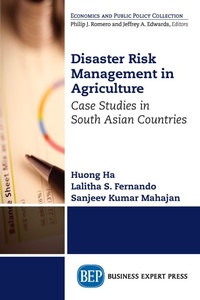
Disaster Risk Management in Agriculture
Description

The challenges related to disaster risk management (DRM) in the agricultural sector are now widely linked to sustainable environment. The fact remains that almost every day a disaster strikes in some part of the world. The regular occurrence of natural and man-made disasters has forced the worldwide communities to look for novel solutions to prevent and mitigate such disasters.
This volume brings together probing studies to disseminate the work of outstanding scholars and practitioners, especially in South Asian countries. Thus, it highlights the need to amalgamate and coordinate the resources and agencies involved in DRM in agriculture to ensure the quality of life to the victims after disasters. The authors incorporate specific themes correlated with DRM in South Asia. They intend to assess: (i) the consequences of distinct disaster risks in agriculture, (ii) the ways in which diverse disaster risk problems are handled in distinct settings, and (iii) the different methodologies embraced by different sectors to prepare for disaster risk.
More details
Other editions
Additional editions
Persons
Content
- Cover
- Disaster Risk Management in Agriculture
- Contents
- List of Figures
- List of Tables
- List of Reviewers
- Acknowledgments
- CHAPTER 1: Disaster Risk Management in Agriculture: Case Studies in South Asia-An Introduction
- Introduction
- Issues and Challenges Associated with Disaster Risk in Agriculture in South Asia
- An Overview of the Chapters
- Lessons: Rebuilding Agriculture after Disaster
- Conclusion
- References
- CHAPTER 2: Pragmatic Study of the Impact of Disasters on Humans and Agriculture Using Data Analytics
- Introduction
- Research Objectives
- Methodology
- Findings
- Relationships/Correlations between Vital Parameters
- Relationship between Lives Lost and Cropped Areas Affected
- Relationship between Lives Lost and Houses Damaged
- Conclusion
- Recommendations
- References
- CHAPTER 3: Nuclear Disaster and Sustainability of Indian Agriculture
- Introduction
- Sources of Nuclear Disaster Risks in India
- Climate Change Concerns and India's Nuclear Energy Program
- Natural Hazards-Led Nuclear Disaster Threatsat Nuclear Power Plants
- Disaster Threats Caused by Accidental Nuclear War Risks and Nuclear Proliferation
- The New Challenge of Terrorism
- Impact of Nuclear Disaster on Agriculture
- Radioactive Elements Adjoining the Fukushima Marine Environment and Seafood
- Nuclear Disaster and Agricultural Sustainability in India
- FAO's Concerns about World Food Security
- Fukushima Nuclear Disaster, EU Strategies, and Lessons for Indian Agriculture
- Respondents' Perceptions of Disaster Management
- Findings of a Survey Conducted on Respondentsby the Author
- Conclusion
- References
- CHAPTER 4: Building Resilience to Natural Disasters: Toward Sustainable Agricultural Practices in Sri Lanka
- Background of the Study and Problem Identification
- Methodology
- Literature Review on Agriculture and Disasters
- Disaster Resilience
- Vulnerability
- Early Warning Systems
- Sustainable Agriculture
- Sustainable Agricultural Policies and Best Practices
- Empirical Research on Sustainable Agricultural Practices
- Policy Gaps, Analysis, and Methodologies
- Data Analysis and Discussion
- Analysis of Agricultural Policy in Sri Lanka
- Hector Kobbekaduwa Agrarian Research and Training Institute (HKATI)
- Sri Lanka Council for Agricultural Research Policy
- Institute of Postharvest Technology
- National Food Promotion Board
- Ceylon Fertilizer Company Ltd
- Strengths and Weaknesses of Sri Lankan Agricultural Policy
- Recommendations
- Enhance Public Awareness about Disaster-Prone Landsand Time Periods
- Provide Proper Consultation for Farmers on Strategies for Resilient Agriculture
- Introduce Livelihood Diversification Practicesto Vulnerable Communities
- Preserve and Reawaken Indigenous Agricultural Knowledgeand Technology
- Increased Access to Credit and Safety Nets
- Encourage Farmers to Use Organic Fertilizers
- Establish Proper Coordination among Agricultural Institutions
- Recognize Disaster Resilience as a Key Priority Area in Agriculture
- Conclusion
- Limitations of the Study
- References
- CHAPTER 5: Natural Disasters and Agriculture in Bangladesh: Planning and Management
- Introduction
- Research Objectives
- Methodology
- Natural Disasters and Agricultural Production
- Floods
- Drought
- Cyclones and Storm Surges
- Saline Water Intrusion
- Planning and Management Relatedto Natural Disasters
- Water Management
- Irrigation
- Fertilizer and High-Yielding Variety (HYV) Seeds
- Agricultural Research
- Legal Initiatives
- Conclusion and Recommendations
- References
- CHAPTER 6: A Call for Action to Mitigate the Cost of Natural Disaster in the Agricultural Sector: A Case Study in India
- Introduction
- Objectives of the Study
- Research Methodology
- Findings and Discussions
- Hazard and Vulnerability Profile of Himachal Pradesh
- Profile of Agriculture in Himachal Pradesh
- An Assessment of the Extent of Damage due to Monsoon
- Loss of Human Lives
- Loss of Animals
- Houses Damaged
- Damage to Roads
- Damage of Agriculture Crops
- Damage to Irrigation and Water Supply Schemes
- Damage to Horticultural Crops
- Damage to Electricity Infrastructure
- Damage to Community/Government Assets
- Loss of Fisheries
- Mechanisms for Calculation of Assistance
- Present Institutional and Legal Arrangement
- State Disaster Management Authority
- The State Executive Committee
- State and District Crisis Management Group
- Future Requirements
- Need to Understand the Nature
- Agricultural Insurance and Compensation of Losses
- Warning Systems
- Increased Financial Resources
- Reducing Risks from Flash Floods
- Role of Communities and Local Government
- References
- CHAPTER 7: Food Security through Public (Food) Distribution System in a Postdisaster Situation: A Comparative Study of Bangladesh and West Bengal (India)
- Introduction
- Key Issues
- Flood and Food Security
- Findings
- Conclusion
- References
- CHAPTER 8: Urban Flooding and Threats to Sustainable Development: A Study of Srinagar and Chennai Floods
- Introduction
- Review of Documents
- Objectives of the Study
- Research Methodology
- The Jammu and Kashmir Floods:The Worst Since 1902
- What Caused Floods in Jammu and Kashmir?
- Chennai Floods (November-December 2015)
- Findings of the Study
- A New Strategy for Urban Floods Disaster Management
- Sendai Framework: A Global Roadmap on DRR
- Conclusion: A Roadmap for Future
- References
- CHAPTER 9: Disaster Risk Management in the Agricultural Sector in South Asia: Lessons Learned and Policy Implications
- Introduction
- Lessons Learned, Policy Implications, and Recommendations
- Limitations
- Conclusion
- References
- List of Contributors1
- About the Authors
- Index
- Ad Page
- Back Cover
