

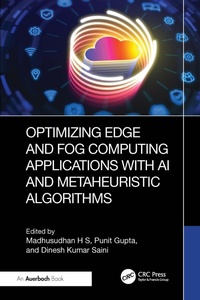
Optimizing Edge and Fog Computing Applications with AI and Metaheuristic Algorithms
Published on 16. September 2025
272 pages
978-1-040-41099-8 (ISBN)
Description

Fog and edge computing are two paradigms that have emerged to address the challenges associated with processing and managing data in the era of the Internet of Things (IoT). Both models involve moving computation and data storage closer to the source of data generation, but they have subtle differences in their architectures and scopes. These differences are one of the subjects covered in Optimizing Edge and Fog Computing Applications with AI and Metaheuristic Algorithms. Other subjects covered in the book include:
Designing machine learning (ML) algorithms that are aware of the resource constraints at the edge and fog layers ensures efficient use of computational resources
Resource-aware models using ML and deep leaning models that can adapt their complexity based on available resources and balancing the load, allowing for better scalability
Implementing secure ML algorithms and models to prevent adversarial attacks and ensure data privacy
Securing the communication channels between edge devices, fog nodes, and the cloud to protect model updates and inferences
Kubernetes container orchestration for fog computing
Federated learning that enables model training across multiple edge devices without the need to share raw data
The book discusses how resource optimization in fog and edge computing is crucial for achieving efficient and effective processing of data close to the source. It explains how both fog and edge computing aim to enhance system performance, reduce latency, and improve overall resource utilization. It examines the combination of intelligent algorithms, effective communication protocols, and dynamic management strategies required to adapt to changing conditions and workload demands. The book explains how security in fog and edge computing requires a combination of technological measures, advanced techniques, user awareness, and organizational policies to effectively protect data and systems from evolving security threats. Finally, it looks forward with coverage of ongoing research and development, which are essential for refining optimization techniques and ensuring the scalability and sustainability of fog and edge computing environments.
Designing machine learning (ML) algorithms that are aware of the resource constraints at the edge and fog layers ensures efficient use of computational resources
Resource-aware models using ML and deep leaning models that can adapt their complexity based on available resources and balancing the load, allowing for better scalability
Implementing secure ML algorithms and models to prevent adversarial attacks and ensure data privacy
Securing the communication channels between edge devices, fog nodes, and the cloud to protect model updates and inferences
Kubernetes container orchestration for fog computing
Federated learning that enables model training across multiple edge devices without the need to share raw data
The book discusses how resource optimization in fog and edge computing is crucial for achieving efficient and effective processing of data close to the source. It explains how both fog and edge computing aim to enhance system performance, reduce latency, and improve overall resource utilization. It examines the combination of intelligent algorithms, effective communication protocols, and dynamic management strategies required to adapt to changing conditions and workload demands. The book explains how security in fog and edge computing requires a combination of technological measures, advanced techniques, user awareness, and organizational policies to effectively protect data and systems from evolving security threats. Finally, it looks forward with coverage of ongoing research and development, which are essential for refining optimization techniques and ensuring the scalability and sustainability of fog and edge computing environments.
More details
Language
English
Place of publication
London
United Kingdom
Publishing group
Taylor & Francis Ltd
Target group
College/higher education
Illustrations
22 Tables, black and white; 22 Line drawings, color; 9 Line drawings, black and white; 22 Illustrations, color; 9 Illustrations, black and white
File size
21,14 MB
ISBN-13
978-1-040-41099-8 (9781040410998)
Copyright in bibliographic data and cover images is held by Nielsen Book Services Limited or by the publishers or by their respective licensors: all rights reserved.
Schweitzer Classification
Other editions
Additional editions
Madhusudhan H S | Punit Gupta | Dinesh Kumar Saini
Optimizing Edge and Fog Computing Applications with AI and Metaheuristic Algorithms
Book
09/2025
1st Edition
Auerbach
€207.70
Shipment within 15-20 days
Persons
Madhusudhan H S is an associate professor in the Department of Computer Science and Engineering at Vidyavardhaka College of Engineering, Mysuru, India.
Punit Gupta is an associate professor in the Department of Computer and Communication Engineering at Pandit Deendayal Energy University, Gujarat, India.
Dinesh Kumar Saini is a full professor at the School of Computing and Information Technology, Manipal University, Jaipur, India.
Punit Gupta is an associate professor in the Department of Computer and Communication Engineering at Pandit Deendayal Energy University, Gujarat, India.
Dinesh Kumar Saini is a full professor at the School of Computing and Information Technology, Manipal University, Jaipur, India.
Content
1. Introduction to Resource Optimization in Fog and Edge Computing 2. Artificial Intelligence Inspired Scheduling in Edge Computing 3. Supervised Machine Learning for Load Balancing in Fog Environments 4. Blockchain-Based Secure Data Sharing System in Fog-Edge System 5. Securing IoT System Using ML Models 6. Federated Machine Learning Algorithm Aggregation Strategy for Collaborative Predictive Maintenance 7. Advance Machine Learning Algorithm Aggregation Strategy for Decentralized Collaborative Models 8. Artificial Intelligence and Machine Learning-Based Predictive Maintenance in Fog and Edge Computing Environment 9. Deep Reinforcement Learning-Based Task Scheduling in Edge Computing 10. Secure, Adaptable, and Collaborative AI: Federated Machine Learning Enhanced with Meta-Learning and Differential Privacy 11. EP-MPCHS: Edge Server-Based Cloudlet Offloading Using Multi-Core and Parallel Heap Structures
