

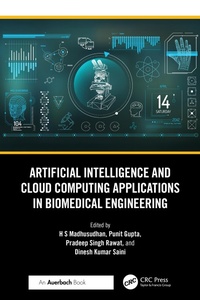
Artificial Intelligence and Cloud Computing Applications in Biomedical Engineering
Published on 22. September 2025
250 pages
978-1-040-42363-9 (ISBN)
Description

Biomedical engineering is undergoing a transformation because of AI, which is allowing creative solutions that enhance patient outcomes, diagnosis, treatment planning, and healthcare delivery. Artificial Intelligence and Cloud Computing Applications in Biomedical Engineering examines the salient characteristics of AI in biomedical engineering, highlighting its practical applications and new directions. Highlights of the book include:
Genome sequence and visualization
The role of AI and cloud in detection of diseases
Nature-inspired algorithms for disease detection
Frameworks for disease classification
With a focus on designing AI techniques for disease detection, the book explores the role of AI in biomedical engineering. It discusses how machine learning (ML) and deep learning (DL) are at the heart of AI applications in biomedical engineering. ML algorithms, particularly those based on neural networks, enable computers to learn from large datasets, identify patterns, and make predictions or decisions without explicit programming, and implementing ML algorithms is a focus of the book. Another focus is on DL, a subset of ML, and how it uses multi-layered neural networks to achieve high accuracy in such complex tasks as image and speech recognition. Biomedical engineering generates massive amounts of data from medical imaging, genomic sequencing, wearable devices, electronic health records (EHR), and other sources. This book also discusses AI-driven big data analytics, which allows researchers and clinicians to derive from data meaningful insights, aiding in early disease detection, personalized treatment plans, and patient monitoring.
Genome sequence and visualization
The role of AI and cloud in detection of diseases
Nature-inspired algorithms for disease detection
Frameworks for disease classification
With a focus on designing AI techniques for disease detection, the book explores the role of AI in biomedical engineering. It discusses how machine learning (ML) and deep learning (DL) are at the heart of AI applications in biomedical engineering. ML algorithms, particularly those based on neural networks, enable computers to learn from large datasets, identify patterns, and make predictions or decisions without explicit programming, and implementing ML algorithms is a focus of the book. Another focus is on DL, a subset of ML, and how it uses multi-layered neural networks to achieve high accuracy in such complex tasks as image and speech recognition. Biomedical engineering generates massive amounts of data from medical imaging, genomic sequencing, wearable devices, electronic health records (EHR), and other sources. This book also discusses AI-driven big data analytics, which allows researchers and clinicians to derive from data meaningful insights, aiding in early disease detection, personalized treatment plans, and patient monitoring.
More details
Language
English
Place of publication
London
United Kingdom
Publishing group
Taylor & Francis Ltd
Target group
College/higher education
Illustrations
29 Tables, black and white; 32 Line drawings, color; 5 Line drawings, black and white; 1 Halftones, color; 33 Illustrations, color; 5 Illustrations, black and white
File size
11,51 MB
ISBN-13
978-1-040-42363-9 (9781040423639)
Copyright in bibliographic data and cover images is held by Nielsen Book Services Limited or by the publishers or by their respective licensors: all rights reserved.
Schweitzer Classification
Other editions
Additional editions
Madhusudhan H S | Punit Gupta | Pradeep Singh Rawat
Artificial Intelligence and Cloud Computing Applications in Biomedical Engineering
Book
09/2025
1st Edition
Auerbach
€206.00
Shipment within 15-20 days
Madhusudhan H S | Punit Gupta | Pradeep Singh Rawat
Artificial Intelligence and Cloud Computing Applications in Biomedical Engineering
Book
09/2025
1st Edition
Auerbach
€93.50
Shipment within 15-20 days
Persons
Dr. Madhusudhan H S is an associate professor in the Department of Computer Science and Engineering at Vidyavardhaka College of Engineering, Mysuru, India.
Dr. Punit Gupta is an associate professor in the department of Computer and Communication Engineering at Pandit Deendayal Energy University, India.
Dr. Pradeep Singh Rawat is an assistant professor with the Department of Computer Science and Engineering at DIT University, Dehradun, India.
Dr. Dinesh Kumar Saini is a full professor at the School of Computing and Information Technology, Manipal University
Dr. Punit Gupta is an associate professor in the department of Computer and Communication Engineering at Pandit Deendayal Energy University, India.
Dr. Pradeep Singh Rawat is an assistant professor with the Department of Computer Science and Engineering at DIT University, Dehradun, India.
Dr. Dinesh Kumar Saini is a full professor at the School of Computing and Information Technology, Manipal University
Content
1. Artificial Intelligence and Computational Biology in Drug Discovery 2. Techniques of AI/ML for Genomics Visualisation in Plants 3. Computing Architectures on the Cloud to Address Current Problems in Structural Bioinformatics 4. Application of AI for Diseases Detection and Prevention 5. AI for Diseases Detection and Prevention 6. Machine Learning Techniques for Detecting Lung Cancer 7. A Review on AI Approaches for the Detection of Diabetic Retinopathy 8. Intelligent Applications for Medical Image Analysis 9. Machine Learning Integration with Biomedical Problems 10. Intelligent Tools and Techniques for Real Life Diseases 11. Free Space Detection in Medical Image Analysis for the Visually Impaired Using Histogram Equalization and Adaptive Region Growing
