

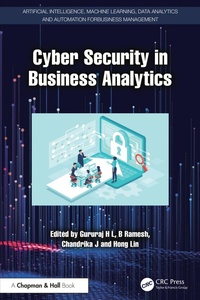
Cyber Security in Business Analytics
Published on 30. September 2025
220 pages
978-1-040-41729-4 (ISBN)
Description

There is a growing need for insights and practical experiences in the evolving field of cyber security for business analytics a need addressed by Cyber Security in Business Analytics. Divided into sections covering cyber security basics, artificial intelligence (AI) methods for threat detection, and practical applications in e-commerce and e-banking, the book's team of experts provides valuable insights into securing business data and improving decision-making processes. It covers topics such as data privacy, threat detection, risk assessment, and ethical considerations, catering to both technical and managerial audiences.
* Presents real-case scenarios for enhancing understanding of how cyber security principles are applied in diverse organizational settings
* Offers advanced technologies such as artificial intelligence methods for cyber threat detection, offering readers
* Provides a detailed exploration of howAI can make cybersecurity better by helping detect threats, unusual activities, and predict potential risks
* Focuses on the convergence of cyber security and data-driven decision-making and explores how businesses can leverage analytics while safeguarding sensitive information
* Includes insights into cutting-edge techniques in the field, such as detailed explorations of various cyber security tools within the context of business analytics
Cyber Security in Business Analytics will be useful for scholars, researchers and professionals of computer science and analytics.
* Presents real-case scenarios for enhancing understanding of how cyber security principles are applied in diverse organizational settings
* Offers advanced technologies such as artificial intelligence methods for cyber threat detection, offering readers
* Provides a detailed exploration of howAI can make cybersecurity better by helping detect threats, unusual activities, and predict potential risks
* Focuses on the convergence of cyber security and data-driven decision-making and explores how businesses can leverage analytics while safeguarding sensitive information
* Includes insights into cutting-edge techniques in the field, such as detailed explorations of various cyber security tools within the context of business analytics
Cyber Security in Business Analytics will be useful for scholars, researchers and professionals of computer science and analytics.
More details
Series
Language
English
Place of publication
London
United Kingdom
Publishing group
Taylor & Francis Ltd
Target group
Professional and scholarly
Illustrations
23 Tables, black and white; 58 Line drawings, black and white; 1 Halftones, black and white; 59 Illustrations, black and white
File size
5,78 MB
ISBN-13
978-1-040-41729-4 (9781040417294)
Copyright in bibliographic data and cover images is held by Nielsen Book Services Limited or by the publishers or by their respective licensors: all rights reserved.
Schweitzer Classification
Other editions
Additional editions
Gururaj H L | B. Ramesh | Chandrika J
Cyber Security in Business Analytics
Book
09/2025
1st Edition
Chapman & Hall/CRC
€207.50
Shipment within 10-20 days
Persons
Dr. Gururaj H L is currently working as Associate Professor, Department of Computer Science and Engineering, Manipal Institute of Technology, Bengaluru, India. He holds a Ph.D degree in Computer Science and Engineering from Visweswaraya Technological University, Belagavi, India. He is a professional member of ACM and working as ACM Distinguish Speaker. He is the founder of Wireless Internetworking Group(WiNG). He is a Senior member of IEEE and lifetime member of ISTE and CSI. Dr. Gururaj received young scientist award from Government of India. He has 8 years of teaching experience.at both UG and PG level. His research interests include BlockChain Technology, Cyber Security, Wireless Senor Network, Ad-hoc networks, IOT, Data Mining, Cloud Computing and Machine Learning. He has guided 30 UG students and 10 PG students. He is an Editorial Board member of the International Journal of Block chains and Cryptocurrencies (IJBC) and editor of EAI publishers. He has published more than 75 research papers including 2 ESCI publications in various international journals such in Science Citation Index, IEEE Access, Scopus, and UGC referred journals. He has presented 20 papers at various international Conferences. He has authored 1 book on Network Simulators. He worked as reviewer for various journals and conferences.
Dr. B. Ramesh completed his B.E degree in computer science and engineering from Mysore University, Karnataka, India in 1991 and M.Tech degree in computer science from DAVV, Indore, Madhya Pradesh, India, in 1995 and Ph.D degree from Anna University in 2009. Currently he is working as a professor and the head in the Department of Computer Science and Engineering at Malnad College of Engineering, Hassan, India. His current research interests lie in the areas of congestion control QoS-aware routing algorithms in ad hoc networks and multimedia networks.
Dr. Chandrika J. completed her B.E degree in computer science and engineering from Mysore University, Karnataka, India in 1991 and M.Tech degree in Computer Science and Engg Mysore University, Karnataka, India, in 1997 and Ph.D degree from VTU, Belgaum in 2014. Currently she is working as an associate professor in the Department of Computer Science and Engineering at Malnad College of Engineering, Hassan, India. Her current research interests lie in the areas of data mining algorithms and streaming and multimedia database. International Journal of Computer Theory and Engineering,
Dr. Hong Lin holds a Ph.D. in Computer Science. His graduate work includes theoretical and empirical studies of parallel programming models and implementations. Dr. Lin has worked on large-scale computational biology at Purdue University, active networks at the National Research Council Canada, and network security at Nokia, Inc. Dr. Lin joined UHD in 2001 and he is currently a professor in computer science. He has worked on parallel computing, multi-agent systems, and affective computing since he joined UHD. He established the Grid Computing Lab at UHD through an NSF MRI grant. He has been a Scholars Academy mentor, an REU faculty mentor, and a CAHSI faculty mentor. He is a senior member of ACM. A faculty member at University of Houston-Downtown since 2001.
Dr. B. Ramesh completed his B.E degree in computer science and engineering from Mysore University, Karnataka, India in 1991 and M.Tech degree in computer science from DAVV, Indore, Madhya Pradesh, India, in 1995 and Ph.D degree from Anna University in 2009. Currently he is working as a professor and the head in the Department of Computer Science and Engineering at Malnad College of Engineering, Hassan, India. His current research interests lie in the areas of congestion control QoS-aware routing algorithms in ad hoc networks and multimedia networks.
Dr. Chandrika J. completed her B.E degree in computer science and engineering from Mysore University, Karnataka, India in 1991 and M.Tech degree in Computer Science and Engg Mysore University, Karnataka, India, in 1997 and Ph.D degree from VTU, Belgaum in 2014. Currently she is working as an associate professor in the Department of Computer Science and Engineering at Malnad College of Engineering, Hassan, India. Her current research interests lie in the areas of data mining algorithms and streaming and multimedia database. International Journal of Computer Theory and Engineering,
Dr. Hong Lin holds a Ph.D. in Computer Science. His graduate work includes theoretical and empirical studies of parallel programming models and implementations. Dr. Lin has worked on large-scale computational biology at Purdue University, active networks at the National Research Council Canada, and network security at Nokia, Inc. Dr. Lin joined UHD in 2001 and he is currently a professor in computer science. He has worked on parallel computing, multi-agent systems, and affective computing since he joined UHD. He established the Grid Computing Lab at UHD through an NSF MRI grant. He has been a Scholars Academy mentor, an REU faculty mentor, and a CAHSI faculty mentor. He is a senior member of ACM. A faculty member at University of Houston-Downtown since 2001.
Content
1. Introduction to Learning Methods for Business Analytics 2. Emerging Cyber Security Challenges in the Business World 3. Cyber Security Issues and Challenges in E-shopping/E-commerce 4. Knowledge Representation of Various Business Models 5. Reactive vs. Proactive Cybersecurity & Real-Time Threat Protection 6. Exploring the Importance of Incident Management in Modern Organizations 7. Issues and Challenges in E-banking: Case Study 8. Cyber Security of Machine Learning Systems for Business Data 9. Privacy-Preserving Deep Learning Techniques for Business Big Data 10. Navigating Cybersecurity Tools: A Comprehensive Guide from Entry to Expert Level 11. Improving Cybersecurity Measures in Business Analytics for E-Commerce Platforms in Africa: Cyber Laws, Challenges, and Solutions 12. Optimizing User Engagement with Personalized Recommendations and Targeted Advertising
