

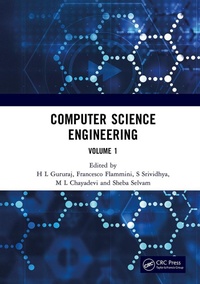
Computer Science Engineering
Proceedings of the 1st International Conference on Computing and Intelligent Information Systems (ICCIIS 2024), Bangalore, India, 19-20th April, 2024 Volume 1
1st Edition
Published on 20. December 2024
764 pages
978-1-040-29905-0 (ISBN)
Description

This book provides a comprehensive overview of the latest advancements and research in the fields of computing and intelligent information systems. It compiles cutting-edge studies, innovative methodologies, and practical applications presented at the conference ICCIIS 2024.
The book delves into several core areas of modern computing and intelligent information systems. Key topics include artificial intelligence, exploring machine learning algorithms and neural networks; information systems and robotic process automation, highlighting efficient business process automation strategies; and signal, image, and video processing, focusing on innovative techniques for multimedia analysis. Big data analytics is also covered with insights into data mining and predictive analytics. Cloud computing and cybersecurity are explored, emphasizing secure, scalable solutions for data storage and protection. The Internet of Things (IoT) is examined for its impact on interconnected devices and smart systems. Additionally, the book explores advanced computing and intelligent networks, addressing the development of high-performance computing systems and sophisticated network architectures.
This book is intended for academics, researchers, and professionals in the fields of computing and information systems, as well as students pursuing advanced studies in these areas. It is also a valuable resource for industry practitioners seeking to stay abreast of the latest trends and innovations in AI, big data, and cybersecurity.
The book delves into several core areas of modern computing and intelligent information systems. Key topics include artificial intelligence, exploring machine learning algorithms and neural networks; information systems and robotic process automation, highlighting efficient business process automation strategies; and signal, image, and video processing, focusing on innovative techniques for multimedia analysis. Big data analytics is also covered with insights into data mining and predictive analytics. Cloud computing and cybersecurity are explored, emphasizing secure, scalable solutions for data storage and protection. The Internet of Things (IoT) is examined for its impact on interconnected devices and smart systems. Additionally, the book explores advanced computing and intelligent networks, addressing the development of high-performance computing systems and sophisticated network architectures.
This book is intended for academics, researchers, and professionals in the fields of computing and information systems, as well as students pursuing advanced studies in these areas. It is also a valuable resource for industry practitioners seeking to stay abreast of the latest trends and innovations in AI, big data, and cybersecurity.
More details
Edition
1. Auflage
Language
English
Place of publication
London
United Kingdom
Publishing group
Taylor & Francis Ltd
Target group
College/higher education
Professional and scholarly
File size
386,65 MB
ISBN-13
978-1-040-29905-0 (9781040299050)
Copyright in bibliographic data and cover images is held by Nielsen Book Services Limited or by the publishers or by their respective licensors: all rights reserved.
Schweitzer Classification
Other editions
Additional editions
Gururaj H L | Francesco Flammini | S. Srividhya
Computer Science Engineering
Proceedings of the 1st International Conference on Computing and Intelligent Information Systems (ICCIIS 2024), Bangalore, India, 19-20th April, 2024 Volume 1
Book
12/2024
1st Edition
CRC Press
€255.60
Shipment within 10-20 days
Persons
Dr. Gururaj H L is currently working as an Associate Professor, Department of Information Technology, Manipal Institute of Technology (MIT), Bangalore, India. He is a professional member of ACM and working as ACM distinguish speaker from 2018. He is the Founder of Wireless Internetworking Group (WiNG). He is a senior member of IEEE and lifetime member of ISTE and CSI. He received a Young Scientist Award from SERB, DST, Government of India in December 2016. He is an editorial board member of the International Journal of Block chains and Cryptocurrencies and Special Editor of EAI publishers. He has published more than 100 research papers in various international journals and conferences. He was honored as chief guest, resource person, session chair, keynote speaker, TPC member, advisory committee member at national and international seminars, workshops and conferences.
Francesco Flammini got with honors his master (2003) and doctoral (2006) degrees in Computer Engineering from the University of Naples Federico II, Italy. He is currently a Professor of Computer Science with a focus on Cyber-Physical Systems at Maelardalen University (Sweden). He has been a Senior Lecturer and the chair of the Cyber-Physical Systems group at Linnaeus University (Sweden). He has worked for almost 15 years in private and public companies, including Ansaldo STS (now Hitachi Rail) and IPZS (Italian State Mint and Polygraphic Institute), on large international projects addressing intelligent transportation systems, critical infrastructure protection and cybersecurity, as a technical leader and unit head. He is an IEEE Senior Member and the Chair of the IEEE SMC Technical Committee on Homeland Security. He is also a member of the ERCIM Working Group on Formal Methods for Industrial Critical Systems (FMICS), He has (co)authored 100+ scientific publications and he has served as a chair, invited speaker, steering/program committee member, and editor for several international conferences and journals.
Dr. S. Srividhya, is working as a Professor, HOD, Department of Information Science and Engineering, BNM Institute of Technology, Bengaluru, Karnataka, India, affiliated to Visvesvaraya Technological University. She obtained her M.Tech, in Information Technology, from Anna University, and Ph.D from VTU. She is having 16 years of academic experience. She has published 21 research articles SCI, Scopus, International and national conferences. She has received funding from ATAL and IEDC for the conduction of faculty development program and projects respectively. She had published a book entitled "Machine Learning Modern concepts and Algorithms", Scientific International Publishing House. She is a life member of The Indian Society for Technical Education, Computer Society of India, International Association of Engineers and Institution of Engineers. Her research areas of interest include Image processing, Robotics and Computer Vision.
Dr. Chayadevi M L, working as Professor and Head, Computer Science & Engg, BNMIT Bangalore, Karnataka, India, with a total teaching experience of 24 years. She has been Graduated with B.E in ComputerScience from SJCE, Mysore, M.Tech. in Computer Engineering from SJCE, & Ph.D on "Knowledge Discovery from Medical Image Databases: Detection and Classification of TB and MP Smear Images with their Performance Evaluation" from VTU. Her research interests include Medical Image processing, Datamining, Knowledge Engineering, PatternRecognition, Speech Recognition, Biomedical applications, Deep learning and ML with Agriculture etc. She has authored 35+ publications in National and International Journals, Conferences and Patents. She has published book chapters at Tata McGraw Hill, Springer and Elsevier Publications in the area of Medical ImageProcessing and Cognitive computing and also Editor for Springer CCIS801 series. She has chaired several National and International Conferences as Session Chair and General Chair. She is also reviewer for National and International Journals and Conferences. Organized several SDPs, workshops, FDPs, workshops, Technical/Expert talks and seminars. She has also supervised M.Tech dissertations, BE projects and supervising Ph.D work of Research Scholars.
Dr. Sheba Selvam, Professor and Head, Department of Artificial Intelligence and Machine Learning has 8 years of teaching and 6 years 7 months of research experience. Professor Sheba Selvam obtained her B. Tech [Hons] degree from SASTRA University, Tanjore, Masters in Engineering from Anna University Chennai and full time PhD from National Institute of Technology Tiruchirappalli (NITT). She has 26 publications to her credit in SCI, Scopus, International and national conferences. She had published a book entitled "Advanced Genetic Algorithms in AI and ML", Scientific International Publishing House. She also written a book chapter entitled "Root-Cause Analysis Using Ensemble Model for Intelligent Decision-Making" in Algorithms for Intelligent Systems. She has Published an Indian patent on "Cryptographic Security of Data Transfers in Computer Systems" and a design patent granted on "Smart Spectacle with Bluetooth Speaker". Dr. Sheba Selvam has also received 3 Lakhs fund from VTU TEQIP 1.3 for conducting 5-day Training programme on "Outcome Based Education and NBA Accreditation." She is reviewer for different international conferences and reputed journals. Her research interests include Social Media Retrieval, Semantic Web, Machine Learning, Deep Learning, Sentiment Analysis and Ontological Modelling.
Francesco Flammini got with honors his master (2003) and doctoral (2006) degrees in Computer Engineering from the University of Naples Federico II, Italy. He is currently a Professor of Computer Science with a focus on Cyber-Physical Systems at Maelardalen University (Sweden). He has been a Senior Lecturer and the chair of the Cyber-Physical Systems group at Linnaeus University (Sweden). He has worked for almost 15 years in private and public companies, including Ansaldo STS (now Hitachi Rail) and IPZS (Italian State Mint and Polygraphic Institute), on large international projects addressing intelligent transportation systems, critical infrastructure protection and cybersecurity, as a technical leader and unit head. He is an IEEE Senior Member and the Chair of the IEEE SMC Technical Committee on Homeland Security. He is also a member of the ERCIM Working Group on Formal Methods for Industrial Critical Systems (FMICS), He has (co)authored 100+ scientific publications and he has served as a chair, invited speaker, steering/program committee member, and editor for several international conferences and journals.
Dr. S. Srividhya, is working as a Professor, HOD, Department of Information Science and Engineering, BNM Institute of Technology, Bengaluru, Karnataka, India, affiliated to Visvesvaraya Technological University. She obtained her M.Tech, in Information Technology, from Anna University, and Ph.D from VTU. She is having 16 years of academic experience. She has published 21 research articles SCI, Scopus, International and national conferences. She has received funding from ATAL and IEDC for the conduction of faculty development program and projects respectively. She had published a book entitled "Machine Learning Modern concepts and Algorithms", Scientific International Publishing House. She is a life member of The Indian Society for Technical Education, Computer Society of India, International Association of Engineers and Institution of Engineers. Her research areas of interest include Image processing, Robotics and Computer Vision.
Dr. Chayadevi M L, working as Professor and Head, Computer Science & Engg, BNMIT Bangalore, Karnataka, India, with a total teaching experience of 24 years. She has been Graduated with B.E in ComputerScience from SJCE, Mysore, M.Tech. in Computer Engineering from SJCE, & Ph.D on "Knowledge Discovery from Medical Image Databases: Detection and Classification of TB and MP Smear Images with their Performance Evaluation" from VTU. Her research interests include Medical Image processing, Datamining, Knowledge Engineering, PatternRecognition, Speech Recognition, Biomedical applications, Deep learning and ML with Agriculture etc. She has authored 35+ publications in National and International Journals, Conferences and Patents. She has published book chapters at Tata McGraw Hill, Springer and Elsevier Publications in the area of Medical ImageProcessing and Cognitive computing and also Editor for Springer CCIS801 series. She has chaired several National and International Conferences as Session Chair and General Chair. She is also reviewer for National and International Journals and Conferences. Organized several SDPs, workshops, FDPs, workshops, Technical/Expert talks and seminars. She has also supervised M.Tech dissertations, BE projects and supervising Ph.D work of Research Scholars.
Dr. Sheba Selvam, Professor and Head, Department of Artificial Intelligence and Machine Learning has 8 years of teaching and 6 years 7 months of research experience. Professor Sheba Selvam obtained her B. Tech [Hons] degree from SASTRA University, Tanjore, Masters in Engineering from Anna University Chennai and full time PhD from National Institute of Technology Tiruchirappalli (NITT). She has 26 publications to her credit in SCI, Scopus, International and national conferences. She had published a book entitled "Advanced Genetic Algorithms in AI and ML", Scientific International Publishing House. She also written a book chapter entitled "Root-Cause Analysis Using Ensemble Model for Intelligent Decision-Making" in Algorithms for Intelligent Systems. She has Published an Indian patent on "Cryptographic Security of Data Transfers in Computer Systems" and a design patent granted on "Smart Spectacle with Bluetooth Speaker". Dr. Sheba Selvam has also received 3 Lakhs fund from VTU TEQIP 1.3 for conducting 5-day Training programme on "Outcome Based Education and NBA Accreditation." She is reviewer for different international conferences and reputed journals. Her research interests include Social Media Retrieval, Semantic Web, Machine Learning, Deep Learning, Sentiment Analysis and Ontological Modelling.
Content
- The conference provides a platform for the Researchers, Industry Professionals, Academicians and Students to explore and publish their innovative solutions for real time problems.
- Create a forum for facilitating the exchange of practical experiences in all aspects of Computer Electronics and Engineering in addition to seeking solutions to the various challenges faced by Practicing Engineers, Technologists, and Scientists.
- The conference provides an international forum where Researchers, Industry Professionals, Academicians and Students across the globe can present and exchange their research innovative ideas and build network for further research collaboration.
- The conference seeks submission of novel research work from Practicing Engineers, Technologists, Scientists from R & D Institutions, Research Scholars, Faculty members and Students on all theoretical and practical aspects of engineering to address new challenges, share solutions at the interface of technology, information, and discuss future research directions
- The rolling flagship conference will feature high-quality research paper presentation and exhibition where top industries would be exhibiting their innovative products of high impact technology.
- Create a forum for facilitating the exchange of practical experiences in all aspects of Computer Electronics and Engineering in addition to seeking solutions to the various challenges faced by Practicing Engineers, Technologists, and Scientists.
- The conference provides an international forum where Researchers, Industry Professionals, Academicians and Students across the globe can present and exchange their research innovative ideas and build network for further research collaboration.
- The conference seeks submission of novel research work from Practicing Engineers, Technologists, Scientists from R & D Institutions, Research Scholars, Faculty members and Students on all theoretical and practical aspects of engineering to address new challenges, share solutions at the interface of technology, information, and discuss future research directions
- The rolling flagship conference will feature high-quality research paper presentation and exhibition where top industries would be exhibiting their innovative products of high impact technology.
