

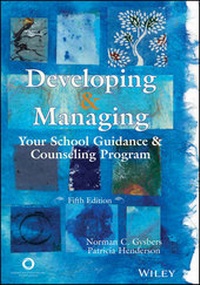
Developing and Managing Your School Guidance and Counseling Program
Description

Reviews / Votes
"A rich resource for school counselors, school counselingprogram leaders, and counselor educators alike. I have relied onprevious editions to help me organize my own campus program, lead adistrict program, and educate graduate students. I highly recommendthis book!" --Elias Zambrano, PhD TheUniversity of Texas at San Antonio "This book guides you through the steps necessary totransform a traditional, reactive 'one student at atime' school counseling program into a program that isresponsive and ensures that the academic, personal, social, andcareer needs of all students are being met."--Mary L. Libby, Head Counselor John Jay HighSchool San Antonio, TX "Gysbers and Henderson's significant and valuedcontributions to the profession continue with this fifth edition.Their work supports the school counseling profession as integraland central to education and leads to excellence in schoolcounseling programs that facilitate student learning anddevelopment" --Kenneth F. Hughey, PhDKansas State UniversityMore details
Other editions
Additional editions
Persons
Norman C. Gysbers, PhD, is a Curators' Professor in the Department of Educational, School, and Counseling Psychology at the University of Missouri-Columbia.
Patricia Henderson, EdD, is a former director of guidance at the Northside Independent School District in San Antonio, Texas.
Content
Preface
One of the most fundamental obligations of any society is to prepare its adolescents and young adults to lead productive and prosperous lives as adults. This means preparing all young people with a solid enough foundation of literacy, numeracy, and thinking skills for responsible citizenship, career development, and lifelong learning. (Harvard Graduate School of Education, 2011, p. 1)
As we enter the second decade of the 21st century, the United States continues to undergo substantial changes in its occupational, social, and economic structures. Occupational and industrial specialization continue to increase dramatically. Increasing size and complexity are the rule rather than the exception, often creating job invisibility and making the transition from school to work and from work to further education and back again more complex and difficult.
Social structures and social and personal values also continue to change and become more diverse. Emerging social groups are challenging established groups, asking for equality. People are on the move, too, from rural to urban areas and back again and from one region of the country to another in search of economic, social, and psychological security. Our population is becoming increasingly diverse.
All of these changes are creating substantial challenges for our children and adolescents. A rapidly changing work world and labor force; violence in the home, school, and community; divorce; teenage suicide; substance abuse; and sexual experimentation are just a few examples. These challenges are not abstract aberrations. These challenges are real, and they are having and will have a substantial impact on the personal-social, career, and academic development of our children and adolescents.
Responding to Challenges
In response to these and other continuing societal and individual needs and challenges, educational leaders and policymakers are in the midst of reforming the entire educational enterprise (National Association of Secondary School Principals, 2004; No Child Left Behind Act of 2001; Race to the Top, 2011; Zhao, 2009). Guidance and counseling in the schools also continues to undergo reform, changing from a position-services model to a comprehensive program firmly grounded in principles of human growth and development. This change makes guidance and counseling in the schools an integral part of education and an equal partner with the overall instruction program, focusing on students' academic, career, and personal-social development.
Traditionally, however, guidance and counseling was not conceptualized and implemented in this manner because, as Aubrey (1973) suggested, guidance and counseling was seen as a support service lacking a content base of its own. Sprinthall (1971) made this same point when he stated that the practice of guidance and counseling has little content and that guidance and counseling textbooks usually avoid discussion of a subject matter base for guidance and counseling programs.
If guidance and counseling is to become an equal partner in education and meet the increasingly complex needs of individuals and society, our opinion is that guidance and counseling must conceptually and organizationally become a program with its own content base and structure. This call is not new; many early pioneers issued the same call. But the call was not loud enough during the early years, and guidance and counseling became a position and then a service with an emphasis on duties, processes, and techniques. The need and the call continued to emerge occasionally thereafter, however, but not until the late 1960s and early 1970s did it reemerge and become visible once more in the form of a developmental comprehensive program.
This is not to say that developmental guidance and counseling was not present before the late 1960s. What it does mean is that by the late 1960s the need for attention to aspects of human development other than "the time-honored cognitive aspect of learning subject matter mastery" (Cottingham, 1973, p. 341) had again become apparent. Cottingham (1973) characterized these other aspects of human development as "personal adequacy learning" (p. 342). Kehas (1973) pointed to this same need by stating that an individual should have opportunities "to develop intelligence about his [or her] self-his [or her] personal, unique, idiosyncratic, individual self" (p. 110).
Reconceptualization of Guidance and Counseling
The next step in the evolution of guidance and counseling was to establish guidance and counseling as a comprehensive program-a program that is an integral part of education with a content base and organizational structure of its own. In response to this need, Gysbers and Moore (1981) published a book titled Improving Guidance Programs. It presented a content-based, kindergarten through 12th-grade comprehensive guidance and counseling program model and described the steps to implement the model. The first, second, third, and fourth editions of our current book built on the model and implementation steps presented in Improving Guidance Programs and substantially expanded and extended the model and implementation steps. This fifth edition expands and extends the model and steps even further, sharing what has been learned through various state and local adoption and adaptations since 2006.
Organization of This Book
Five phases of developing comprehensive guidance and counseling programs are used as organizers for this book. The five phases are planning (Chapters 1-4), designing (Chapters 5 and 6), implementing (Chapters 7-9), evaluating (Chapter 10), and enhancing (Chapter 11). In several chapters, ways to attend to the increasing diversity of school populations and the roles and responsibilities of district- and building-level guidance and counseling leaders are highlighted. The appendixes offer examples of forms and procedures used by various states and school districts in the installation of comprehensive guidance and counseling programs. Also included as an appendix are the ethical standards of the American School Counselor Association (ASCA) and the Multicultural Counseling Competencies of the Association for Multicultural Counseling and Development (Arredondo et al., 1996; Sue, Arredondo, & McDavis, 1992).
Part I: Planning
Chapter 1 traces the evolution of guidance and counseling in the schools from the beginning of the 20th century. The changing influences, emphases, and structures from then until now are described and discussed in detail. The emergence of comprehensive guidance and counseling programs is highlighted. Having an understanding of the evolution of guidance and counseling in the schools and the emergence of developmental comprehensive programs is the first step toward improving your school's guidance and counseling program. Chapter 2 is based on this understanding and focuses on the issues and concerns in planning and organizing for guidance and counseling program improvement. Chapter 3 then presents a model guidance and counseling program based on the concept of life career development; it is organized around four basic elements. Chapter 4, the last chapter in the planning phase, discusses the steps involved in finding out how well your current program is working and where improvement is needed.
Part II: Designing
Chapter 5 begins the designing phase of the program improvement process and focuses on designing the program of your choice. Issues and steps in selecting the desired program structure for your comprehensive program are presented. Chapter 6 describes the necessary tasks required to plan the transition to a comprehensive guidance and counseling program.
Part III: Implementing
Chapter 7 presents the details of beginning a new program in a school or district, and Chapter 8 emphasizes the details of managing and maintaining the program. Chapter 9 first looks at how to ensure that school counselors have the necessary competence to develop, manage, and implement a comprehensive guidance and counseling program and then highlights counselor supervision procedures.
Part IV: Evaluating
Comprehensive guidance and counseling program evaluation is discussed in detail in Chapter 10. Program evaluation, personnel evaluation, and results evaluation are featured, with attention given to procedures for each.
Part V: Enhancing
Chapter 11 focuses on the use of data gathered from program, personnel, and results evaluation and from needs assessments to redesign and enhance a comprehensive guidance and counseling program that has been in place for a number of years. The chapter uses actual data gathered in a school district and describes in detail the way this school district built on the guidance and counseling program foundation it had established in the early 1980s to update and enhance its program to meet continuing and changing student, school district, and community needs.
Who Should Read This Book
A goal of this book is to inform and involve all members of a kindergarten through 12th-grade guidance and counseling staff in the development and management of comprehensive school guidance and counseling programs. Although specific parts are highlighted for guidance and counseling program leaders (central or building-level directors, supervisors, coordinators, department heads) and school administrators, the information provided is important...
