

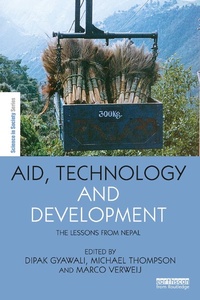
Aid, Technology and Development
The Lessons from Nepal
1st Edition
Published on 8. December 2016
260 pages
978-1-317-22054-1 (ISBN)
Description

Over the last 50 years, Nepal has been considered an experiential model in determining the effectiveness and success of global human development strategies, both in theory and in practice. As such, it provides a rich array of in-depth case studies in both development success and failure. This edited collection examines these in order to propose a novel perspective on how human development occurs and how it can be aided and sustained.
Aid, Technology and Development: The lessons from Nepal champions plural rationality from both a theoretical and practical perspective in order to challenge and critique the status quo in human development understanding, while simultaneously presenting a concrete framework with which to aid citizen and governmental organisations in the galvanization of human development.
Including contributions by leading international social scientists and development practitioners throughout Nepal, this book will be of great interest to students, scholars and practitioners working in the field of foreign aid and development studies.
Aid, Technology and Development: The lessons from Nepal champions plural rationality from both a theoretical and practical perspective in order to challenge and critique the status quo in human development understanding, while simultaneously presenting a concrete framework with which to aid citizen and governmental organisations in the galvanization of human development.
Including contributions by leading international social scientists and development practitioners throughout Nepal, this book will be of great interest to students, scholars and practitioners working in the field of foreign aid and development studies.
More details
Series
Edition
1. Auflage
Language
English
Place of publication
London
United Kingdom
Publishing group
Taylor & Francis Ltd
Target group
College/higher education
Professional and scholarly
Illustrations
18 Tables, black and white; 7 Line drawings, black and white
File size
3,30 MB
ISBN-13
978-1-317-22054-1 (9781317220541)
Copyright in bibliographic data and cover images is held by Nielsen Book Services Limited or by the publishers or by their respective licensors: all rights reserved.
Schweitzer Classification
Other editions
Additional editions
Dipak Gyawali | Michael Thompson | Marco Verweij
Aid, Technology and Development
The Lessons from Nepal
Book
06/2018
1st Edition
Routledge
€71.90
Shipment within 10-20 days
Dipak Gyawali | Michael Thompson | Marco Verweij
Aid, Technology and Development
The Lessons from Nepal
Book
11/2016
1st Edition
Routledge
€215.41
Shipment within 10-20 days
Persons
Dipak Gyawali is a hydroelectric power engineer trained at Moscow Energy Institute and a political economist trained at the Energy and Resources Group of the University of California at Berkeley and was Nepal's Minister of Water Resources in 2002/2003. A Pragya (Academician) of the Nepal Academy of Science and Technology, he conducts interdisciplinary research at the interface of technology and society, mostly from the perspectives of Cultural Theory. He has been a visiting professor/research scholar as well as member of advisory boards throughout various universities and international organizations, including UN University in Yokohama, Battelle Pacific Northwest National Lab and Mekong's MPower. Currently he is on the advisory committee of UNESCO's World Water Assessment Program, Stockholm International Water Institute's Scientific Program Committee, and IDS Sussex STEPs Center' advisory board. He chairs Nepal Water Conservation Foundation as well as Inter Disciplinary Analysts.
Michael Thompson has had a long association with Nepal: first as a teenage?soldier in the Malayan "emergency" (where he served in the British army's Gurkha Division), then as a Himalayan mountaineer, and?subsequently as an anthropologist-cum-policy analyst. Trained at University College London (B.Sc, Ph.D) and Oxford (B.Litt), he is currently a senior researcher at the International Institute for Applied Systems Analysis, a global change think-tank in Austria. There he develops and applies the concept of "plural rationality": people doing very different things and yet still behaving rationally, given their different sets of convictions as to how the world is and people are.
Marco Verweij is Professor of Political Science at Jacobs University in Bremen, Germany. He holds a doctorate in social and political science from the European University Institute in Florence, Italy, and previously earned his keep at the Max Planck Institute for Research on Collective Goods in Bonn, Germany, and at the Singapore Management University. In his research, he attempts to understand how 'wicked' social and environmental problems can be resolved through the combined forces of (inter)governmental action, entrepreneurship, technological innovation, as well as civil society engagement. He also explores the possible synergies between social and political theory, brain research and the analysis of human complex systems.
?
Michael Thompson has had a long association with Nepal: first as a teenage?soldier in the Malayan "emergency" (where he served in the British army's Gurkha Division), then as a Himalayan mountaineer, and?subsequently as an anthropologist-cum-policy analyst. Trained at University College London (B.Sc, Ph.D) and Oxford (B.Litt), he is currently a senior researcher at the International Institute for Applied Systems Analysis, a global change think-tank in Austria. There he develops and applies the concept of "plural rationality": people doing very different things and yet still behaving rationally, given their different sets of convictions as to how the world is and people are.
Marco Verweij is Professor of Political Science at Jacobs University in Bremen, Germany. He holds a doctorate in social and political science from the European University Institute in Florence, Italy, and previously earned his keep at the Max Planck Institute for Research on Collective Goods in Bonn, Germany, and at the Singapore Management University. In his research, he attempts to understand how 'wicked' social and environmental problems can be resolved through the combined forces of (inter)governmental action, entrepreneurship, technological innovation, as well as civil society engagement. He also explores the possible synergies between social and political theory, brain research and the analysis of human complex systems.
?
Content
Part 1: The Dharma of Development: A Conceptual Framework
Chapter 1 The Dharma of Development (Michael Thompson, Dipak Gyawali and Marco Verweij)
Chapter 2 A Cultural Theory of How to Aid Development (Marco Verweij)
Chapter 3 The Arrested Success of Pro-Poor Initiatives in Democratic Nepal (Bihari Krishna Shrestha)
Chapter 4 Trickle to Torrent to Irrelevance? Six Decades of Foreign Aid in Nepal (Sudhindra Sharma)
Part 2: The Case Studies
Chapter 5 Bhattedanda Milkway: Why a Climate- and Mountain-Friendly Technology Continues to Be Ignored (Madhukar Upadhya)
Chapter 6 Whither Electric Vehicles? (Ashok Raj Pandey)
Chapter 7 Micro and Small Hydro: Serial Leap-frogging to a Braver Nepal (Ajoy Karki)
Chapter 8 Large Hydro: Failures in Financial Engineering (Ratna Sansar Shrestha)
Chapter 9 Biogas: Buoyant or Bust? (Saroj Rai)
Chapter 10 Water Supply and Sanitation: Elusive Targets and Slippery Means (Anil Pokhrel)
Chapter 11 Community Forestry: Thwarting Desertification and Facing Second Generation Problems (Hemant Ojha)
Part 3: Beyond the Age of Aid
Chapter 12 Nepal's Experience of Foreign Aid, and How It Can Kick the Habit (Prakash Chandra Lohani)Chapter 13 Afterword:The Lessons from Nepal (Dipak Gyawali, Michael Thompson and Marco Verweij)
Chapter 1 The Dharma of Development (Michael Thompson, Dipak Gyawali and Marco Verweij)
Chapter 2 A Cultural Theory of How to Aid Development (Marco Verweij)
Chapter 3 The Arrested Success of Pro-Poor Initiatives in Democratic Nepal (Bihari Krishna Shrestha)
Chapter 4 Trickle to Torrent to Irrelevance? Six Decades of Foreign Aid in Nepal (Sudhindra Sharma)
Part 2: The Case Studies
Chapter 5 Bhattedanda Milkway: Why a Climate- and Mountain-Friendly Technology Continues to Be Ignored (Madhukar Upadhya)
Chapter 6 Whither Electric Vehicles? (Ashok Raj Pandey)
Chapter 7 Micro and Small Hydro: Serial Leap-frogging to a Braver Nepal (Ajoy Karki)
Chapter 8 Large Hydro: Failures in Financial Engineering (Ratna Sansar Shrestha)
Chapter 9 Biogas: Buoyant or Bust? (Saroj Rai)
Chapter 10 Water Supply and Sanitation: Elusive Targets and Slippery Means (Anil Pokhrel)
Chapter 11 Community Forestry: Thwarting Desertification and Facing Second Generation Problems (Hemant Ojha)
Part 3: Beyond the Age of Aid
Chapter 12 Nepal's Experience of Foreign Aid, and How It Can Kick the Habit (Prakash Chandra Lohani)Chapter 13 Afterword:The Lessons from Nepal (Dipak Gyawali, Michael Thompson and Marco Verweij)
