

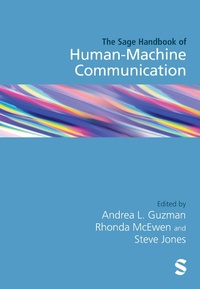
The SAGE Handbook of Human-Machine Communication
1st Edition
Published on 1. June 2023
640 pages
978-1-5297-8674-3 (ISBN)
Description

The SAGE Handbook of Human-Machine Communication has been designed to serve as the touchstone text for researchers and scholars engaging in new research in this fast-developing field. Chapters provide a comprehensive grounding of the history, methods, debates and theories that contribute to the study of human-machine communication. Further to this, the Handbook provides a point of departure for theorizing interactions between people and technologies that are functioning in the role of communicators, and for considering the theoretical and methodological implications of machines performing traditionally 'human' roles. This makes the Handbook the first of its kind, and a valuable resource for students and scholars across areas such as communication, media and information studies, and computer science, as well as for practitioners, engineers and researchers interested in the foundational elements of this emerging field.
Part 1: Histories and Trajectories
Part 2: Approaches and Methods
Part 3: Concepts and Contexts
Part 4: Technologies and Applications
Part 1: Histories and Trajectories
Part 2: Approaches and Methods
Part 3: Concepts and Contexts
Part 4: Technologies and Applications
More details
Edition
1. Auflage
Language
English
Place of publication
London
United Kingdom
Publishing group
Sage Publications Ltd (Digital)
Target group
Professional and scholarly
Product notice
Reflowable
File size
7,68 MB
ISBN-13
978-1-5297-8674-3 (9781529786743)
Copyright in bibliographic data and cover images is held by Nielsen Book Services Limited or by the publishers or by their respective licensors: all rights reserved.
Schweitzer Classification
Other editions
Additional editions
Andrea L. Guzman | Rhonda McEwen | Steven Jones
The SAGE Handbook of Human-Machine Communication
Book
06/2023
1st Edition
SAGE Publications Ltd
€186.40
Shipment within 15-20 days
Persons
Andrea L. Guzman is an associate professor of communication at Northern Illinois University and co-director of The Human-Machine Communication Lab at NIU. Her research focuses on HMC theory and people's perceptions of artificial intelligence, including voice-based assistants and automated news-writing programs. Guzman is editor of Human-Machine Communication: Rethinking Communication, Technology, and Ourselves, and her award-winning research has been published in top journals, including New Media & Society, Computers in Human Behavior, Digital Journalism, and Journalism & Mass Communication Quarterly and has been presented at leading interdisciplinary and disciplinary conferences. Guzman served as the inaugural chair of the Human-Machine Communication Interest Group of the International Communication Association. Dr. Rhonda N. McEwen is the 14th President and Vice-Chancellor of Victoria University in the University of Toronto; Canada Research Chair in Tactile Interfaces, Communication and Cognition; a Professor of Emerging Media & Communication; and a faculty member at the Institute of Communication, Culture, Information & Technology. Dr. McEwen combines communication studies, and applied and behavioral sciences to examine the social and cognitive effects of technologies. Her pioneering approach to communication research employs experimental techniques, eye tracking, observations, sensor data, and interviews to investigate Human-Machine Communication involving children and adults across the user spectrum, including those diagnosed with communication and learning disorders. Journalists from CBS news magazine 60 Minutes covered McEwen's research in 2012 and 2013, and she has over 47 publications, including articles in Human-Robot Interaction Companion; Information, Communication & Society; Computers and Education; Learning & Instruction; New Media and Society; and information science journals.
Steve Jones is UIC Distinguished Professor of Communication and Adjunct Professor of Computer Science at the University of Illinois Chicago, USA and Adjunct Research Professor in the Institute for Communications Research at the University of Illinois Urbana-Champaign, USA. He is editor of New Media & Society and co-editor of Mobile Media & Communication. His research interests encompass popular music studies, music technology, sound studies, internet studies, media history, virtual reality, human-machine communication, social robotics and human augmentics. His research has been funded by the National Science Foundation, National Institutes of Health, National Cancer Institute, Centers for Disease Control and the Tides Foundation.
Steve Jones is UIC Distinguished Professor of Communication and Adjunct Professor of Computer Science at the University of Illinois Chicago, USA and Adjunct Research Professor in the Institute for Communications Research at the University of Illinois Urbana-Champaign, USA. He is editor of New Media & Society and co-editor of Mobile Media & Communication. His research interests encompass popular music studies, music technology, sound studies, internet studies, media history, virtual reality, human-machine communication, social robotics and human augmentics. His research has been funded by the National Science Foundation, National Institutes of Health, National Cancer Institute, Centers for Disease Control and the Tides Foundation.
Content
Editors' Introduction - Andrea L. Guzman, Rhonda McEwen, & Steve Jones
Foreword: Human-Machine Communication, Humacomm, and Origins - Steve Mann
Part 1: Histories and Trajectories
Part 1: Introduction
1. Machines are Us: An Excursion in the History of HMC - Kate K. Mays and James E. Katz
2. The interdisciplinarity of HMC: Rethinking communication, media, and agency - Andreas Hepp & Wiebke Loosen
3. Cybernetics and Information Theory in Human-Machine Communication - Ronald Kline
4. Cyborgs and Human-Machine Communication Configurations - Katina Michael, Jeremy Pitt, Roba Abbas, Christine Perakslis, MG Michael
5. The Meaning and Agency of Twenty-First-Century AI - Jonathan Roberge
6. The History and Future of Human-Robot Communication - Florian Shkurti
7. From CASA to TIME: Machine as a Source of Media Effects - S. Shyam Sundar, Jin Chen
8. Computer-Supported Cooperative Work (CSCW) and Human-Machine Communication (HMC) - Steve Jones & Rhonda McEwen
9. HMC and HCI: Cognates on a Journey - Victoria McArthur & Cosmin Munteanu
10. Developing a Theory of Artificial Minds (ToAM) to Facilitate Meaningful Human-AI Communication - Nandini Asavari Bharadwaj, Adam Kenneth Dube, Victoria Talwar, and Elizabeth Patitsas
11. HMC and Theories of Human-Technology Relations - Eleanor Sandry
12. Philosophical Contexts and Consequences of Human-Machine Communication - David J. Gunkel
13. Critical and Cultural Approaches to Human-Machine Communication - Andrew Iliadis
14. Gender and Identity in Human-Machine Communication - Leopoldina Fortunati
15. Literature and HMC: Poetry and/as the Machine - Margaret Rhee
16. Human-Machine Communities: How Online Computer Games Model the Future - Nathaniel Poor
17. Perfect Incommunicability: War and the strategic paradox of human-machine communication - Jeremy Packer, Joshua Reeves, and Kate Maddalena
Part 2: Approaches and Methods
Part 2: Introduction
18. Human-Robot Interaction - Autumn Edwards
19. Auditing Human-Machine Communication Systems Using Simulated Humans - Nicholas Diakopoulos, Jack Bandy, Henry Dambanemuya
20. Experiments in Human-Machine Communication Research - Nicole Kraemer & Jessica Szczuka
21. Detecting the States of Our Minds: Developments in Physiological and Cognitive Measures - Michelle Lui
22. Human shoppers, AI cashiers, and cloud-computing others: Methodological approaches for machine surveillance in commercial retails environments - Kristina M. Green
23. Visual Research Methods in Human-Machine Communications - Herve Saint-Louis
24. Observing Communication with Machines - Patric R. Spence, and David Westerman, Zhenyang Luo
25. Coding ethnography: Human-machine communication in collaborative software development - Jack Jamieson
26. An ethnography for studying HMC: What can we learn from observing how humans communicate with machines? - Sharon Ringel
27. Talking About "Talking with Machines": Interview as Method within HMC - Andrea L. Guzman
28. Feminist, Postcolonial, and Crip Approaches to Human-Machine Communication Methodology - Paula Gardner & Jess Rauchberg
29. A Research Ethics for Human-Machine Communication: A First Sketch - Charles Ess
Part 3: Concepts and Contexts
Part 3: Introduction
30. Rethinking Affordances for Human-Machine Communication Research - Gina Neff & Peter Nagy
31. Affect research in human-machine communication: The case of social robots - Carmina Rodriguez-Hidalgo
32. Social Presence in Human-Machine Communication - Kun Xu & David Jeong
33. Interpersonal Interactions Between People and Machines - Astrid Rosenthal-von der Puetten and Kevin Koban
34. Dual-Process Theory in Human-Machine Communication - Kevin Koban & Jaime Banks
35. Privacy and Human-Machine Communication - Christoph Lutz
36. Natural Language Processing - Natalie Parde
37. Datafication in Human-Machine Communication Between Representation and Preferences: An Experiment of Non-Binary Gender Representation in Voice-Controlled Assistants - J.L. Mortensen, N.N. Siegfredsen, and A. Bechmann
38. Human-Machine Communication and the Domestication Approach - Jenny Kennedy & Rowan Wilken
39. Intersectionality and Human-Machine Communication - Sarah Myers West
40. Human-Machine Communication, Artificial Intelligence, and Issues of Data Colonialism - Beth Coleman
41. A feminist Human-Machine Communication Framework: Collectivizing by design for inclusive work futures - Chinar Mehta, Payal Arora, and Usha Raman
42. Dishuman-machine communication: Disability imperatives for reimagining norms in emerging technology - Gerard Goggin
43. Robotic Art - The aesthetics of machine communication - Damith Herath, Stelarc
44. Labour, Automation, and Human-Machine Communication - Julian Posada, Gemma Newlands, and Milagros Miceli
45. The Brain Center Beneath the Interface: Grounding HMC in Infrastructure, Information, and Labour - Vincent Manzerolle
46. AI, Human-Machine Communication and Deception - Simone Natale
47. Governing the Social Dimensions of Collaborative Robotic Design: Influence, manipulation and other non-physical harms - Sara Brooks and AJung Moon
48. Who's liable?: Agency and accountability in human-machine communication - Jasmine E. McNealy
49. The Popular Cultural Origin of Communicating Robots in Japan - Keiko Nishimura
Part 4: Technologies and Applications
Part 4: Introduction
50. Human Social Relationships with Robots - Maartje de Graaf & Jochen Peter
51. Algorithms as a Form of Human-Machine Communication - Taina Bucher
52. Bot-to-bot Communication: Relationships, Infrastructure, and Identity - Wei-Jie (Josh) Xiao and Samuel C . Woolley
53. Communicating with Conversational Assistants: Uses, Contexts, and Effects - Yi Mou & Yuheng Wu
54. Conceptualizing Empathic Child-Robot Communication - Ekaterina Pashevich
55. Haptics, Human Augmentics, and Human-Machine Communication - Jason Archer
56. Love and Sex and Robots, Oh My! A Call for HMC Attention - Riley Richards
57. Virtual Reality as Human-Machine Communication - Eric Novotny, Joomi Lee, and Sun Joo (Grace) Ahn
58. HMC in the Educational Context - Chad Edwards & Matthew Craig
59. Human-Machine Communication in Healthcare - Jihyun Kim, Hayeon Song, Kelly Merrill Jr., Taenyun Kim, and Jieun Kim
60. Why Human-Machine Communication Matters for the Study of Artificial Intelligence in Journalism - Seth C. Lewis & Felix M. Simon
61. Human-Machine Communication in Marketing and Advertising - Weizi Liu & Mike Z. Yao
62. Human-Machine Communication in Retail - Jenna Jacobson, Irina Gorea
63. Autonomous Vehicles: Where Automation Ends and the Communication Begins - Thilo von Pape
64. HMC in Space Operations - Regina Peldszus
65. Religious Human-Machine Communication: Practices, Power, and Prospects - Pauline Hope Cheong & Yashu Chen
Foreword: Human-Machine Communication, Humacomm, and Origins - Steve Mann
Part 1: Histories and Trajectories
Part 1: Introduction
1. Machines are Us: An Excursion in the History of HMC - Kate K. Mays and James E. Katz
2. The interdisciplinarity of HMC: Rethinking communication, media, and agency - Andreas Hepp & Wiebke Loosen
3. Cybernetics and Information Theory in Human-Machine Communication - Ronald Kline
4. Cyborgs and Human-Machine Communication Configurations - Katina Michael, Jeremy Pitt, Roba Abbas, Christine Perakslis, MG Michael
5. The Meaning and Agency of Twenty-First-Century AI - Jonathan Roberge
6. The History and Future of Human-Robot Communication - Florian Shkurti
7. From CASA to TIME: Machine as a Source of Media Effects - S. Shyam Sundar, Jin Chen
8. Computer-Supported Cooperative Work (CSCW) and Human-Machine Communication (HMC) - Steve Jones & Rhonda McEwen
9. HMC and HCI: Cognates on a Journey - Victoria McArthur & Cosmin Munteanu
10. Developing a Theory of Artificial Minds (ToAM) to Facilitate Meaningful Human-AI Communication - Nandini Asavari Bharadwaj, Adam Kenneth Dube, Victoria Talwar, and Elizabeth Patitsas
11. HMC and Theories of Human-Technology Relations - Eleanor Sandry
12. Philosophical Contexts and Consequences of Human-Machine Communication - David J. Gunkel
13. Critical and Cultural Approaches to Human-Machine Communication - Andrew Iliadis
14. Gender and Identity in Human-Machine Communication - Leopoldina Fortunati
15. Literature and HMC: Poetry and/as the Machine - Margaret Rhee
16. Human-Machine Communities: How Online Computer Games Model the Future - Nathaniel Poor
17. Perfect Incommunicability: War and the strategic paradox of human-machine communication - Jeremy Packer, Joshua Reeves, and Kate Maddalena
Part 2: Approaches and Methods
Part 2: Introduction
18. Human-Robot Interaction - Autumn Edwards
19. Auditing Human-Machine Communication Systems Using Simulated Humans - Nicholas Diakopoulos, Jack Bandy, Henry Dambanemuya
20. Experiments in Human-Machine Communication Research - Nicole Kraemer & Jessica Szczuka
21. Detecting the States of Our Minds: Developments in Physiological and Cognitive Measures - Michelle Lui
22. Human shoppers, AI cashiers, and cloud-computing others: Methodological approaches for machine surveillance in commercial retails environments - Kristina M. Green
23. Visual Research Methods in Human-Machine Communications - Herve Saint-Louis
24. Observing Communication with Machines - Patric R. Spence, and David Westerman, Zhenyang Luo
25. Coding ethnography: Human-machine communication in collaborative software development - Jack Jamieson
26. An ethnography for studying HMC: What can we learn from observing how humans communicate with machines? - Sharon Ringel
27. Talking About "Talking with Machines": Interview as Method within HMC - Andrea L. Guzman
28. Feminist, Postcolonial, and Crip Approaches to Human-Machine Communication Methodology - Paula Gardner & Jess Rauchberg
29. A Research Ethics for Human-Machine Communication: A First Sketch - Charles Ess
Part 3: Concepts and Contexts
Part 3: Introduction
30. Rethinking Affordances for Human-Machine Communication Research - Gina Neff & Peter Nagy
31. Affect research in human-machine communication: The case of social robots - Carmina Rodriguez-Hidalgo
32. Social Presence in Human-Machine Communication - Kun Xu & David Jeong
33. Interpersonal Interactions Between People and Machines - Astrid Rosenthal-von der Puetten and Kevin Koban
34. Dual-Process Theory in Human-Machine Communication - Kevin Koban & Jaime Banks
35. Privacy and Human-Machine Communication - Christoph Lutz
36. Natural Language Processing - Natalie Parde
37. Datafication in Human-Machine Communication Between Representation and Preferences: An Experiment of Non-Binary Gender Representation in Voice-Controlled Assistants - J.L. Mortensen, N.N. Siegfredsen, and A. Bechmann
38. Human-Machine Communication and the Domestication Approach - Jenny Kennedy & Rowan Wilken
39. Intersectionality and Human-Machine Communication - Sarah Myers West
40. Human-Machine Communication, Artificial Intelligence, and Issues of Data Colonialism - Beth Coleman
41. A feminist Human-Machine Communication Framework: Collectivizing by design for inclusive work futures - Chinar Mehta, Payal Arora, and Usha Raman
42. Dishuman-machine communication: Disability imperatives for reimagining norms in emerging technology - Gerard Goggin
43. Robotic Art - The aesthetics of machine communication - Damith Herath, Stelarc
44. Labour, Automation, and Human-Machine Communication - Julian Posada, Gemma Newlands, and Milagros Miceli
45. The Brain Center Beneath the Interface: Grounding HMC in Infrastructure, Information, and Labour - Vincent Manzerolle
46. AI, Human-Machine Communication and Deception - Simone Natale
47. Governing the Social Dimensions of Collaborative Robotic Design: Influence, manipulation and other non-physical harms - Sara Brooks and AJung Moon
48. Who's liable?: Agency and accountability in human-machine communication - Jasmine E. McNealy
49. The Popular Cultural Origin of Communicating Robots in Japan - Keiko Nishimura
Part 4: Technologies and Applications
Part 4: Introduction
50. Human Social Relationships with Robots - Maartje de Graaf & Jochen Peter
51. Algorithms as a Form of Human-Machine Communication - Taina Bucher
52. Bot-to-bot Communication: Relationships, Infrastructure, and Identity - Wei-Jie (Josh) Xiao and Samuel C . Woolley
53. Communicating with Conversational Assistants: Uses, Contexts, and Effects - Yi Mou & Yuheng Wu
54. Conceptualizing Empathic Child-Robot Communication - Ekaterina Pashevich
55. Haptics, Human Augmentics, and Human-Machine Communication - Jason Archer
56. Love and Sex and Robots, Oh My! A Call for HMC Attention - Riley Richards
57. Virtual Reality as Human-Machine Communication - Eric Novotny, Joomi Lee, and Sun Joo (Grace) Ahn
58. HMC in the Educational Context - Chad Edwards & Matthew Craig
59. Human-Machine Communication in Healthcare - Jihyun Kim, Hayeon Song, Kelly Merrill Jr., Taenyun Kim, and Jieun Kim
60. Why Human-Machine Communication Matters for the Study of Artificial Intelligence in Journalism - Seth C. Lewis & Felix M. Simon
61. Human-Machine Communication in Marketing and Advertising - Weizi Liu & Mike Z. Yao
62. Human-Machine Communication in Retail - Jenna Jacobson, Irina Gorea
63. Autonomous Vehicles: Where Automation Ends and the Communication Begins - Thilo von Pape
64. HMC in Space Operations - Regina Peldszus
65. Religious Human-Machine Communication: Practices, Power, and Prospects - Pauline Hope Cheong & Yashu Chen
