

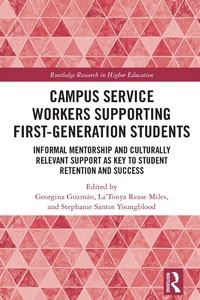
Campus Service Workers Supporting First-Generation Students
Informal Mentorship and Culturally Relevant Support as Key to Student Retention and Success
1st Edition
Published on 29. November 2021
264 pages
978-1-000-48717-6 (ISBN)
Description

This unique collection of testimonials, critical essays, and first-hand accounts demonstrates the significant contribution of campus service workers in supporting the retention and success of first-generation college students.
Using a Freirean framework to ground individual stories, the text identifies ways in which campus workers connect with students, provide informal mentorship, and offer culturally relevant support during students' transition to college and beyond. Drawing on a range of interviews, case studies, and research studies, emphasis is placed on the unique challenges faced by first-generation and minority students such as cultural alienation, imposter syndrome, language barriers, and financial insecurity. Ultimately, the text dismantles notions of social hierarchies that separate workers and college students and encourages institutions to invest in these workers and their contribution to student well-being and success.
This book will benefit researchers, academics, and educators with an interest in the higher education and student affair practice and higher education administration more broadly. Those specifically interested in multicultural education and the study of race and ethnicity within US higher educational contexts will also benefit from this book.
Using a Freirean framework to ground individual stories, the text identifies ways in which campus workers connect with students, provide informal mentorship, and offer culturally relevant support during students' transition to college and beyond. Drawing on a range of interviews, case studies, and research studies, emphasis is placed on the unique challenges faced by first-generation and minority students such as cultural alienation, imposter syndrome, language barriers, and financial insecurity. Ultimately, the text dismantles notions of social hierarchies that separate workers and college students and encourages institutions to invest in these workers and their contribution to student well-being and success.
This book will benefit researchers, academics, and educators with an interest in the higher education and student affair practice and higher education administration more broadly. Those specifically interested in multicultural education and the study of race and ethnicity within US higher educational contexts will also benefit from this book.
More details
Series
Edition
1. Auflage
Language
English
Place of publication
London
United Kingdom
Publishing group
Taylor & Francis Ltd
Target group
College/higher education
Illustrations
11 Halftones, black and white; 11 Illustrations, black and white
ISBN-13
978-1-000-48717-6 (9781000487176)
Copyright in bibliographic data and cover images is held by Nielsen Book Services Limited or by the publishers or by their respective licensors: all rights reserved.
Schweitzer Classification
Other editions
Additional editions
Georgina Guzman | La'Tonya Miles | Stephanie Youngblood
Campus Service Workers Supporting First-Generation Students
Informal Mentorship and Culturally Relevant Support as Key to Student Retention and Success
Book
05/2023
1st Edition
Routledge
€63.80
Shipment within 10-20 days
Georgina Guzman | La'Tonya Miles | Stephanie Youngblood
Campus Service Workers Supporting First-Generation Students
Informal Mentorship and Culturally Relevant Support as Key to Student Retention and Success
Book
11/2021
1st Edition
Routledge
€206.60
Shipment within 10-20 days
Persons
Georgina Guzman is Associate Professor of English at California State University Channel Islands, USA.
La'Tonya Rease Miles is Dean of Student Affairs at Menlo College, USA.
Stephanie Santos Youngblood is an Ed.D. student at Arizona State University.
La'Tonya Rease Miles is Dean of Student Affairs at Menlo College, USA.
Stephanie Santos Youngblood is an Ed.D. student at Arizona State University.
Content
Part 1: Paradigm Shifts: Critically Reframing Campus Service Workers' Roles in Student Success
Seeing Ourselves on Campus in (Un)Likely Places: Campus Service Workers' Ethos of Care and Horizontal Mentorship of First-Generation Students, Andrea N. Hunt and Alyson Bergner
Custodians of Student Success: Campus Citizenship in the Borderlands, T. Mark Montoya
We Do Way More Than Just Clean Up Puke...We Connect with Students: Custodial Staff as Informal Mentors at a Large, Public University, Yolanda M. Wiggins
To Boldly Go Where No One Has Gone Before: What Captain Picard and His Mentor, Boothby, Can Teach Us About the Future of Student Support, La'Tonya Rease Miles
Part 2: Testimonials and Counternarratives: The Roles of Campus Service Workers in Supporting Student Success
A. Validating Identities
"Heyyy, sis!": Black Women Breaking Barriers Together at a P.W.I., Jada DaMae Anderson
"Call Me Young Chan": How a Campus Housekeeper Taught Me to Be Korean Again, Young Chan Lim
Siempre la Hija de una Campesina: My Journey from the Central Valley to Los Angeles, and Back, Susy N. Puente
From Nobody to Somebody: Finding a Friend and Mentor in a Campus Worker as an International Student, Yuhang (Doris) Cai
B. Forming Cultural Counterspaces
Latinas in the Chemistry Building: Making and Reclaiming Space, Isis Frausto-Vicencio
Social and Cultural Exchange as Means of Counterhegemonic Education: How A Campus Groundskeeper Helped Me Discover My Agency and Sense of Belonging as a First-Generation, Nontraditional, Reverse-Transfer Latina Student, Sarai V. Kashani
Dropping Anchor in Unfamiliar Spaces: Reflections of a First-Generation Black Woman's Search for Community at a Predominantly White University, Penny S. Seals
C. Mentorship, Belonging, and Community Empowerment
Community Educator, Institutional Ally, Custodian: Lessons from Senor Mauricio's Pedagogy of Care in UCLA's Academic Advancement Program, Ifeoma A. Amah and Cindy Raquel Escobedo
!Aqui, Alla, El Pueblo Vencera!: Examining a Campus Service Worker's Role as Activist, Mentor, and Inspiration, Martha N. Xuncax
Primera Generacion, Pero No La Ultima: Finding a Support Network as a Student Worker in the Campus Dining Halls, Nancy Valencia with Tara Prescott-Johnson
Two Chicken Wings, an Apple, and a Bag of Chips: The Impact of Food Service Workers on the Retention of a First-Generation, Single Mother, Kimberly Walker
D. Supporting Post-Completion Success
From First-Year Student to Professor: Growing a Social Consciousness and Learning Life-Long Values From Campus Residence Hall Workers, Georgina Guzman
Confessions of a First-Gen Professional: How I Learned to Survive the Professional World in the Break Rooms, Loading Docks, and Supply Rooms of UCLA, Stephanie Santos Youngblood
Becoming a First-Gen Lawyer: How Service Workers Shaped the Advocate I Am Today, Daysi N. Alonzo
Becoming Middle-Class Faculty With Working-Class Sensibilities, Jennie Luna
La Fille de Leonard: What Quebecois Cultural Sovereignty Taught Me About Working with Historically Marginalized Students, Nancy-Jean Pement
Part 3: Call to Action/Praxis: Successful Projects and Justice for Campus Service Workers
Building Horizontal Relationships Through Spanish Community-Engaged Learning: Voices of First-Generation Latinx Students, Carla Suhr
Beyond the Bottom Line: Layoffs Leading to a Reflection on Transformational Resistance, Lindsay Romasanta and Belinda Zamacona
During a Pandemic, Who Protects the Protectors? LaShyra Nolen
Seeing Ourselves on Campus in (Un)Likely Places: Campus Service Workers' Ethos of Care and Horizontal Mentorship of First-Generation Students, Andrea N. Hunt and Alyson Bergner
Custodians of Student Success: Campus Citizenship in the Borderlands, T. Mark Montoya
We Do Way More Than Just Clean Up Puke...We Connect with Students: Custodial Staff as Informal Mentors at a Large, Public University, Yolanda M. Wiggins
To Boldly Go Where No One Has Gone Before: What Captain Picard and His Mentor, Boothby, Can Teach Us About the Future of Student Support, La'Tonya Rease Miles
Part 2: Testimonials and Counternarratives: The Roles of Campus Service Workers in Supporting Student Success
A. Validating Identities
"Heyyy, sis!": Black Women Breaking Barriers Together at a P.W.I., Jada DaMae Anderson
"Call Me Young Chan": How a Campus Housekeeper Taught Me to Be Korean Again, Young Chan Lim
Siempre la Hija de una Campesina: My Journey from the Central Valley to Los Angeles, and Back, Susy N. Puente
From Nobody to Somebody: Finding a Friend and Mentor in a Campus Worker as an International Student, Yuhang (Doris) Cai
B. Forming Cultural Counterspaces
Latinas in the Chemistry Building: Making and Reclaiming Space, Isis Frausto-Vicencio
Social and Cultural Exchange as Means of Counterhegemonic Education: How A Campus Groundskeeper Helped Me Discover My Agency and Sense of Belonging as a First-Generation, Nontraditional, Reverse-Transfer Latina Student, Sarai V. Kashani
Dropping Anchor in Unfamiliar Spaces: Reflections of a First-Generation Black Woman's Search for Community at a Predominantly White University, Penny S. Seals
C. Mentorship, Belonging, and Community Empowerment
Community Educator, Institutional Ally, Custodian: Lessons from Senor Mauricio's Pedagogy of Care in UCLA's Academic Advancement Program, Ifeoma A. Amah and Cindy Raquel Escobedo
!Aqui, Alla, El Pueblo Vencera!: Examining a Campus Service Worker's Role as Activist, Mentor, and Inspiration, Martha N. Xuncax
Primera Generacion, Pero No La Ultima: Finding a Support Network as a Student Worker in the Campus Dining Halls, Nancy Valencia with Tara Prescott-Johnson
Two Chicken Wings, an Apple, and a Bag of Chips: The Impact of Food Service Workers on the Retention of a First-Generation, Single Mother, Kimberly Walker
D. Supporting Post-Completion Success
From First-Year Student to Professor: Growing a Social Consciousness and Learning Life-Long Values From Campus Residence Hall Workers, Georgina Guzman
Confessions of a First-Gen Professional: How I Learned to Survive the Professional World in the Break Rooms, Loading Docks, and Supply Rooms of UCLA, Stephanie Santos Youngblood
Becoming a First-Gen Lawyer: How Service Workers Shaped the Advocate I Am Today, Daysi N. Alonzo
Becoming Middle-Class Faculty With Working-Class Sensibilities, Jennie Luna
La Fille de Leonard: What Quebecois Cultural Sovereignty Taught Me About Working with Historically Marginalized Students, Nancy-Jean Pement
Part 3: Call to Action/Praxis: Successful Projects and Justice for Campus Service Workers
Building Horizontal Relationships Through Spanish Community-Engaged Learning: Voices of First-Generation Latinx Students, Carla Suhr
Beyond the Bottom Line: Layoffs Leading to a Reflection on Transformational Resistance, Lindsay Romasanta and Belinda Zamacona
During a Pandemic, Who Protects the Protectors? LaShyra Nolen
