

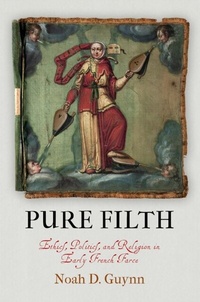
Pure Filth
Ethics, Politics, and Religion in Early French Farce
1st Edition
Published on 11. October 2019
272 pages
978-0-8122-9649-5 (ISBN)
Description

As Noah D. Guynn observes, early French farce has been summarily dismissed as filth for centuries. Renaissance humanists, classical moralists, and Enlightenment philosophes belittled it as an embarrassing reminder of the vulgarity of medieval popular culture. Modern literary critics and theater historians often view it as comedy's poor relation-trite, smutty pap that served to divert the masses and to inure them to lives of subservience. Yet, as Guynn demonstrates in his reexamination of the genre, the superficial crudeness and predictability of farce belie the complexities of its signifying and performance practices and the dynamic, contested nature of its field of reception. Pure Filth focuses on overlooked and occluded content in farce, arguing that apparently coarse jokes conceal finely drawn, and sometimes quite radical, perspectives on ethics, politics, and religion.
Engaging with cultural history, political anthropology, and critical, feminist, and queer theory, Guynn shows that farce does not pander to the rabble in order to cultivate acquiescence or curb dissent. Rather, it uses the tools of comic theater-parody and satire, imitation and exaggeration, cross-dressing and masquerade-to address the urgent issues its spectators faced in their everyday lives: economic inequality and authoritarian rule, social justice and ethical renewal, sacramental devotion and sacerdotal corruption, and heterosocial relations and household politics. Achieving its subtlest effects by employing the lewdest forms of humor, farce reveals that aspirations to purity, whether ethical, political, or religious, are inevitably mired in the very filth they repudiate.
Engaging with cultural history, political anthropology, and critical, feminist, and queer theory, Guynn shows that farce does not pander to the rabble in order to cultivate acquiescence or curb dissent. Rather, it uses the tools of comic theater-parody and satire, imitation and exaggeration, cross-dressing and masquerade-to address the urgent issues its spectators faced in their everyday lives: economic inequality and authoritarian rule, social justice and ethical renewal, sacramental devotion and sacerdotal corruption, and heterosocial relations and household politics. Achieving its subtlest effects by employing the lewdest forms of humor, farce reveals that aspirations to purity, whether ethical, political, or religious, are inevitably mired in the very filth they repudiate.
Reviews / Votes
"[T]his book succeeds in showing farce's historical significance as an engaging ethical form. Noah Guynn makes a major, overdue contribution by giving this repertory its full due. The wit of his writing makes it a peculiarly refreshing tonic during this pandemic year." (Speculum) "Pure Filth is a scholarly yet very readable reappraisal of what farce is as a genre, and of how it is considerably subtler than we often assume. Guynn is commendably fair-minded in his criticism of those he disagrees with. He is scrupulously attentive to avoiding possible pitfalls of decontextualised analysis, whilst acknowledging that the performance history of early farce is always liable to be sketchy. All this makes for an exemplary study in the genre of farce." (H-France) "[T]here is no denying the merits of [Guynn's] project: it is thoughtful and thought-provoking, well grounded in relevant intertexts and critical theory, and groundbreaking in its success at reimagining the 'ludic, interactive, and unpredictable liveness of the festive stage.'" (Renaissance Quarterly) "Pure Filth is an expansive study of early French farce with a great deal to offer anyone interested in the transition from medieval to early modern drama...Rather than downplaying the superficiality, obscenity, and kitsch that characterize farce, Noah Guynn shows how these qualities allow the genre as a whole to imagine 'the possibility of a more ethical and just future precisely by disrupting a conventional language of virtue and vice and by demonstrating the scandalous lack of justice in the present moment.' His argument...is all the more remarkable and worth reading because it troubles along the way any settled boundary between the Middle Ages and postmodernity, theology and theory, compliance and rebellion." (Romantic Review) "[A] brilliant study . . . In Pure Filth, a book that will become a standard reference for people studying farce, Guynn has brought new life and energy to seemingly innocuous plays, showing his readers that the concerns addressed in farce are our concerns, that farceurs were engaged in a serious battle against repressive authority and hegemonic practices." (EuropeNow) "Employing a sensitive multilayered methodology comprised of literary close reading, contemporary theory, examination of material conditions of theater production and performance, and historical contextualization, Pure Filth successfully extracts us from the subversive versus conservative impasse that plagues scholarship on humor." (Lisa Perfetti, Whitman College) "This is a major study of a sizable body of texts that has tended to be marginalized in mainstream literary studies. Using an array of theoretical tools (poststructuralist, anthropological, feminist, and queer), Noah D. Guynn offers a sophisticated and subtle view of works more often perceived as having little literary merit and sometimes rather crudely read through a functionalist lens." (Simon Gaunt, King's College London)More details
Series
Language
English
Place of publication
Pennsylvania
United States
Target group
College/higher education
Illustrations
2 illus.
File size
5,23 MB
ISBN-13
978-0-8122-9649-5 (9780812296495)
Copyright in bibliographic data and cover images is held by Nielsen Book Services Limited or by the publishers or by their respective licensors: all rights reserved.
Schweitzer Classification
Other editions
Additional editions

Book
11/2019
University of Pennsylvania Press
€70.00
Shipment within 10-20 days
Person
Noah D. Guynn is Professor of French and Comparative Literature at the University of California, Davis.
Content
A Note on Sources
Introduction. The Many Faces of Farce
Chapter 1. The Wisdom of Farts: Ethics and Politics, Farce and Festive Comedy
Chapter 2. A Justice to Come: Messianism and Eschatology in Maistre Pierre Pathelin
Chapter 3. Sacraments and Scatology, Faith and Doubt: Andrieu de La Vigne's MystEre de Saint Martin and Its Farces
Chapter 4. Making History: Misbehaved Women, Well-Behaved Women, and the Sexual Politics of Farce
Afterword. Against Protoforms
Notes
Works Cited
Index
Acknowledgments
Introduction. The Many Faces of Farce
Chapter 1. The Wisdom of Farts: Ethics and Politics, Farce and Festive Comedy
Chapter 2. A Justice to Come: Messianism and Eschatology in Maistre Pierre Pathelin
Chapter 3. Sacraments and Scatology, Faith and Doubt: Andrieu de La Vigne's MystEre de Saint Martin and Its Farces
Chapter 4. Making History: Misbehaved Women, Well-Behaved Women, and the Sexual Politics of Farce
Afterword. Against Protoforms
Notes
Works Cited
Index
Acknowledgments
