

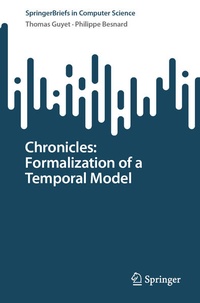
Chronicles: Formalization of a Temporal Model
Description

This book is intended as an introduction to a versatile model for temporal data. It exhibits an original lattice structure on the space of chronicles and proposes new counting approach for multiple occurrences of chronicle occurrences. This book also proposes a new approach for frequent temporal pattern mining using pattern structures. This book was initiated by the work of Ch. Dousson in the 1990's. At that time, the prominent format was Temporal Constraint Networks for which the article by Richter, Meiri and Pearl is seminal.
Chronicles do not conflict with temporal constraint networks, they are closely related. Not only do they share a similar graphical representation, they also have in common a notion of constraints in the timed succession of events. However, chronicles are definitely oriented towards fairly specific tasks in handling temporal data, by making explicit certain aspects of temporal data such as repetitions of an event. The notion of chronicle has been applied both for situation recognition and temporal sequence abstraction. The first challenge benefits from the simple but expressive formalism to specify temporal behavior to match in a temporal sequence. The second challenge aims to abstract a collection of sequences by chronicles with the objective to extract characteristic behaviors.
This book targets researchers and students in computer science (from logic to data science). Engineers who would like to develop algorithms based on temporal models will also find this book useful.
More details
Other editions
Additional editions
Persons
Thomas Guyet is researcher at Inria (Lyon, France). He received a PhD thesis in Computer Science in 2007 from National Polytechnic Institute of Grenoble (France). From 2007 to 2021, he was assistant professor at Institut Agro and was working in the IRISA laboratory in Rennes (France). In 2020, he joined Inria in Lyon as full researcher. His research domain is mainly spatial and temporal data analysis using various computer science paradigms ranging from artificial intelligence domain (logic programming, semantic web, machine learning) to algorithmic (sequential pattern mining, time series analysis). He applies his research mainly to lifescience challenges (medicine, environment and biology)
Content
- Intro
- Preface
- Contents
- List of Symbols
- List of Figures
- 1 Introduction
- 1.1 Why Study Chronicles?
- 1.1.1 Situation Recognition
- 1.1.2 Abstracting Sequences
- 1.2 The Role of a Chronicle and Its Components
- 1.2.1 Injective Mapping from Events in Chronicles to Events in Sequences
- 1.2.2 Consistency and Redundancy of Temporal Constraints
- 1.3 Notions of Temporal Constraints
- 1.3.1 Edge Directions and Negativity of the Temporal Constraints
- 1.3.2 Unlimited Edges vs. Absence of Edges
- 1.3.3 What Is the Meaning of Multiple Temporal Constraints Between Two Events?
- 2 A Formal Account of Chronicles
- 2.1 Preliminary Definitions
- 2.1.1 Event Types and Events
- 2.1.2 Chronicles
- 2.2 Multiset Embeddings
- 2.3 A Preorder Between Chronicles
- 2.4 Chronicles and Subgraph Isomorphisms
- 3 Structuring the Space of Chronicles
- 3.1 Introduction
- 3.2 A Partial Order Between Slim Chronicles
- 3.3 Simple Chronicles
- 3.4 Intersection Between Chronicles
- 3.5 Semilattice Structure for Subspaces of the Chronicles
- 3.6 Summary
- 4 Occurrences of a Chronicle
- 4.1 Introduction
- 4.2 Occurrence of a Chronicle
- 4.3 Counting Occurrences of a Chronicle
- 4.4 Conclusion
- 5 Inducing Chronicles from Event Sequences
- 5.1 Introduction
- 5.2 Generating a Chronicle from a Sequence
- 5.3 Inducing a Chronicle from Event Sequences
- 5.3.1 Dataset of Event Sequences
- 5.3.2 Abstracting a Dataset of Sequences with Chronicles
- 5.3.3 A Dataset Chronicles Reduct
- 5.3.4 Summary
- 5.4 Mining Chronicles from Event Sequences
- 5.4.1 Basic Notions
- 5.4.2 Frequent Chronicles
- 5.4.3 Formal Concept Analysis and Pattern Structures
- 5.4.4 Applying Pattern Structures to Chronicles
- 5.5 Conclusion
- 6 Conclusion
- 6.1 Summary
- 6.2 Perspectives
- A Proofs
- A.1 Proofs for Sect.2.1.2
- A.2 Proofs for Sect.3.2
- A.3 Proofs for Sect.3.3
- A.4 Proofs for Sect.3.5
- A.5 Proofs for Sect.4.2
- A.6 Proofs for Sect.5.2
- A.7 Proofs for Sect.5.3.3
- A.8 Proofs for Sect.5.4.1
- A.9 Proofs for Sect.5.4.4
- B Additional Content
- B.1 Joint Intersection on the Set of Simple Chronicles
- References
- Index
