

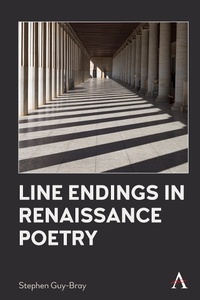
Line Endings in Renaissance Poetry
1st Edition
Published on 11. October 2022
108 pages
978-1-78527-911-9 (ISBN)
Description

This book looks at how Renaissance poets ended their poetic lines. It considers a range of strategies and argues that line endings are crucial to our understanding of the poems. It begins with an introduction summarizing the work that has already been done in this area and demonstrating the author's own method. The main part of the book is divided into three chapters: one on rhyme; one on enjambment; and one on the sestina. These are the most significant kinds of line endings used by English Renaissance poets. The book ends with a brief afterword, wherein the author's findings and some new areas for research are sketched out.
Reviews / Votes
"Stephen Guy-Bray's Line Endings in Renaissance Poetry promises to re-animate discussions of poetic form within English Renaissance studies and beyond. Guy-Bray masterfully details how attention to form can allow readers to tap into complex questions about the aural and visual components of language as it mediates and manipulates access to knowledge, desire and social hierarchy. Written with Guy-Bray's characteristic elegance and wit, this book will be equally useful to undergraduates learning to read poetry, graduate students making their way into professional research and seasoned scholars who could stand to think more about poetry as poetry." -Melissa E. Sanchez, University of Pennsylvania, Pennsylvania. "Elegantly constructed and attractively written, Guy-Bray's book is a brilliant exposition of the aesthetics and significance of Renaissance poetic form." -Neil Rhodes, Professor of English, University St Andrews, Scotland. "Stephen Guy-Bray is one of the finest contemporary critics of English Renaissance poetry currently writing. This is a wonderful book that reminds us vitally that form makes meaning, and that meaning is impossible without form. Guy-Bray's intricate readings of how poetic lines end shed a fascinating light on the fundamental workings of poetry, both in the Renaissance and beyond." -Professor of Early Modern Literature University of Edinburgh, Scotland. "Stephen Guy-Bray has written a delightful book about the line ending in early modern and the most modern of poetry- spry, yet attentive, both generous and mordant in its humour, and sprinkled with sentences and readings of a rare critical power." -Robert Stagg, The Shakespeare Institute / St Anne's College, Oxford. "Guy-Bray's close attention to the line-endings in renaissance poetry is consistently surprising, entertaining and above all enlightening. This study demonstrates how richly rewarding formalist analysis can be when matched with contemporary theoretical concerns, pointing us towards a new queer formalism." -Jim Ellis, Professor of English and Director of the Calgary Institute for the Humanities at the University of Calgary, and the author of The Poem, the Garden, and the World (Northwestern UP, 2023). "Stephen Guy-Bray has written a charming book about line endings, the permeable boundaries of Renaissance poems. Inspired by Agamben's remark that poetry must be graphic, Guy-Bray offers striking analyses of dozens and dozens of poems. A helpful book for any reader of poetry, and for any teacher of Renaissance poetry." -Christopher Warley, Professor, Department of English, University of Toronto, Canada. This is a book that could find its way into classrooms at both graduate and undergraduate levels: it's compact yet wide-ranging, ... Guy-Bray's book testifies to the lasting value and impact of attentive, focused close reading. - Renaissance QuarterlyMore details
Series
Language
English
Place of publication
London
United Kingdom
Target group
Professional and scholarly
US School Grade: College Graduate Student
Edition type
Digital original
File size
0,29 MB
ISBN-13
978-1-78527-911-9 (9781785279119)
Copyright in bibliographic data and cover images is held by Nielsen Book Services Limited or by the publishers or by their respective licensors: all rights reserved.
Schweitzer Classification
Other editions
Additional editions
Stephen Guy-Bray
Line Endings in Renaissance Poetry
Book
10/2022
Anthem Press
€143.50
Shipment within 10-15 days
Person
Stephen Guy-Bray is Professor of English at the University of British Columbia. He specializes in Renaissance poetry, in queer theory, and in poetics.
Content
Acknowledgements; 1. Introduction; 2. Rhyme; 3. Enjambment; 4. Sestina; 5. Forwards; Bibliography; Index
