

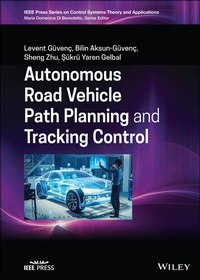
Autonomous Road Vehicle Path Planning and Tracking Control
Description

In Autonomous Road Vehicle Path Planning and Tracking Control, a team of distinguished researchers delivers a practical and insightful exploration of how to design robust path tracking control. The authors include easy to understand concepts that are immediately applicable to the work of practicing control engineers and graduate students working in autonomous driving applications. Controller parameters are presented graphically, and regions of guaranteed performance are simple to visualize and understand.
The book discusses the limits of performance, as well as hardware-in-the-loop simulation and experimental results that are implementable in real-time. Concepts of collision and avoidance are explained within the same framework and a strong focus on the robustness of the introduced tracking controllers is maintained throughout.
In addition to a continuous treatment of complex planning and control in one relevant application, the Autonomous Road Vehicle Path Planning and Tracking Control includes:
* A thorough introduction to path planning and robust path tracking control for autonomous road vehicles, as well as a literature review with key papers and recent developments in the area
* Comprehensive explorations of vehicle, path, and path tracking models, model-in-the-loop simulation models, and hardware-in-the-loop models
* Practical discussions of path generation and path modeling available in current literature
* In-depth examinations of collision free path planning and collision avoidance
Perfect for advanced undergraduate and graduate students with an interest in autonomous vehicles, Autonomous Road Vehicle Path Planning and Tracking Control is also an indispensable reference for practicing engineers working in autonomous driving technologies and the mobility groups and sections of automotive OEMs.
More details
Other editions
Additional editions
Persons
Levent Güvenç, PhD, is Professor in the Department of Mechanical and Aerospace Engineering and the Department of Electrical and Computer Engineering at Ohio State University, USA.
Bilin Aksun-Güvenç, PhD, is Professor in the Department of Mechanical and Aerospace Engineering at Ohio State University, USA.
Sheng Zhu is a Software Engineer on planning and control at DeepRoute.ai with a PhD from the Department of Mechanical and Aerospace Engineering at Ohio State University, USA.
Sükrü Yaren Gelbal is Graduate Research Associate in the Department of Electrical and Computer Engineering at Ohio State University, USA.
Content
Author biographies
Preface
Abbreviations
Chapter 1. Introduction 1
1.1 Motivation and Introduction 1
1.2 History of Automated Driving 4
1.3 ADAS to Autonomous Driving 13
1.4 Autonomous Driving Architectures 14
1.5 Cybersecurity Considerations 15
1.6 Organization and Scope of the Book 16
1.7 Chapter Summary and Concluding Remarks 16
References 16
Chapter 2. Vehicle, Path and Path Tracking Models 21
2.1 Tire Force Model 21
2.1.1 Introduction 21
2.1.2 Tire forces/moments and slip 22
2.1.3 Longitudinal tire force modeling 25
2.1.4 Lateral tire force modeling 28
2.1.5 Self-aligning moment model 30
2.1.6 Coupling of tire forces 32
2.2 Vehicle longitudinal dynamics model 37
2.3 Vehicle Lateral Dynamics Model 41
2.3.1 Geometry of cornering 41
2.3.2 Single track lateral vehicle model 43
2.3.3 Augmented single track lateral vehicle model 47
2.3.4 Linearized single track lateral vehicle model 48
2.4 Path Model 52
2.5 Pure Pursuit: Geometry Based Low Speed Path Tracking 58
2.6 Stanley Method for Path Tracking 59
2.7 Path Tracking in Reverse Driving and Parking 62
2.8 Chapter Summary and Concluding Remarks 63
References 63
Chapter 3. Simulation, Experimentation and Estimation Overview 65
3.1 Introduction to the Simulation Based Development and Evaluation Process 65
3.2 Model-in-the-Loop Simulation 68
3.2.1 Linear and Nonlinear Vehicle Simulation Models 68
3.2.2 Higher Fidelity Vehicle Simulation Models 69
3.3 Virtual Environments Used in Simulation 71
3.3.1 Road Network Creation 71
3.3.2 Driving Environment Construction 73
3.3.3 Capabilities 77
3.4 Hardware-in-the-Loop Simulation 82
3.5 Experimental Vehicle Testbeds 84
3.5.1 Unified Approach 84
3.5.2 Unified AV Functions and Sensors Library 87
3.6 Estimation 88
3.6.1 Estimation of the Effective Tire Radius 88
3.6.2 Slip Slope Method for Road Friction Coefficient Estimation 89
3.6.3 Results and Discussion 92
3.7 Chapter Summary and Concluding Remarks 97
References 97
Chapter 4. Path Description and Generation 100
4.1 Introduction 100
4.2 Discrete Waypoint Representation 100
4.3 Parametric Path Description 103
4.3.1 Clothoids 104
4.3.2 Bezier Curves 107
4.3.3 Polynomial Spline Description 108
4.4 Tracking Error Calculation 113
4.5 Conclusions 114
References 115
Chapter 5. Collision Free Path Planning 117
5.1 Introduction 117
5.2 Elastic Band Method 121
5.2.1 Path Structure 121
5.2.2 Calculation of Forces 121
5.2.3 Reaching Equilibrium Point 124
5.2.4 Selected Scenarios 125
5.2.5 Results 127
5.3 Path Planning with Minimum Curvature Variation 135
5.3.1 Optimization based on G2-quintic Splines Path Description 135
5.3.2 Reduction of Computation Cost using Lookup Tables 138
5.3.3 Geometry-based Collision-free Target Points Generation 142
5.3.4 Simulation Results 145
5.4 Model-based Trajectory Planning 148
5.4.1 Problem Formulation 148
5.4.2 Parameterized Vehicle Control 149
5.4.3 Constrained Optimization on Curvature Control 150
5.4.4 Sampling of the Longitudinal Movements 155
5.4.5 Trajectory Evaluation and Selection 157
5.4.6 Integration of Road Friction Coefficient Estimation for Safety Enhancement 159
5.4.7 Simulation Results in Complex Scenarios 162
5.5 Chapter Summary and Concluding Remarks 169
References 170
Chapter 6. Path Tracking Model Regulation 174
6.1 Introduction 174
6.2 DOB Design and Frequency Response Analysis 175
6.2.1 DOB Derivation and Loop Structure 175
6.2.2 Application Examples 178
6.2.3 Disturbance Rejection Comparison 188
6.3 Q Filter Design 188
6.4 Time Delay Performance 189
6.5 Chapter Summary and Concluding Remarks 193
References 193
Chapter 7. Robust Path Tracking Control 195
7.1 Model Predictive Control for Path Following 196
7.1.1 Formulation of linear adaptive MPC problem 196
7.1.2 Estimation of Lateral Velocity 198
7.1.3 Experimental Results 201
7.2 Design Methodology for Robust Gain-scheduling Law 204
7.2.1 Problem Formulation 204
7.2.2 Design via Optimization in Linear Matrix Inequalities form 205
7.2.3 Parameter-space Gain-scheduling Methodology 207
7.3 Robust Gain-scheduling Application to Path Tracking Control 213
7.3.1 Car Steering Model and Parameter Uncertainty 213
7.3.2 Controller Structure and Design Parameters 215
7.3.3 Application of Parameter-space Gain-scheduling 217
7.3.4 Comparative Study of LMI Design 222
7.3.5 Experimental Results and Discussions 223
7.4 Add-on Vehicle Stability Control for Autonomous Driving 227
7.4.1 Direct Yaw Moment Control Strategies 228
7.4.2 Direct Yaw Moment Distribution via Differential Braking 234
7.4.3 Simulation Results and Discussion 235
7.5 Chapter Summary and Concluding Remarks 238
References 238
Chapter 8. Summary and Conclusions 242
8.1 Summary 242
8.2 Conclusions 244
1
Introduction
This chapter provides an introduction to the whole book. After a section on motivation and introduction, a brief history of automated driving is presented, followed by how Advanced Driver Assistance Systems (ADAS) naturally evolved into autonomous driving functions. Some past and current autonomous driving architectures are presented using examples from the field. A literature review section where the key papers and more recent developments in path planning and robust path-tracking control for autonomous road vehicles, also including the relevant literature on cybersecurity, and how it relates to autonomous vehicle path planning and tracking, are summarized next. This is followed by a section on the scope of the book, briefly detailing what is covered in each chapter. The chapter ends with a brief summary and concluding remarks.
1.1 Motivation and Introduction
The race toward series produced autonomous road vehicles has been rapidly progressing during the last decade. Most automotive OEMs and technology companies had promised or forecasted autonomous driving models by the year 2020, two years before the publication date of this book. This obviously did not take place. While we do not have truly autonomous driving vehicles that the public can currently buy, the currently available lane keeping, adaptive cruise control (ACC), emergency braking systems, traffic jam assistants, and their extended versions in some vehicles allow an almost autonomous highway driving experience under ideal conditions [1]. Autonomous shuttle service has been successfully deployed in a lot of different geofenced areas worldwide [2-4]. Large-scale autonomous taxi service is about to start in several countries in Asia soon, using drive-by-wire vehicles retrofitted with sensors and control systems [5]. Autonomous vehicle races have also been increasing around the world [6]. Autonomous delivery vehicles and autonomous truck platoons are also technologies with many successful, limited-scale deployments [7,8]. Automotive OEMs were planning to introduce autonomous products for the fleet market first, before making them available to the general public. Introduction of autonomous vehicle fleets that can also be used as ride hailed taxis is now expected by the year 2023 even though there may still be delays considering the failed predictions of the recent past. The current technology of traditional and nontraditional automotive OEMs and technology companies like Google's Waymo, and similar ones is sufficiently advanced for nearly full driverless operation in well-mapped environments under ideal conditions. The relatively smaller percentage of nonideal conditions and uncertain environments make it difficult to implement full-scale autonomous driving under arbitrary conditions and environments.
Figure 1.1 Categories of autonomous driving according to SAE.
Autonomous road vehicles have been categorized into six categories by the Society of Automotive Engineers (SAE) as shown in Figure 1.1 [9]. Currently available automated driving technology in series produced vehicles falls under Level 2 which is partial automation. Level 2 partial automation is achieved in series production vehicles with lane-centering control for steering automation and ACC and collision avoidance for automation in the longitudinal direction. L3 partial automation is characterized by all driving actuators being automated and the presence of a driver who can intervene when necessary. Recently introduced autopilot systems for cars are examples of conditional automation where the car takes care of driving in some driving modes like highway driving but the human operator is always in the driver seat to take over control if necessary. The Highway Chauffeur is a Level 3 autonomous highway driving system in which almost all highway driving functions are carried out autonomously, but the driver is needed to take over if something goes wrong or might go wrong like a lane change maneuver [10]. The Highway Chauffeur is currently available technology for series produced vehicles and uses an eHorizon electronic map to take care of driving on the highway until the chosen exit is reached. The Highway Pilot is a Level 4 autonomous driving extension of the Highway Chauffeur [11]. The driver is still in the driver's seat but the vehicle can perform highway driving completely autonomously without the need for driver interaction. Highway Pilots are expected to enter the market after 2022 [12].
In Level 5 driving automation, there is no need for a driver as the vehicle takes care of all driving tasks autonomously. It is clear that SAE Level 4 and Level 5 autonomous vehicles have to be capable of making their own decisions based on situational awareness using perception sensors and decision-making algorithms to satisfy the fixed mission of following the highway between initial and final destination locations. This includes planning their route once the destination point is specified and taking care of path planning, path-tracking control, and collision avoidance maneuvering, if needed, autonomously. This same approach is also needed for the lower speed autonomous driving in urban city environments which is a much more complicated situation due to the many other actors like vulnerable road users being present and more unexpected situations being likely to occur. This book treats path planning, path tracking control, and collision avoidance maneuvering for both urban and highway autonomous driving and also treats pedestrian collision avoidance of autonomous driving in the context of the urban application.
Automated driving shuttles in smart cities that are used for solving the first-mile and last-mile problem are other well-known, emerging examples of autonomous road vehicles [11]. These shuttles operate at relatively lower speeds which definitely improves safety levels while also creating a traffic bottleneck around them. In comparison to limited access highway operation, these shuttles operate in significantly less-structured environments with unpredictable interaction with vulnerable road users such as pedestrians, bicyclists, and scooters. The roads they use involve pedestrian crosswalks, intersections with or without traffic lights, roundabouts, and sharper turns as lower speed of operation is possible. Successful applications of these low-speed autonomous shuttles exist in fixed routes. The whole route needs to be mapped in advance and extra landmarks in the form of signage have to be added in some cases as scan matching of the recorded map is used for localization of these autonomous shuttles. Level 4 like autonomous driving of these shuttles is achieved during the segments of the route without intersections and unexpected interactions with other road users. The safety driver takes over control of the vehicle in intersections and during unexpected events. This is called assisted autonomy and is currently necessary for safe operation. True Level 4 autonomous driving capability of these low-speed urban environment autonomous vehicles is expected to be realized in the near future.
The most fundamental task of an autonomous vehicle is the ability to plan and follow a path while avoiding collisions. Path planning is optimized to make sure that the resulting trajectories have comfortable motion with limited acceleration and jerk. Uncertainties in environmental conditions, vehicle dynamics, vehicle load, and load distribution and the range of required speed from very low speeds for urban driving to highway driving speeds require the path tracking and collision mitigation controls to be robust. The motivation of this book is to contribute to this very important area of autonomous driving by presenting recent research results in path planning and robust path-tracking control. Robustness is achieved through two different approaches. The first one is regulation of the path following dynamic model to reject the uncertainties and disturbances and to handle the variable time delays that are present. The second approach is to use a robust feedforward and feedback controller combination to achieve guaranteed performance. The presence of static or moving obstacles such as other cars, pedestrians, and bicyclists is also treated by presenting methods for modifying the path to avoid such collisions in realistic applications. The methods presented in the book are applicable in real life, having been tested in a realistic hardware-in-the-loop simulation environment and in road testing with a research-level autonomous vehicle in addition to the usual model-in-the-loop simulations.
1.2 History of Automated Driving
Contrary to popular belief, the origins of autonomous driving and automated vehicles go back all the way to the 1920s. Radio-controlled cars were the novelty in the 1920s while 1960s and 1970s saw the emergence of cable-controlled cars, actually and unknowingly taking a step backwards. Computer-controlled cars resembling today's autonomous vehicles started emerging in a very rough form in the 1980s and 1990s. In the first driverless car experiments of the 1920s, an antenna was mounted on the car which was driven by an external operator using radio signals, much like radio-controlled toys. It should be noted that this remote operation forms the basis of some current driverless vehicles being...
