

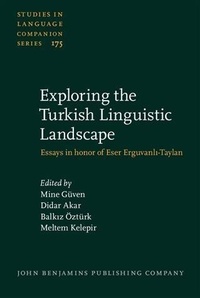
Exploring the Turkish Linguistic Landscape
Essays in honor of Eser Erguvanli-Taylan
1st Edition
Published on 14. June 2016
220 pages
978-90-272-6696-5 (ISBN)
Description

Exploring the Turkish Linguistic Landscape provides in-depth analyses of different aspects of Turkish in the domains of phonology, morphology and syntax, discourse and language acquisition relevant to recent theoretical discussions. While some of the papers in the volume offer new analyses to known linguistic puzzles, others raise new questions which have not been addressed in the literature before. This collection of original articles written by colleagues and students of Prof. Eser Erguvanli-Taylan, honoring her contribution to the field of linguistics, features articles on vowel reduction, consonant clusters, negation, conditionals, voice morphology, evidentiality, acquisition of irregular morphology, complementation and subordination in varieties of Turkish. It will be of interest to a wide audience ranging from theoreticians to typologists and is expected to generate further research on Turkish, as well as to contribute to the cross-linguistic literature on the issues addressed in the volume.
More details
Other editions
Additional editions
Mine Gueven | Didar Akar | Balkiz OEztuerk
Exploring the Turkish Linguistic Landscape
Essays in honor of Eser Erguvanli-Taylan
Book
06/2016
John Benjamins Publishing Co
€119.20
Shipment within 10-15 days
Content
- Intro
- Exploring the Turkish Linguistic Landscape
- Editorial page
- Title page
- LCC data
- image of Eser Erguvanlı-Taylan
- Table of contents
- List of contributors
- Eser E. Erguvanlı-Taylan
- Prof. Eser Erguvanlı-Taylan's Publications
- Books
- Book chapters
- Journal Articles
- Papers in Proceedings
- Vowel epenthesis in the acquisition of English /s/-clusters by Turkish speakers
- 1. Introduction
- 1.1 /s/ clusters
- 2. Turkish
- 3. Research questions
- 4. The study
- 4.1 Participants
- 4.2 Procedure
- 4.2 Analysis
- 5. Results
- 6. Conclusions
- References
- Appendix
- Is there phonological vowel reduction in Turkish?
- 1. Introduction
- 2. The Turkish facts
- 3. Vowel reduction and Government Phonology
- 4. Vural's analysis and the problem of correct derivation
- 5. A syntactic fault line
- 6. Conclusions
- References
- A note on the compatibility of reflexive and causative in the Turkish verb*
- References
- Negative or not - the Case of -(y)AlI beri in Turkish
- 1. Introduction
- 2. Data
- 3. Previous analysis
- 4. Licensing conditions
- 4.1 Inception versus duration
- 4.2 Verb semantics
- 4.2.1 Deictic motion verbs
- 4.2.2 Verbs of inception
- 5. Conclusion
- Acknowledgment
- Reference
- Greek and Turkish Influences in the Clausal Complements of Cunda Turkish
- 1. Introduction
- 1.1 Cunda and Cunda Cretans
- 1.2 Data
- 2. Complementation in CT
- 2.1 Non-finite complement clauses
- 2.2 Finite complement clauses
- 2.3 Preliminary analysis
- 3. Mood and complementation patterns in Greek and Turkish
- 3.1 Turkish
- 3.2 Cretan Greek
- 4. CT: Sorting out the Greek and Turkish elements
- 5. Conclusions
- Acknowledgements
- References
- Clause combining in Turkish as a minority language in Germany*
- 1. Preliminary considerations
- 1.1 Register
- 1.2 Conceptual orality and literacy
- 1.3 Orate-literate in Turkish
- 2. Necdet's texts
- 3. Alternative strategies in clause combining and the orate-literate distinction in Turkish
- 4. Turkish in Germany: Overview
- 5. Clause combining in Turkish in Germany and the Netherlands
- 6. An interim conclusion: Frequency shift and the orate-literate continuum
- 7. A case study: Causal clauses with çünkü
- Anchor 124
- 8. Conclusion
- Abbreviations
- Reference
- Thinking for speaking and the construction of evidentiality in language contact
- 1. Contact-induced change
- 2. Thinking for speaking
- 3. Evidentiality
- 4. Language contact in the Balkans and Anatolia
- 5. Language contact in the Andes
- 6. Recruitment of Perfect tenses to mark nonwitnessed evidentiality
- 7. Sociolinguistic factors in language contact
- 8. Conclusion
- References
- Conditionals in Turkish
- 1. Introduction
- 2. Turkish conditionals in the literature
- 3. Theoretical background: Declerck and Reed's (2001) 'Conditional Approach'
- 4. Database and the analytical framework
- 5. Findings and discussion
- 5. Conclusion
- References
- List of the novels in the database
- The interface of evidentials and epistemics in Turkish
- 1. Evidentiality and some controversies
- 2. Interface of evidentials and epistemics in Turkish: -mIs/-(y)mIs and -DIr
- 3. Relations between evidentials and epistemics: Evidence from acquisition
- 3.1 -mIs/-(y)mIs as a marker of new information and perspective of the self: Mirative function
- 3.2 -mIs/(y)mIs as a marker of mediated information and perspective of the other: Reportative function
- 3.3 -DIr as a marker of uncertainty: Epistemic speculation
- 3.4 -DIr as a marker of certainty: Generic function
- 3.5 Evidential and epistemic contrasts in summary
- 4. Conclusion
- Reference
- Acquisition of morphophonemic alternations and the role of frequency
- 1. Introduction
- 2. The issue
- 3. Design and method
- 3.1 Participants
- 3.2 Test Items
- 3.3 Procedure
- 4. Results
- 4.1 Errors in detail
- 5. Type/ token frequency and alternation rates of the stems ending in voiceless plosives
- 5.1 [k]-ending types and velar deletion
- 5.2 [p]-ending types and tokens I
- 5.3 [t]-ending types and tokens
- 5.4 [t?]-ending types and tokens
- 6. Discussion
- 8. Conclusion
- References
- Different paces (but not different paths) in language acquisition
- 1. Iregular alternations
- 2. Acquisition of irregularity
- 3. Twins vs. singletons
- 4. Challenges for twins
- 5. Method
- 6. Results
- 7. Possible implications
- References
- Index
