

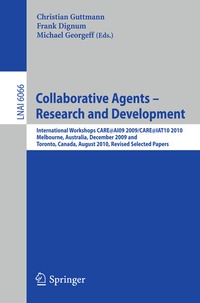
Collaborative Agents - Research and Development
International Workshops, CARE@AI09 2009 / CARE@IAT10 2010Melbourne, Australia, December 1, 2009Toronto, Canada, August 31, 2010Revised Selected Papers
Published on 5. July 2011
VIII, 187 pages
978-3-642-22427-0 (ISBN)
Description

This book constitutes the thoroughly refereed post-conference
proceedings of the first two international workshops on computational
models of collaboration in distributed systems: CARE 2009, held as
satellite event of the 22nd Australasian Joint Conference on Artificial
Intelligence AI09 in Melbourne, Australia, in December 2009 and CARE
2010, held in conjunction with the International Conference on
Intelligent Agent Technology (IAT) in Toronto, Canada, in August 2010.
The 12 revised full papers presented together with 2 invited lectures
were carefully selected from a total of 45 submissions to both events.
The workshops' thematic focus is on collaborative and autonomous agents
that plan, negotiate, coordinate, and act under conditions of incomplete
information, uncertainty, and bounded rationality.
More details
Other editions
Additional editions

Christian Guttmann | Frank Dignum | Michael Georgeff
Collaborative Agents - Research and Development
International Workshops, CARE@AI09 2009 / CARE@IAT10 2010Melbourne, Australia, December 1, 2009Toronto, Canada, August 31, 2010Revised Selected Papers
Book
07/2011
1st Edition
Springer
€53.49
Shipment within 5-7 days
Content
- Title
- Preface
- Organization
- Table of Contents
- Multi-agent Coalition Formation for Distributed Area Coverage
- Introduction
- Preliminary Definitions
- System Modeling and Algorithm Design
- Single Robot Coverage Capability
- Best Coalition Formation
- Algorithm Analysis of Finding the BMWC
- Adaptive Flocking Teams with WVGs
- Team Shape Maintenance
- WVGs for Team (Re)formations
- Experiment and Evaluation
- Future Work
- References
- Modeling Warehouse Logistics Using Agent Organizations
- Introduction
- Warehouse Logistics
- Hierarchy of Hardware Components
- Planning, Scheduling and Plant Layer
- Factors of Complexity
- Prototype Simulation
- Modeling Components
- What Should Be Considered an Agent?
- How to Model an Multi-agent System?
- Agent Organizations
- An Organizational Model for Scheduling
- An Organizational Model for Planning
- Related Work
- Conclusion
- References
- Agent-Based Crisis Management
- Introduction
- Organisations
- Structural Evaluation
- Organisational Simulation
- Simulation Scenario
- The Model
- Experimental Scenarios
- Results
- Conclusions and Future Work
- References
- Male Optimal and Unique Stable Marriages with Partially Ordered Preferences
- Introduction
- Background
- Stable Marriage Problems
- Gale-Shapley Algorithm
- Stable Marriage Problems with Partial Orders
- Finding Male Optimal Weakly Stable Marriages
- On the Uniqueness of Weakly Stable Marriage in SMPs
- Related Work
- Conclusions
- References
- Agent-Based Simulation of Joint Fire Support Teams - Collaboration in Network-Centric Warfare Scenarios
- Introduction
- Modeling Joint Fire Support Teams
- Aims of the Model
- Macro-Level: Time and Environment
- Micro-Level: Objects and Agents
- Coordination and Information Exchange
- Results and Experiences
- Results
- Experiences
- Conclusion and Outlook
- Conclusion
- Outlook
- References
- Intelligent Collaborative Care Management (ICCM): Achieving and Managing Contractual Relationships and Service Delivery
- Introduction
- Basic Model of Customer Care
- Coordination Level Specification: Sharing Domain Properties
- Task Level Specification: Domain Processes and Information
- Implementation Level: Three Stages for a Basic Model of Customer Care
- Uncertainty, Incompleteness and Bounded Resources: Understanding the Need for Adherence and Variation Support
- Problem Description
- Human Participants and Mental Attitudes
- An Extended Model of Collaborative Care
- Contractual Commitment
- Service Delivery
- Concluding Remarks
- Reference
- A Centralized Framework to Multi-robots Formation Control: Theory and Application
- Introduction
- Nomenclature Adapted
- Isogonic Formation: The Methodology
- Formation Preservation during the Rotation
- Computing Isogonic Position Information during the Rotation
- Connectivity Preservation
- Simulation Result
- Conclusion
- References
- Flexible Behaviour Regulation in Agent Based Systems
- Introduction
- Motivations, Organisations, Norms and Trust
- Organisations
- Norms
- Norm Enforcement
- Norm Emergence
- Norm Processing
- Trust
- Case Studies
- Electronic Contracting
- ePCRN
- Conclusions
- References
- Effect of Network Topology in Opinion Formation Models
- Introduction
- Model Formulation and Extensions
- Results
- Topology Before and After the Opinion Formation Process
- Erdos-Rényi (ER) Network versus Small World (SW) Network
- Effect of Initial Opinion Distribution
- Discussion
- References
- Behavior Learning in Minority Games
- Introduction
- Learning in the Minority Games
- Strategies of Agents
- Decision Tree Learning
- Learning with Fixed Strategies
- Adaptive Learning
- Learning Collective Behaviors
- Fitness Function of MG
- Evolutionary Experiments
- Conclusions
- References
- Two Decades of Multiagent Teamwork Research: Past, Present, and Future
- Introduction
- The Past: BDI
- DCOPs
- Background
- k-OPT and t-OPT: Algorithms and Results
- DCEE: Algorithms and the Team Uncertainty Penalty
- DEC-POMDPs
- Background
- Scaling-Up DEC-POMDPs
- Execution-Time Reasoning in DEC-POMDPs
- Conclusion
- References
- Designing Intelligent Healthcare Operations
- Introduction
- Challenges
- Stakeholders and Objectives
- Technology
- Creating Value from Knowledge
- Tools and Techniques of KM
- The Role of Multi Agent Systems
- The Intelligence Continuum
- Returning to the Orthopaedic Operating Room
- Summary
- References
- Collaborative Learning in Uncertain Environments
- Introduction
- Literature Review
- Research Questions
- Model and Simulation
- Scenario Set
- Agents(A)
- Dispatcher (P)
- Collaborative Network (N)
- Simulation Process and Experiment Parameters
- Experiment Setup
- Results
- Conclusion
- References
- Improving Task-Based Plan Coordination
- Introduction
- Two Multi-agent Planning Problems
- Multi-agent System Model
- Coordination Checking for Intra-free Coordination Instances
- An Approximation Algorithm for Finding Coordination Sets
- Finding a Better Algorithm for Intra-free Instances
- Discussion and Conclusions
- References
- Author Index
