

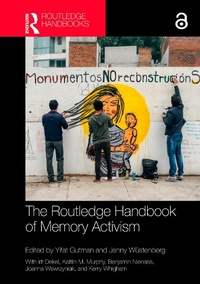
The Routledge Handbook of Memory Activism
1st Edition
Published on 15. February 2023
598 pages
978-1-000-64617-7 (ISBN)
Description

This Handbook is the first systematic effort to map the fast-growing phenomenon of memory activism and to delineate a new field of research that lies at the intersection of memory and social movement studies.
From Charlottesville to Cape Town, from Santiago to Sydney, we have recently witnessed protesters demanding that symbols of racist or colonial pasts be dismantled and that we talk about histories that have long been silenced. But such events are only the most visible instances of grassroots efforts to influence the meaning of the past in the present. Made up of more than 80 chapters that encapsulate the rich diversity of scholarship and practice of memory activism by assembling different disciplinary traditions, methodological approaches, and empirical evidence from across the globe, this Handbook establishes important questions and their theoretical implications arising from the social, political, and economic reality of memory activism.
Memory activism is multifaceted, takes place in a variety of settings, and has diverse outcomes - but it is always crucial to understanding the constitution and transformation of our societies, past and present. This volume will serve as a guide and establish new analytic frameworks for scholars, students, policymakers, journalists, and activists alike.
From Charlottesville to Cape Town, from Santiago to Sydney, we have recently witnessed protesters demanding that symbols of racist or colonial pasts be dismantled and that we talk about histories that have long been silenced. But such events are only the most visible instances of grassroots efforts to influence the meaning of the past in the present. Made up of more than 80 chapters that encapsulate the rich diversity of scholarship and practice of memory activism by assembling different disciplinary traditions, methodological approaches, and empirical evidence from across the globe, this Handbook establishes important questions and their theoretical implications arising from the social, political, and economic reality of memory activism.
Memory activism is multifaceted, takes place in a variety of settings, and has diverse outcomes - but it is always crucial to understanding the constitution and transformation of our societies, past and present. This volume will serve as a guide and establish new analytic frameworks for scholars, students, policymakers, journalists, and activists alike.
Reviews / Votes
"More than a roadmap to memory activism or an account of its revitalizing effects on Memory Studies, this Handbook offers an illuminating set of reflections on the import and reach of activist memory projects across the globe and across the political spectrum. Here, scholars and activists alike will find essential examples, caveats, provocative questions, and forms of inspiration for the work ahead."Marianne Hirsch, Columbia University, USA
"Key issues and debates in the field of memory studies are presented here from a pioneering vantage point - that of memory activism. The experiences and dilemmas covered in this Handbook come from across the globe and offer multiple mirrors in which to reflect on and enrich one's own findings and perspectives. A must for researchers, practitioners, and activists!"
Elizabeth Jelin, Centro de Investigaciones Sociales (IDES-CONICET), Argentina
"Late to develop, the attention to memory is quickly spreading in social movement studies. This Handbook of Memory Activism offers a most relevant contribution on how mnemonic and political changes are connected, and on the arenas, the actors, and the places of memory practices 'in action'. It comprehensively demonstrates how memories of past struggles affect contentious politics and democratic developments more broadly."
Donatella della Porta, Scuola Normale Superiore, Italy
"[The handbook identifies] the new 'turns' and provide[s] a wealth of approaches to the study of memory in IR, playing an important role in shaping the field. [It is] a very useful resource to anyone new to the study of memory in IR."
International Affairs, 99:6 2023, Dovile Budryte, Georgia Gwinnett College, USA and Vilnius University, Lithuania
More details
Series
Edition
1. Auflage
Language
English
Place of publication
London
United Kingdom
Publishing group
Taylor & Francis Ltd
Target group
College/higher education
Professional and scholarly
Illustrations
46 Halftones, black and white; 46 Illustrations, black and white
ISBN-13
978-1-000-64617-7 (9781000646177)
Copyright in bibliographic data and cover images is held by Nielsen Book Services Limited or by the publishers or by their respective licensors: all rights reserved.
Schweitzer Classification
Other editions
Additional editions
Yifat Gutman | Jenny Wuestenberg
The Routledge Handbook of Memory Activism
Book
08/2024
1st Edition
Routledge
€71.80
Shipment within 15-20 days
Yifat Gutman | Jenny Wuestenberg
The Routledge Handbook of Memory Activism
Book
02/2023
1st Edition
Routledge
€289.90
Shipment within 15-20 days
Persons
Yifat Gutman is a Senior Lecturer in the Department of Sociology and Anthropology at Ben-Gurion University of the Negev. She holds a PhD in Sociology from the New School for Social Research in New York (2012). Her research focuses on memory activism and political change in and after ethnonational conflict.
Jenny Wuestenberg is Professor of History and Memory Studies and the Director of the Centre for Public History, Heritage and Memory at Nottingham Trent University. She is Co-Founder and Co-President (2016-2022) of the Memory Studies Association, as well as the Chair of the COST Action CA20105 on Slow Memory (2021-2025).
Jenny Wuestenberg is Professor of History and Memory Studies and the Director of the Centre for Public History, Heritage and Memory at Nottingham Trent University. She is Co-Founder and Co-President (2016-2022) of the Memory Studies Association, as well as the Chair of the COST Action CA20105 on Slow Memory (2021-2025).
Content
Foreword. Introduction: The Activist Turn in Memory Studies Part 1: Debates Introduction: Contentions over Memory Activism. 1. Mobilizing Materialities: The Making and Breaking of Monuments 2. Populism and the Collective Past: Revisionism or Memory Activism? 3. Unlocked Memory Activism: Has Social Distancing Changed Commemoration? 4. Memory vs. History: The Politics of Temporality 5. Regimes of Temporality 6. Memory Activism in History 7. Transnational Memory Activism and Performative Nationalism 8. Intersectionality and Memory Activism 9. Activist Voices: What Is at Stake - A Short Manifesto for Activist Memory Studies Part 2: Actors and Agency Introduction: Agent, Structure and Subjectivity. 10. Implicated Subjects 11. Extreme Right 12. Communities 13. Coalitions 14. Scholars 15. Conservatives 16. Border-Crossers 17. Ghosts 18. Anti-Neoliberals 19. Activist Voices: Post Heroes 20. Activist Voices: Museum Entrepreneurs Part 3: Institutions and Institutionalization Introduction: Definitions and Contestations. 21. Administration 22. Law 23. States 24. Political Parties 25. International Organizations 26. Redress Economies 27. Activist Voices: Education - Interview with Tanja Vaitulevich 28. Class 29. Family 30. Religion 31. Slavery 32. Empire 33. Colonialism 34. Museums Part 4: Spaces Introduction: Constructing Spaces of Memory Activism. 35. Migrant Spaces 36. Urban Spaces 37. Queer Spaces 38. (De)Colonial Spaces 39. Post-Conflict and Mid-Conflict Spaces 40. Deindustrialized Spaces 41. Sacred Spaces 42. Indigenous Spaces 43. Mediated Spaces 44. Clandestine Spaces 45. Activist Voices: Singing Spaces - Interview with Rana Sulaiman 46. Post-Soviet Spaces 47. Latin America 48. North America 49. The Arctic 50. Africa 51. Middle East and North Africa 52. South East Asia 53. East Asia 54. Oceania 55. East-Central Europe 56. Post-German Spaces Part 5: Sites and Practices Introduction: Memory Activism as Embodied Practice. 57. Memory Sites 58. Mapping Memory 59. Activist Voices: Nomadic Monuments - Interview with Aida Sehovic 60. Museums and "Curatorial Activism" 61. Tours and Tourism 62. Performance 63. Reenactment 64. Activist Voices: The 1965 Events in Indonesia 65. #memoryactivism and Online Commemoration 66. Digital Campaigns, Forums, and Archives 67. Literary Memory Activism 68. Anniversaries and National Holidays 69. Activist Voices: Art 70. Exhumations Part 6: Normative Dilemmas Introduction: Democratizing the Past? 71. Memory and Illiberalism 72. Memory, Pluralism and White Supremacy 73. Memory Activism and the Global Production of Knowledge 74. Between Conflict and Consensus 75. Between Ownership and Appropriation 76. Between Agency and Suspension 77. Activist Voices: From Civil Revolt to Established Institutions 78. Activist Voices: Memory Activism with and Against the State - Interview with Sergio Beltran-Garcia
