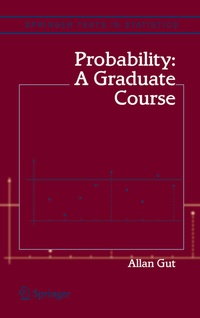
Probability: A Graduate Course
Description

"I know it's trivial, but I have forgotten why". This is a slightly exaggerated characterization of the unfortunate attitude of many mathematicians toward the surrounding world. The point of departure of this book is the opposite.
This textbook on the theory of probability is aimed at graduate students, with the ideology that rather than being a purely mathematical discipline, probability theory is an intimate companion of statistics. The book starts with the basic tools, and goes on to chapters on inequalities, characteristic functions, convergence, followed by the three main subjects, the law of large numbers, the central limit theorem, and the law of the iterated logarithm. After a discussion of generalizations and extensions, the book concludes with an extensive chapter on martingales.
The main feature of this book is the combination of rigor and detail. Instead of being sketchy and leaving lots of technicalities to be filled in by the reader or as easy exercises, a more solid foundation is obtained by providing more of those not so trivial matters and by integrating some of those not so simple exercises and problems into the body of text.
Some results have been given more than one proof in order to illustrate the pros and cons of different approaches. On occasion we invite the reader to minor extensions, for which the proofs reduce to minor modifications of existing ones, with the aim of creating an atmosphere of a dialogue with the reader (instead of the more typical monologue), in order to put the reader in the position to approach any other text for which a solid probabilistic foundation is necessary.
Allan Gut is a professor of Mathematical Statistics at Uppsala University, Uppsala, Sweden. He is the author of the Springer monograph "Stopped Random Walks" (1988), the Springer textbook "An Intermediate Course in Probability" (1995), and has published around 60 articles in probability theory. His interest in attracting amore general audience to the beautiful world of probability has been manifested in his Swedish popular science book Sant eller Sannolikt ("True or Probable"), Norstedts förlag (2002).
From the reviews:
"This is more substantial than the usual graduate course in probability; it contains many useful and interesting details that previously were scattered around the literature and gives clear evidence that the writer has a great deal of experience in the area."
Short Book Reviews of the International Statistical Institute, December 2005
"...This book is a readable, comprehensive, and up-to-date introductory textbook to probability theory with emphasis on limit theorems for sums and extremes of random variables. The purchase is worth its price."
Journal of the American Statistical Association, June 2006
Reviews / Votes
From the reviews:
"It is an excellent text. It is written in a beautiful style, with proper emphasis on the topics necessary for students to be successful in dealing with probability at the highest level." James Kuelbs, University of Wisconsin.
"This is more substantial than the usual graduate course in probability; it contains many useful and interesting details that previously were scattered around the literature and gives clear evidence that the writer has a great deal of experience in the area." Short Book Reviews of the International Statistical Institute, December 2005
"...This book is a readable, comprehensive, and up-to-date introductory textbook to probability theory with emphasis on limit theorems for sums and extremes of random variables. The purchase is worth its price." Journal of the American Statistical Association, June 2006
"Allan Gut is a probabilist specializing in limit theorems. . One judges a book both by content-selection of material-and by how well this material is expounded. I think that the book stands up well on both counts. I suspect that Gut's real motivation in writing it was his love of the material, and enthusiasm for writing about it. The book forms a valuable and worthy addition to the literature, in my opinion." (N. H. Bingham, Journal of the Royal Statistical Society, Series A: Statistics in Society, Vol. 169 (1), 2006)
"The book is nicely written and contains numerous examples and exercises. The author shows many applications, mostly to random walks, extremes, and statistics. The book is valuable for detailed but concise and well readable treatment of the main topics . ." (Dalibor Volný, Mathematical Reviews, Issue 2006 a)
"The book under review is an excellent addition to the literature. It contains material that every graduate student ought to know, which is presented in a user friendly style. . There are more than 250 references. which the readers will find to be useful. There are enough examples and exercises. Motivations are amply provided throughout and are illuminating. It is a pleasure to read the book and, in the opinion of the reviewer, every graduate student of probability would find it so." (B. V. Rao, Sankhya, Vol. 68 (2), 2006)
More details
Other editions
Additional editions