

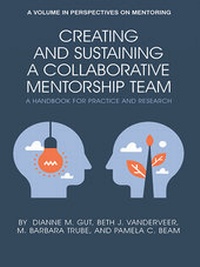
Creating and Sustaining a Collaborative Mentorship Team
A Handbook for Practice and Research
1st Edition
Published on 9. January 2020
105 pages
978-1-64802-102-2 (ISBN)
Description

In response to changes in the workforce, scholars are calling for mentoring that is more fluid, flexible, and responsive to the needs of diverse groups of individuals, whether culturally (Kochan & Pascarelli, 2012; Kochan, Searby, George, & Mitchell Edge, 2015) or intergenerationally (Thorpe, 2012) diverse. With these changes, there are greater demands for intergenerational and intercultural collaboration and mentoring. One response to these changes is to take a more collaborative, interactive, and transformational approach to mentoring. In response, this book provides a model for collaborative mentoring, based on best-practice, grounded in theory and research, and framed by the Dynamic Model of Collaborative Mentorship. Each chapter provides a description of one of the five components of the mentoring model which are grounded in theory and include: agency, values, engagement, patterns, and roles. Individual chapters provide resources, prompts and questions to guide reflection, and suggested readings.
This book is authored by four individuals who work, research, and write as a team. The book itself is the product of their mentoring research as well as their mentoring practice in action. It is current and timely, focusing on team processes which are collaborative, dynamic, reflective, and continuously developing and evolving.
This book is authored by four individuals who work, research, and write as a team. The book itself is the product of their mentoring research as well as their mentoring practice in action. It is current and timely, focusing on team processes which are collaborative, dynamic, reflective, and continuously developing and evolving.
All prices
More details
Other editions
Additional editions
Dianne M. Gut | Beth J. VanDerveer | M. Barbara Trube
Creating and Sustaining a Collaborative Mentorship Team
A Handbook for Practice and Research
Book
09/2020
Information Age Publishing
€55.30
Shipment within 3-4 weeks
Dianne M. Gut | Beth J. VanDerveer | M. Barbara Trube
Creating and Sustaining a Collaborative Mentorship Team
A Handbook for Practice and Research
Book
09/2020
Information Age Publishing
€105.30
Shipment within 3-4 weeks
Content
- Front Cover
- Creating and Sustaining a Collaborative Mentorship Team
- A Handbook for Practice and Research
- A Volume in Perspectives on Mentoring
- Series Editor:
- Fran Kochan, Auburn University
- CONTENTS
- 1. Introducing the Dynamic Model of Collaborative Mentorship: A Story from Initiation to Continuous Collaboration 1
- 2. Agencies 13
- 3. Values 25
- 4. Engagements 37
- 5. Patterns 51
- 6. Roles 61
- 7. Implementation 71
- Perspectives on Mentoring
- Creating and Sustaining a Collaborative Mentorship Team
- A Handbook for Practice and Research
- By
- Dianne M. Gut, Ohio University Beth J. VanDerveer, Ohio University M. Barbara Trube, Walden University Pamela C. Beam, Ohio University
- Information Age Publishing, Inc. Charlotte, North Carolina www.infoagepub.com
- CHAPTER 1
- Introducing the Dynamic Model of Collaborative Mentorship
- A Story from Initiation to Continuous Collaboration
- Context
- Initiating the Mentorship
- Mentoring Functions
- Discovering Mutuality
- Expanding Networks
- Building Community
- Community of Learning
- Relational Qualities
- Transformational Practice
- Reflective Practice
- The Study
- Review of the Literature
- Conceptual Framework
- Methodology
- FINDINGS OF THE STUDY
- OUTCOMES OF THE STUDY
- CONSTRUCTING A DMCM
- Figure 1.1. The dynamic model of collaborative mentorship.
- AGENCIES
- Values
- ENGAGEMENTS
- Patterns
- Roles
- Implementation
- Continuous Collaboration
- CHAPTER 2
- Agencies
- Figure 2.1. Agencies portion of the DMCM.
- AGENCY DEFINED
- CONCEPTUAL UNDERPINNINGS OF AGENCY IN THE DMCM
- Developmental Team Building
- Relational Agency
- Cultural Competence
- AGENCIES AS A COMPONENT OF THE DYNAMIC MODEL OF COLLABORATIVE MENTORING
- ENACTMENT OF AGENCIES
- Evaluating Your Work Habits and Preferences
- 1. Are you most productive when you work alone? With one other person? With a team of people? Does it depend on the project/ assignment? Why?
- 2. What types of leaders/leadership style(s) do you respond well to? What strategies do you have that will help you work with leaders who do not possess your preferred style(s)?
- 3. What communication strategies are you most comfortable with? What is your preferred strategy (email, face to face, through an online chat or project management software/framework) for communicating in the workplace?
- 4. When do you feel you are most productive (early morning, midmorning, afternoon, evening, late night) related to work assignments?
- 5. When planning your workday, how do you typically plan/structure your tasks?
- 6. What kind of working environment(s) do you find best support your productivity (e.g., silence, some ambient noise, noisy or actively busy)?
- 7. How will your work style/pattern be enhanced or hindered when working with your team? What changes will you need to make to ensure your team's success?
- Determining Your Work Style
- 1. What is most important to me when working with others?
- 2. What do I enjoy most about working on a job-related task?
- 3. When there are several options for completing a task, how do I usually decide how to proceed?
- 4. How do I approach a task that is long term?
- 5. How do I feel about taking risks in the workplace?
- 6. Which of the following characteristics apply to me: accommodating, competitive, tolerant, critical, insecure, punctual, absent- minded, open-minded, loyal, focused, eager to learn, meticulous, energetic, moody, self-reliant, take-charge, big-pictu...
- Evaluating Yourself as a Team Member
- Building Communication Skills
- Developing Leadership Skills
- Developing Listening Skills
- Being a Good Team Member
- Managing Time Wisely
- Getting to Know Team Members
- Setting SMART Goals
- Creating Action Plans
- Setting Timetables/Benchmarks
- Solving Problems
- Disagreeing Without Being Disagreeable
- Related Resources
- CHAPTER 3
- Values
- Figure 3.1. Values portion of the DMCM.
- Values Defined
- CONCEPTUAL UNDERPINNINGS OF VALUES IN THE DMCM
- Appreciative Inquiry
- Mindful Mentoring
- Strengths-Based Approaches
- VALUES AS A COMPONENT OF THE DMCM
- ENACTMENT OF VALUES
- Values and Daily Events
- Check Your Motivations
- Pay Attention
- Live in the Moment
- Accept Yourself
- Be Mindful
- Values of Goals and Outcomes-Discussion Guide
- 1. When and under what circumstances did you get together?
- 2. When you got together, what was discussed (list topics)?
- 3. What are you working on right now?
- 4. What is your progress to date in achieving the group's goals and outcomes?
- 1. What is going particularly well in your group relationships right now?
- 2. What has been the greatest challenge in your group relationship thus far?
- 3. What needs to be done to improve the group relationships?
- 4. What support would be helpful?
- 5. Learning
- 6. What are we learning about ourselves? The group? The relationships?
- 7. What has the group learned?
- 8. What are some of the conditions that promote that learning?
- 9. What are some personal insights? Hunches? Things to look for?
- Share Value Stories
- AI Exercise
- Trust Activity
- Related Resources
- CHAPTER 4
- ENGAGEMENTS
- Figure 4.1. Engagements portion of the DMCM.
- Engagement Defined
- Types of Engagement
- Personal-Role Engagement
- Self-Engagement
- Team Engagement
- Strategies for Engagement
- 1. At the onset of the collaborative mentorship, schedule time for group learning so individuals bond with others, establish relationships and friendships, and develop a spirit of camaraderie, making it possible for individuals to connect with others...
- 2. Set individual and team goals, monitor progress toward goal achievement for individuals and team members, and acknowledge successes of individuals and team members as progress is made toward goal attainment and at goal achievement
- 3. Provide ongoing development opportunities through professional learning and mentoring networks that support individual team members as autonomous and engaged in advancing in their own professional roles
- and
- 4. Support collaboration, creative exploration, and team-member sharing of new or novel ideas in safe spaces built on respect, trust, and honesty to strengthen team cohesion through reciprocal mentoring.
- 5. Advocate for team and individual growth of colleagues by challenging each other to think outside the box, move out of comfort zones, exercise intellectual flexibility, and stretch in order to create original ideas and make unique contributions to ...
- CONCEPTUAL UNDERPINNINGS FOR ENGAGEMENT
- Education Diplomacy
- Emotional Intelligence
- Enactment of Engagement
- Use the Internet: The ISA Engagement Scale
- Find Your Team MAGIC
- Create an A-PLUS Team
- Climate of Engagement Plan
- Related Resources
- CHAPTER 5
- Patterns
- Figure 5.1. Patterns portion of the DMCM.
- PATTERNS DEFINED
- Communication Patterns
- Team Patterns
- CONCEPTUAL Underpinnings of Patterns in the DMCM
- Habits of Mind
- Community of Practice (CoP)
- PATTERNS AS A COMPONENT OF THE DMCM
- Enactment of Patterns
- Questions for Myers Building Habits of Mind
- Questions for Developing a Plan of Action for the Community of Practice
- Working as a Team Member
- Collaborative Teamwork Patterns
- CHAPTER 6
- Roles
- Figure 6.1. Roles portion of the DMCM.
- ROLES AS A COMPONENT OF THE DYNAMIC MODEL OF COLLABORATIVE MENTORING
- OUTCOMES, PRODUCTS, AND TOOLS
- Roles Defined
- Leader
- Manager
- Visionary
- Advocate
- Counselor
- Expert
- Supporter
- Conceptual Underpinnings of Roles in the DMCM
- Enactment of Roles
- Am I a Good Fit?
- Let Me! Role Switching
- But What If? Scenarios
- CHAPTER 7
- Implementation
- Challenges
- Competition
- Generational Differences
- Content Knowledge
- Mentoring/Interaction Styles
- SOLUTIONS
- Summary of Key Concepts
- Share Your Experiences
- REFERENCES
- Glossary
- About the Authors
- REFERENCES
- GLOSSARY
- ABOUT THE AUTHORS
- BACK COVER

