

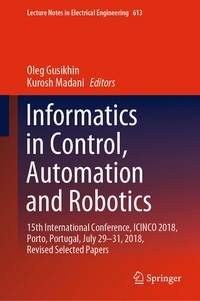
Informatics in Control, Automation and Robotics
15th International Conference, ICINCO 2018, Porto, Portugal, July 29-31, 2018, Revised Selected Papers
1st Edition
Published on 25. October 2019
XVII, 570 pages
978-3-030-31993-9 (ISBN)
Description

The goal of this book is to familiarize readers with the latest research on, and recent advances in, the field of Informatics in Control, Automation and Robotics. It gathers a selection of papers highlighting the state-of-the-art in Intelligent Control Systems, Optimization, Robotics and Automation, Signal Processing, Sensors, Systems Modelling and Control. Combining theoretical aspects with practical applications, the book offers a well-balanced overview of the latest achievements, and will provide researchers, engineers and PhD students with both a vital update and new inspirations for their own research.
More details
Series
Language
English
Place of publication
Cham
Switzerland
Publishing group
Springer International Publishing
Target group
Professional and scholarly
Product notice
Reflowable
Illustrations
XVII, 570 p. 341 illus., 223 illus. in color.
File size
69,19 MB
ISBN-13
978-3-030-31993-9 (9783030319939)
DOI
10.1007/978-3-030-31993-9
Schweitzer Classification
Other editions
Additional editions

Oleg Gusikhin | Kurosh Madani
Informatics in Control, Automation and Robotics
15th International Conference, ICINCO 2018, Porto, Portugal, July 29-31, 2018, Revised Selected Papers
Book
10/2019
Springer
€213.99
Shipment within 7-9 days
Content
- Intro
- Preface
- Organization
- Conference Chair
- Program Chair
- Program Committee
- Additional Reviewers
- Invited Speakers
- Contents
- Fast and Simple Interacting Models of Drape Tool and Ply Material for Handling Free Hanging, Pre-impregnated Carbon Fibre Material
- 1 Introduction
- 2 The FlexDraper Tool and Material
- 3 The Process and Model Requirements
- 4 Related Work
- 5 The Drape Tool Model
- 5.1 Kinetic Energy and Drape Tool Kinematics
- 5.2 Interlink Constraints
- 5.3 Actuator Movements
- 6 The Ply Material Model
- 6.1 Derivation of r
- 6.2 Derivation of rho
- 6.3 Derivation of gamma
- 7 Validation
- 7.1 Tool Model
- 7.2 Ply Model
- 8 Conclusions and Future Work
- References
- Optimal Time-Sampling in a Statistical Process Control with a Polynomial Expected Loss
- 1 Introduction
- 2 Problem Formulation
- 2.1 Process Monitoring Conditions
- 2.2 Variable Sampling Time-Interval
- 2.3 Polynomial Loss Model
- 3 Optimal Time-Sampling for a Known
- 3.1 Analytical Solution of the Extremal Problem
- 3.2 Numerical Solution of EP
- 3.3 Numerical Evaluation of the Optimal and Suboptimal Sampling Time-Intervals
- 4 Time-Sampling Independent of
- 4.1 Case 1=0
- 4.2 Case 1&0
- 4.3 Numerical Evaluation of the Time-Samplings i(z) and ii(z)
- 5 Conclusions
- References
- Observability for the Wave Equation with Variable Support in the Dirichlet and Neumann Cases
- 1 Introduction
- 1.1 Alternating Observation
- 1.2 One Dimensional Neumann Problem
- 2 The One Dimensional Problem
- 2.1 One Dimensional Neumann Problem
- 3 Applications - One Dimensional Case
- 4 Multidimensional Dirichlet Problem
- 4.1 The Role of {ti}i=-1,.,N.
- 5 Applications - Multidimensional Case
- 6 Numerical Simulations
- 7 Conclusions
- References
- Nonprehensile Manipulation Control and Task Planning for Deformable Object Manipulation: Results from the RoDyMan Project
- 1 Introduction
- 1.1 The RoDyMan Project
- 1.2 Literature Review
- 2 Robot Design
- 2.1 Mechatronic Design
- 2.2 Software Architecture
- 3 Manipulation Planning for Deformable Objects
- 3.1 Modelling of Deformable Objects
- 3.2 Detection of Deformable Objects
- 3.3 Task Planning to Stretch a Deformable Object by a Tool
- 4 Nonprehensile Manipulation: Planning and Control
- 4.1 Holonomic Rolling
- 4.2 Nonholonomic Rolling
- 4.3 Friction-Induced Manipulation
- 4.4 Tossing of a Deformable Object
- 5 Discussion and Future Work
- References
- Towards a Novel Maintenance Support System Based On mini-terms: Mini-term 4.0
- 1 Introduction
- 1.1 Previous Works. from Micro-term to Long-Term
- 1.2 Maintenance Support Systems and the Industry 4.0
- 1.3 Mini-term Degradation Path. A Change Point
- 2 What Kind of Pathology Produces the Change Point?
- 2.1 Welding Line at Ford Almussafes Factory
- 2.2 A Test Bench for a Welding Station
- 2.3 Pathologies Analyzed
- 2.4 Rules Definition Based on Statistical Analysis
- 3 How Does It Affect the Production Rate?
- 4 Mini-term 4.0. A New Paradigm for Failure Prognosis
- 4.1 Mini-term 4.0 Installation Setup
- 4.2 Towards a Real-Time mini-term Whatchdog for Failure Prognosis at Ford Motor Company
- 5 Conclusions and Future Works
- References
- Automated Nonlinear Control Structure Design by Domain of Attraction Maximization with Eigenvalue and Frequency Domain Specifications
- 1 Introduction
- 2 Background
- 2.1 Stability of Nonlinear Systems and the Domain of Attraction
- 2.2 Linear Systems and Sensitivity Analysis
- 2.3 Optimization by Grammatical Evolution
- 3 Methods
- 3.1 Centroids for Pole Placement
- 3.2 Frequency Response Magnitude Specifications
- 3.3 Optimization Problem and Domain of Attraction Estimation
- 4 Experiments
- 4.1 Optimization Setup
- 4.2 Inverted Pendulum
- 5 Conclusion
- References
- Computational Experience with a Modified Newton Solver for Discrete-Time Algebraic Riccati Equations
- 1 Introduction
- 2 Basic Theory and Conceptual Algorithm
- 3 Algorithmic Details
- 3.1 Computing Residual and Closed-Loop Matrices
- 3.2 Iterative Process
- 3.3 Finding the Step Size
- 3.4 Backtracking Strategy
- 4 Numerical Results
- 4.1 Pure Line Search, Identity Matrices Q and R
- 4.2 Backtracking, Identity Matrices Q and R
- 4.3 Pure Line Search, Diagonal Matrices Q and R
- 4.4 Backtracking, Diagonal Matrices Q and R
- 5 Conclusions
- References
- Influence of the Predictive Rainfall/Runoff Model Accuracy on an Optimal Water Resource Management Strategy
- 1 Introduction
- 2 Water Asset Management Strategy
- 2.1 Integrated Model
- 2.2 Flow-Based Network
- 2.3 Optimal Allocation Planning
- 3 Predictive Rainfall/Runoff Models
- 3.1 State of the Art
- 3.2 Data-Driven ARX Models for Flood Forecasting
- 3.3 Example of Prediction Results
- 4 Case Study
- 4.1 Description
- 4.2 Design of the Optimal Water Allocation Strategy
- 4.3 Water Allocation Planning
- 5 Conclusions
- References
- Interlocking Problem in Automatic Disassembly Planning and Two Solutions
- Abstract
- 1 Introduction
- 2 Contact and Relation Matrices: Fundamental Tools
- 3 Separability Check
- 3.1 Definition of Separability
- 3.2 Separable Pairs Search Process
- 4 Set and Closure: Mathematical Representation
- 4.1 Set
- 4.2 Subassembly and Closure
- 5 Divide-and-Conquer Disassembly Strategy
- 5.1 Subassembly Search Process
- 5.2 Procedure of Divide-and-Conquer Strategy
- 6 Case Study
- 6.1 'Separable Pairs' Method
- 6.2 Divide-and-Conquer Strategy
- 7 Conclusion
- Acknowledgement
- Appendix
- References
- Thermal Imaging for Psychophysiological State Detection in the Human-Machine Interface (HMI) Control System
- 1 Introduction
- 1.1 Participants
- 1.2 Simulation of Human-Machine Interaction
- 1.3 Data Acquisition
- 1.4 Data Analysis
- 1.5 Procedure
- 2 Results
- 2.1 Maximum Facial Temperature
- 2.2 Mean Nasal Temperature
- 2.3 Mean Forehead Temperature
- 2.4 Differential Energy Between Philtrum and Forehead
- 2.5 Comparison with Conventional Biomarker
- 3 Discussions
- 3.1 Facial Temperature Biomarkers
- 3.2 Human-Machine Interface Prediction
- 4 Conclusions
- References
- Nonlinear Model Predictive Control Algorithms for Industrial Articulated Robots
- 1 Introduction
- 2 Nonlinear Robot Model
- 3 Integration Concept
- 4 Nonlinear Design of Model Predictive Control
- 4.1 Criterion and Cost Function
- 4.2 Equations of Predictions - Algorithm with Nonlinear Prediction
- 4.3 Equations of Predictions - Single-Pass Algorithm
- 4.4 Square-Root Minimization
- 5 Simulation Examples
- 5.1 Simulation Setup
- 5.2 Summary of the Results
- 6 Conclusion
- References
- Experimental Investigation of a Biologically Inspired Gripper with Active Haptic Control for Geometric Compliancy
- Abstract
- 1 Introduction
- 1.1 Background
- 1.2 Overview
- 1.3 Related Studies
- 1.4 Fin Ray Effect® Mechanism and Related Studies
- 2 Conceptual Design of Flexible Gripper
- 2.1 Closed-Loop Robotic System Integration
- 2.2 Design of Flexible Gripper
- 2.3 Simulation for Optimal Conformity
- 2.4 Robot Sensory System Integration
- 3 Active Haptic Control
- 3.1 Pseudocode and Mechatronic Control
- 3.2 Dynamic Interferences Forces
- 4 Testing of Active Haptic Control
- 4.1 Visual Static Testing
- 4.2 Dynamic Testing Preparation
- 4.3 Dynamic Performance Without Haptic Feedback Control
- 4.4 Dynamic Performance of Haptic Feedback Control
- 5 Discussion
- 5.1 Gripper Performance
- 6 Conclusions
- References
- Quantifying Robotic Swarm Coverage
- 1 Introduction
- 2 Quantifying Coverage
- 2.1 Preliminaries
- 2.2 Calculating eN
- 2.3 The Pitfalls of Discretization
- 2.4 Setup for Main Examples
- 3 Error Metric Extrema
- 3.1 Extrema Bounds via Nonlinear Programming
- 3.2 Error Metric for Optimal Swarm Design
- 4 Error Metric Probability Density Function
- 4.1 Kernel Density Estimation
- 4.2 Theoretical Central Limit Theorem
- 4.3 Numerical Approximation of the Error Metric PDF
- 4.4 Benchmark for Stochastic Controllers
- 5 Future Work
- 6 Conclusion
- References
- Design of a Vibration Driven Motion System Based on a Multistable Tensegrity Structure
- 1 Introduction
- 2 Mechanical Model of the Tensegrity Structure
- 2.1 Topology of the Tensegrity Structure
- 2.2 Equations of Motion and Equilibrium Configurations of the Tensegrity Structure
- 3 Parameter Finding for the Tensegrity Structure
- 3.1 Multistability of the Tensegrity Structure
- 3.2 Tilting by Changing the Equilibrium Configuration
- 4 Design of the Actuation of the Tensegrity Structure
- 4.1 Modal Analysis of the Tensegrity Structure
- 4.2 Frequency Response Analysis of the Tensegrity Structure
- 5 Simulation of the Vibration Driven Motion System
- 5.1 Modeling of the Vibration Driven Motion System
- 5.2 Motion Characteristics of the Vibration Driven Motion System
- 5.3 Change of the Equilibrium Configuration of the Vibration Driven Motion System
- 6 Conclusion
- References
- An Experimental Study for the Contactless Manipulation of Single Object in Vertical Plane Using Multiple Air Jets
- Abstract
- 1 Introduction
- 2 Outline and Problem Setting of Proposed Technology
- 2.1 Basic Idea and Conveyance Image
- 2.2 An Essential Problem to Be Solved
- 3 Preliminary Experiments to Propose the Air Jet Relay Control Method
- 3.1 Consideration of Air Jet Manipulation Experiment on a Flat Surface
- 3.2 Observation of the Behavior of an Object When Two Air Jets Join in the Air
- 4 Proposed Control Method
- 4.1 Approach to Problem Solving
- 4.2 Proposed Algorithm
- 5 Demonstration Experiment
- 5.1 Outline of Experiment
- 5.2 Experimental Results and Discussion
- 6 Conclusion
- References
- Combined Feedback-Feed Forward Control Strategy for a Knee Rehabilitation Device with Soft Actuation
- 1 Introduction
- 2 Device Modeling Approach
- 3 Combined Feedback and Feedforward Control Strategy
- 3.1 Control Requirements
- 3.2 Control Design
- 3.3 Controller Simulation
- 4 Results and Discussion
- 4.1 Simulation Results
- 4.2 Experimental Results
- 5 Conclusion
- References
- Controlling Off-Road Bi-steerable Mobile Robots: An Adaptive Multi-control Laws Strategy
- 1 Introduction
- 2 Modeling of the Robot
- 2.1 Assumptions and Notations
- 2.2 Classical Motion Equations
- 2.3 Modeling Robot Motion in Two Subsystems
- 3 Observation of Sideslip Angles
- 3.1 Observer State
- 3.2 Observer Equations
- 4 Control Laws
- 4.1 Rear Steering Angle
- 4.2 Front Steering Angle
- 4.3 Curvature Anticipation
- 5 Prevention of Steering Angle Saturations
- 6 Experimental Results
- 6.1 Experimental Setup
- 6.2 Maneuverability Improvement and Tracking Accuracy
- 6.3 Prevention of Steering Saturation
- 7 Conclusion
- References
- On Randomized Searching for Multi-robot Coordination
- 1 Introduction
- 2 Problem Definition
- 2.1 Actions
- 2.2 Constraints
- 2.3 Composite Configuration Space
- 3 Proposed Algorithm
- 3.1 Discrete RRT
- 3.2 Proposed Improvements
- 4 Experiments
- 5 Conclusion
- References
- Increasing Machining Accuracy of Industrial Manipulators Using Reduced Elastostatic Model
- 1 Introduction
- 1.1 Related Work
- 1.2 Problem Statement
- 2 Theoretical Background
- 2.1 Virtual Joint Method
- 2.2 Identification
- 2.3 Design of Experiment
- 3 Model Description
- 3.1 Stiffness Estimation
- 3.2 Deflection Maps
- 4 Results
- 4.1 Deflection Maps
- 4.2 Deflection Compensation
- 5 Discussion
- 6 Conclusion
- References
- Control of Force in Surgical Robots with Random Time Delays Using Model Predictive Control
- Abstract
- 1 Introduction
- 2 System's Control Architecture
- 2.1 Communication System
- 2.2 Master Level
- 2.3 Slave Model
- 3 Simulations Results
- 4 Discussions
- 5 Future Work
- 6 Conclusion
- References
- An IPM Approach to Multi-robot Cooperative Localization: Pepper Humanoid and Wheeled Robots in a Shared Space
- 1 Introduction
- 2 Methodology
- 2.1 Problem Definition
- 2.2 Inverse Perspective Mapping (IPM)
- 2.3 Detection Phase
- 3 Results and Discussion
- 3.1 Tests with Static Objects
- 3.2 Tests with Wheeled Robots
- 4 Conclusion
- References
- Study of the Physiological Parameters of a Regulated Oxygen Mask
- 1 Introduction
- 2 Conclusions from Previous Work
- 2.1 Physical Model of the Mask
- 2.2 Equilibrium Trajectory of the Mask
- 2.3 Results from the Appplication of the Routh Criterion
- 3 Study of the Mask Physiological Parameters
- 3.1 Opening Time
- 3.2 Closing Time
- 3.3 Mask Pressure Value
- 3.4 Mask Pressure Overshoot
- 4 Improvement of the Mask Behaviour
- 5 Conclusion
- References
- Linear Discrete-Time Systems - H Dynamic Output-Feedback Control with Preview
- 1 Introduction
- 2 Problem Formulation
- 3 State-Feedback Tracking Control
- 3.1 Stationary State-Feedback Tracking Control
- 4 Dynamic Output-Feedback Tracking Control
- 4.1 BRL for Systems with Tracking Signal
- 4.2 The Output-Feedback Tracking Control
- 5 Stationary Output-Feedback Tracking Control
- 6 Conclusions
- References
- Direct Integrability for State Feedback Optimal Control with Singular Solutions
- 1 Introduction
- 2 The Optimal Control Problem Formulation
- 3 The Case of Block Sub Triangular Single Input Systems
- 3.1 The Class of Dynamics Considered
- 3.2 Results for the Class of Dynamics Considered
- 3.3 The Example of a SIR Model
- 4 An Extended Case
- 4.1 The Example of a SIR Model with No Immunization
- 5 Conclusions
- References
- Petri Nets Tracking Control for Electro-pneumatic Systems Automation
- 1 Introduction
- 2 Basic Concepts
- 2.1 Petri Nets
- 2.2 Interpreted Petri Nets
- 3 Tracking Control Problem
- 3.1 Electro-Pneumatic Component Models
- 3.2 Building the Plant Model
- 3.3 Specification Model
- 3.4 Tracking Control Problem
- 4 Control Synthesis Algorithm
- 4.1 Properties of the Closed-Loop System
- 4.2 Ladder Diagram
- 5 Case Study
- 6 Conclusions
- References
- 18O Isotope Separation Process Control
- Abstract
- 1 Introduction
- 2 Modeling of the Isotope Separation Process
- 3 The Proposed Control Strategy
- 4 Controllers Tuning and Simulations Results
- 5 Conclusions
- References
- Approximate Bayesian Prediction Using State Space Model with Uniform Noise
- 1 Introduction
- 2 Multidimensional Uniform Distribution and Geometrical Interpretation of its Support
- 2.1 Definition of Uniform Pdf
- 2.2 Examples of Supports
- 2.3 Approximation of a Complex Pdf by a Uniform Pdf with a Parallelotopic Support
- 3 Approximate Bayesian Estimation of Uniform State Space Model
- 3.1 Bayesian Filtering
- 3.2 Linear State Space Model with Uniform Noise
- 3.3 Approximate State Estimation of LSU Model
- 4 Approximate Predictor for Scalar Output and -dimensional State
- 4.1 Predictive Pdf
- 4.2 Point Prediction
- 5 Algorithmic Summary
- 6 Experiments
- 6.1 Experiment Setup
- 6.2 Results
- 6.3 Discussion
- 7 Concluding Remarks
- References
- Author Index
