

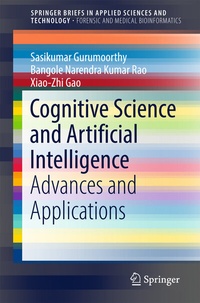
Cognitive Science and Artificial Intelligence
Description

This book presents interdisciplinary research on cognition, mind and behavior from an information processing perspective. It includes chapters on Artificial Intelligence, Decision Support Systems, Machine Learning, Data Mining and Support Vector Machines, chiefly with regard to the data obtained and analyzed in Medical Informatics, Bioinformatics and related disciplines. The book reflects the state-of-the-art in Artificial Intelligence and Cognitive Science, and covers theory, algorithms, numerical simulation, error and uncertainty analysis, as well novel applications of new processing techniques in Biomedical Informatics, Computer Science and its applied areas. As such, it offers a valuable resource for students and researchers from the fields of Computer Science and Engineering in Medicine and Biology.
More details
Other editions
Additional editions
Persons
Dr. Sasikumar Gurumoorthy a Professor in the Department of Computer Science and Systems engineering at Sree Vidyanikethan Engineering College at Tirupati, India. He has published more than 90 technical papers in various international journals, conferences, and book chapters and has guided 57 Students for their M.Tech, B.Tech, MSc, B.Sc., degrees in both computer science, Computer Science and Systems Engineering and Information Technology. He is associated with many professional bodies like CSI, IAENG, ISTE, AIRCC, IACSIT, IDES, IFERP, WASET, and INEER. He is on the editorial board of several international journals like AIRCC, NCICT, MAT Journals, IFERP, IFERP, IJERCSE and he is a reviewer for over 11 international journals. His current interests include soft computing and artificial intelligence in biomedical engineering, human and machine interaction and applications of intelligent system techniques, new user interfaces, brain-based interactions, human-centric computing, fuzzy sets and systems, image processing, cloud computing, content-based learning and social network analysis.
Dr. Bangole Narendra Kumar Rao
received his Ph.D. degree from Jawaharlal Nehru Technological University, Hyderabad. He is currently a Professor at the Department of Computer Science and Systems Engineering, and has been the Chairman, Board of Computer Science and Systems Engineering. He has also been the Head of the Department of Computer Science and Systems Engineering since July 2014. He has published more than 15 scientific papers in the field of Software Testing. His research interests include Software Process Optimization, Soft Computing Techniques and Data Mining in Computer Science and Engineering.
Dr. Xiao-Zhi Gao
received his B.Sc. and M.Sc. degrees from the Harbin Institute of Technology, China in 1993 and 1996, respectively. He earned a D.Sc. (Tech.) degree from the Helsinki University of Technology, Finland in 1999. Since January 2004, he has been working as an instructor at the same university. He is also a Guest Professor of Beijing Normal University, Harbin Institute of Technology, and Beijing City University, China. Dr. Gao has published more than 150 technical papers in refereed journals and for international conferences. He is an Associate Editor of the Journal of Intelligent Automation and Soft Computing and an editorial board member of the Journal of Applied Soft Computing, International Journal of Bio-Inspired Computation, and Journal of Hybrid Computing Research. Dr. Gao was the General Chair of the 2005 IEEE Mid-Summer Workshop on Soft Computing in Industrial Applications. His current research interests are neural networks, fuzzy logic, evolutionary computing, swarm intelligence, and artificial immune systems, together with their applications in industrial electronics.
Content
1.Construction of Breast Cancer Based Protein Protein Interaction Network Using Multiple Sources of Datasets.- 2.A Novel Evolutionary Automatic Clustering Technique by Unifying Initial Seed Selection Algorithms and K-Means into Teaching-Learning-Based Optimization.- 3.Classification of Abnormal Blood Vessels in Diabetic Retinopathy using Neural Network.- 4.Flue-cured tobacco Leaves classification: A Generalized approach using Deep Convolutional Neural Networks.- 5.The Adaptive Strategies Improving Web Personalization Using the Tree Seed Algorithm (TSA).- 6.An Experimental Evaluation of Integrated Dematal and Fuzzy Cognitive Maps for Cotton Yield Prediction.
