

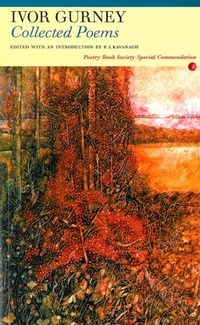
Collected Poems
Published on 27. July 2012
320 pages
978-1-84777-991-5 (ISBN)
Description

P.J. Kavanagh's 1982 edition of the 'Collected Poems established Ivor Gurney (1890-1937) as one of the most original poets of the early twentieth century. His experiences in the First World War, his love of his native Gloucestershire countryside were sources of a unique poetic voice: Vigorous, lyrical and passionate.
In this new, substantially revised edition, Gurney can be enjoyed in his entirety by a new generation of readers. The poems have been re-ordered to take into account new work on Gurney, the texts corrected from the archive and editorial material substantially revised, while retaining P.J. Kavanagh's extensive original introduction.
To many readers, the 1982 edition was a revelation. Re-reading Gurney, writes P.J. Kavanagh, 'is to be reminded how miraculously good he can be: his celebration of the ordinary, his eye for detail, his musical ear that combines traditional rhythms with the unpredictable...'
In this new, substantially revised edition, Gurney can be enjoyed in his entirety by a new generation of readers. The poems have been re-ordered to take into account new work on Gurney, the texts corrected from the archive and editorial material substantially revised, while retaining P.J. Kavanagh's extensive original introduction.
To many readers, the 1982 edition was a revelation. Re-reading Gurney, writes P.J. Kavanagh, 'is to be reminded how miraculously good he can be: his celebration of the ordinary, his eye for detail, his musical ear that combines traditional rhythms with the unpredictable...'
Reviews / Votes
Reviewed by Neil Curry in The North, Issue 35Gloucester-born Ivor Gurney published his first slim volume, Severn and Somme, in 1917 when he was twenty-seven.It was very little different from the dozens of other Rupert Brooke-alike collections, as they have been called.Patriotic and idealistic. 'Now, youth, the hour of thy dread passion will come' and so on.But one brief poem does catch our attention. 'Bach and the Sentry' so clearly refers to an actual event.On guard duty one darkOctober night his spirit is lifted by the memory of a favourite Bach Prelude, but then he wonders whether, when he hears it again, after the war is over, it might not bring back the numbness he has just been feeling - the 'dull sense of No Man's Land again.' It is a provocative idea and expressed with such unfussy directness.
This is no ordinary soldier and no ordinary war poet.Six years earlier he had won a scholarship to the Royal Academy of Music, where his tutor, Sir Charles Stanford, whose pupils had included Vaughan Williams, Ireland and Bliss, declared that Gurney was potentially 'the biggest of them all'.And anyone who has heard the tenor Paul Agnew's recording of Gurney's 'Severn Meadows' will know why.There is such an eerie simplicity and beauty to the title song that it is hard to believe Gurney wrote it in the trenches of Caulaincourt in 1917 while serving as a private, a front-line infantryman, with the Gloucester Regiment.
He had enlisted early in 1915 and for two and a half years he fought in some of the most bloody areas of carnage: the Somme, Ypres and Passchendaele.Wounded once, sent back into acton and subsequently caught in a gas attack, he was repatriated and cared for at Newcastle General Hospital, but after showing some signs of mental disturbance he was sent off to Lord Derby's war Hospital at Warrington, where they were pioneering the use of electric shock treatment.Out of the frying pan...
Discharged finally in 1918, like many others of his generation, he could not settle.He left the Royal College and over the next four years had a succession of jobs: farm labourer, tax official, cold storage worker and a silent cinema pianist.The only consistent thing was his poetry.In this new Collected Poems (which is not a Complete Poems) PJ Kavanagh gives us over one hundred poems which were written during those years of restlessness.
His battlefield experience still occupied his mind a great deal, but these are not war poems in the usual mould.He had grown out of Rupert Brooke.In a letter to his friend Marion Scott he had written perceptively that 'Brooke would not have improved with age.His manner has become mannerism.' And there is none of that rhetoric of outrage which we have grown used to either.he is very far removed from the likes of Owen and Sassoon and the officer corps.His firsthand accounts startle us with their actuality and distinctiveness. 'The Silent One'opens with one of those pitiful infantry advances over No Man's Land.one of his friends
faced unbroken wire; stepped over, and went,
A noble fool, faithful to his stripes - and ended.
The matter-of-fact tone serves to emphasise the pointlessness of it.But then comes farce.Gurney had been in this situation before and was keeping head down, when an officer
[in] the politest voice - a finicking accent, said:
'Do you think you might crawl through, there;there's a hole?'
The brilliance of observation in that word finiking and the whole nonsensical courtesy of it is matched by Gurney's reply:
In the afraid
Darkness, shot at; I smiled, as politely replied -
'I'm afraid not, Sir.'
We want to laugh, but as we do, we remember that men had been shot for less.
Gurney has been called the most coolly unillusioned of all English combat poets.That he saw things clearly is clear from the detail.When the Verey pistols are fired there is that 'Dreadful green light baring the ruined trees'.The troops huddle in 'low huts, candle-lit, shaded close by slitten oilsheets.' What also marks him out is his concern for others, and not others in the abstract but real live others such as the 'Welsh pit boys' singing 'David of the White Rock' and sharing their 'Woodbines breakfast'.
In his war poems he makes vivid what to us is extraordinary, but like Hopkins, whom he greatly admired, he is also a pot with the great gift of being able to celebrate the ordinary, what he calls 'the dearness of common things'.
...
In the early years of the 1920s, when Gurney was trying to work out what was happening to him and to the country, the masters of the new modernism - men who, interestingly, had never seen active service - marched off in quite another direction and forgot all about him, but we are finding now that there are voices from that period which speak to us with a far greater immediacy than the Ezra Pounds and the TS Eliots ever did, and Ivor Gurney's is one of those voices.
This is a fine new edition.There are poems here we have not had the chance to see before.PJ Kavanagh's perceptive introduction has been retained, but in all other aspects it is a great improvement on the 1982 edition from OUP which was so badly designed - cluttered and ugly.Carcanet are to be congratulated. Fred Beake, Acumen, January 2005:
Review of Ivor Gurney, ,Collected Poems, and Lorine Niedecker, Collected Works (University of California Press)
Gurney's self is almost the subject of his poems. However, this is slightly misleading, because through the medium of Gurney's self, we see scenes from the Great War, or his beloved Gloucestershire, with a curious detachment, as if we were there. Thus his 'Costwold Ways' is a list of things seen on walks that summarize the history of the area, or in 'The Silent One' it is somehow us and not Gurney who is being asked to make a stupid crawl through the trench wire, and declines. It is often said, of course, that Gurney's poetry is the summary of his own tragedy, but I think the strength of it lies in its distancing of that material, and making it more universal. This obsession with Gurney's personal tragedy tends also to obscure his frequent exuberance. Gurney is a poet with far more joy and light than it is fashionable to say...
These are difficult books to review because they both contain so many shifts of direction, but suffice it to say that they are both books to read and re-read, and of great long-term importance. There will no doubt be more editions. Ivor Bertie Gurney was born in 1890 in Gloucester where he became a choirboy and an organ scholar, imbibing that rich tradition of anglican choral music and psalmody which had such an effect on his own work. He went on to study at the Royal College of Music where his composition tutor considered him one of the finest students he had ever had, surpassing in potential even Vaughan Williams.
Ivor, however, was an unstable character, prone to bouts of depression, eating disorders and generally odd behaviour. His experiences in the First World War, in which he served as a private; exacerbated these problems; he returned from the front incapable of holding down any kind of employment or of maintaining normal relationships.
He was never dangerous, though; he loved walking long distances at night, he was sometimes convinced he was being attacked by radio waves, he gave up sleeping and some of his poems betray an obsession with washing (which he called 'laving'). His family could not cope with his peculiarities - or his need for money - and in 1922 he was committed to an asylum. He remained confined the rest of his life, dying of TB on the last day of 1937.
By summarising Gurney's life thus, I have already disappointed his editor P. J. Kavanagh, who writes: 'my dearest wish would be for the reader to approach him first with no knowledge at all of his medical history.' Gurney himself often seemed able to ignore that medical history - the poems he wrote while confined rarely mention hs surroundings - just as he was earlier able to imagine himself back in his beloved Gloucestershire while sitting in a trench, and to compose poems and songs in the English pastoral idiom against the din of exploding shells. He maintained a sort of detachment in order to write- except for those moments of awful lucidity where he recognised himself as 'wasting in one/ Packed ward, where ceiling flat-white is for heaven'.
The fruits of Gurney's life are some exquisite song-settings, and a collection of admittedly uneven poetry, some of which is as lyrical and heartrending as his best songs. Sometimes
he combined his two talents, setting a number of his own lyrics to music - most notably 'The Wanderer', whose concluding lines' Do not forget me quite,/ O Severn meadows' are quoted in a memorial to him in Gloucester Cathedral.
Gurney's Collected Poems were first published in 1982; in this revised and corrected edition the poems have been ordered differently to present a clearer picture of the poet's progress, the gradual disintegration of his mind shot through with flashes of clarity.
Even people who do not normally read poetry will be touched by the story of Ivor Gurney, as portrayed in his own words - for he is not as 'detached' as he may at first appear. Many of his war poems include details about the life of the common soldier missing from the works of officer-poets, while his best short poems, as the darkness began to close around him, are unassuming, direct and memorable in their sorrowful simplicity:
The songs I had are withered
Or varnished clean
yet there are bright tracks
Where i have been,
And there grow flowers
For others' delight.
Think well, O singer
Soon comes night.
More details
Language
English
Place of publication
Manchester
United Kingdom
Publishing group
Carcanet Press Ltd
File size
1,32 MB
ISBN-13
978-1-84777-991-5 (9781847779915)
Copyright in bibliographic data and cover images is held by Nielsen Book Services Limited or by the publishers or by their respective licensors: all rights reserved.
Schweitzer Classification
Other editions
Additional editions
Ivor Gurney | P. J. Kavanagh
Collected Poems
Book
02/2004
Fyfield Books
€33.00
Article exhausted; check different version
Persons
P.J. Kavanagh was born in England in 1931, and worked as a lecturer, actor and broadcaster, as well as a writer. His Collected Poems were published in 1992, the year in which he was given the Cholmondeley Award for poetry. His memoir The Perfect Stranger won the Richard Hillary Prize in 1966, and his first novel A Song and Dance was awarded the Guardian Fiction Prize in 1968. From 1983 to 1996 P.J. Kavanagh was a columnist on the Spectator, and from 1996 to 2002 on The Times Literary Supplement. In addition to his four novels for adults and two children's novels, he wrote a travel autobiography (Finding Connections), a literary companion (Voices in Ireland) and has edited The Oxford Book of Short Poems and The Essential G.K. Chesterton, and, for Carcanet, a new edition of his Collected Poems of Ivor Gurney.
Content
- Cover
- Title Page
- Epigraph
- Table of Contents
- Acknowledgements
- Introduction
- Foreword to the New Edition
- Chronology
- Maps
- From Severn and Somme (1917)
- To the Poet before Battle
- Strange Service
- The Mother
- Bach and the Sentry
- Song and Pain
- Song
- Ballad of the Three Spectres
- Time and the Soldier
- After-Glow
- Praise
- Song of Pain and Beauty
- Requiem
- Pain
- Servitude
- From War's Embers (1919)
- Turmut-Hoeing
- Ypres - Minsterworth
- To His Love
- Old Martinmas Eve
- Companion - North-East Dug-Out
- The Poplar
- The Battalion Is Now On Rest
- Photographs
- De Profundis
- 1917-c. 1919 Poems from letters
- other early MSS and TSS
- The Old City - Gloucester
- Memory, Let All Slip
- To the Prussians of England
- Excursion
- Song of Urgency
- Song
- Above Ashleworth
- Crickley Hill
- O Tree of Pride
- Equal Mistress
- Above Maisemore
- When From the Curve
- There Was Such Beauty
- The Companions
- Crocus Ring
- Michaelmas
- Between the Boughs
- Walking Song
- April Gale
- Personages
- If I Walked Straight Slap
- Sonnet to J.S. Bach's Memory
- Advice
- c. 1920-1922 Poems originating in MS notebooks
- other single MS or TS poems
- Quiet Talk
- The Change
- The Songs I Had
- London Dawn
- Song
- Generations
- Moments
- April - Dull Afternoon
- The Valley Farm
- When I Am Covered
- Changes
- North Woolwich
- Cotswold Ways
- Longford Dawns
- The Bare Line of the Hill
- I Saw England - July Night
- Clay
- Saturday's Comings
- When March Blows
- Yesterday Lost
- Andromeda over Tewkesbury
- Wandering Thoughts
- The Dark Tree
- Had I a Song
- The Lock Keeper
- On the Night
- Swift and Slow
- The Telegraph Post
- Fragment
- We Who Praise Poets
- Winter Has Clouds
- Hedges
- Remembrances
- In the Old Time
- The Dearness of Common Things
- What Evil Coil
- The Hoe Scrapes Earth
- Compensations
- The Garden
- Time to Come
- Rainy Midnight
- Water Colours
- February Dawn
- Going Out at Dawn
- Possessions
- Possessions
- Darkness Has Cheating Swiftness
- Laventie
- Smudgy Dawn
- Half Dead
- June Night
- The Bargain
- Roads - Those Roads
- Lovely Playthings
- Songs Come to the Mind
- The Poet Walking
- The Cloud
- Daily - Old Tale
- By Severn
- Of Cruelty
- Blighty
- Small Chubby Dams
- Brimscombe
- Kilns
- Billet
- First Time In
- The Soaking
- New Year's Eve
- Glimmering Dusk
- Thoughts on Beethoven
- Friendly Are Meadows
- Crucifix Corner
- What I Will Pay
- The Touchstone - Watching Malvern
- Tobacco
- La Gorgue
- Strange Hells
- That Centre of Old
- Canadians
- First March
- After War
- Riez Bailleul
- Near Vermand
- Early Spring Dawn
- First Time In
- George Chapman - The Iliad
- Drachms and Scruples
- Stars Sliding
- Behind the Line
- Schubert
- Townshend
- Brown Earth Look
- Looking Out
- Near Vermand
- Robecq Again
- London
- The Bronze Sounding
- Kettle Song
- Larches
- Quiet Fireshine
- Imitation
- Old Dreams
- Looking Up There
- The Not-Returning
- Looking There
- The Escape
- Thomas Heywood
- Poem
- Mist on Meadows
- Bach - Under Torment
- Silver Birch
- Old Thought
- Towards Lillers
- Tobacco Plant
- On Foscombe Hill
- East Wind
- The High Hills
- From the Meadows - The Abbey
- Schubert
- Leckhampton Chimney Has Fallen Down
- When the Body Might Free
- All Souls' Day 1921
- Autumn's Flame
- Up There
- Midnight
- On a Two-Hundredth Birthday
- Tewkesbury
- Sonnet - September 1922
- September 1922-1925 Poems written in asylums. From single MSS
- TS and MS groups
- boxes and late notebooks
- There Is a Man
- The Incense Bearers
- To God
- The Interview
- A Wish
- Hedger
- There Have Been Anguishes
- Riez Bailleul
- Old Times
- The Shame
- On Somme
- After 'The Penny Whistle'
- The Golden Age
- Hazlitt
- Cut Flowers
- The Dream
- War Poet
- Masterpiece
- Snow
- March
- The Awakening
- The Love Song
- The Sea Borders
- The Motetts of William Byrd
- First Poem
- Like Hebridean
- The Coin
- Varennes
- Epitaph on a Young Child
- Christopher Marlowe
- Song of Autumn
- The Nightingales
- Dawns I Have Seen
- The Last of the Book
- To Long Island First
- Walt Whitman
- Henry David Thoreau
- Washington Irving
- Portraits
- The New Poet
- The Battle
- Regrets After Death
- Serenade
- Butchers and Tombs
- Don Juan in Hell
- The Bohemians
- Autumn
- Signallers
- To Y
- The Lightning Storm
- The County's Bastion
- Of Grandcourt
- The Silent One
- The Noble Wars of Troy
- Felling a Tree
- The Elements
- Song
- The Poets of My County
- War Books
- Song
- Prelude
- While I Write
- The Mangel-Bury
- Memory
- It Is Winter
- Farewell
- It Is Near Toussaints
- The Storm at Night
- To Clare
- An Appeal for Death
- For Mercy of Death
- Hell's Prayer
- To Crickley
- The Betrayal
- Gloucester
- The Coppice
- December 30th
- St Sylvester's Night
- Poem for End
- 1926 and after Late MS poems
- Music Room
- Early Winter
- The Depths
- I Read Now So
- Poets' Affection
- Traffic in Sheets
- Friend of the Mists
- The Shelter from the Storm
- The Two
- The Pedlar's Song
- Going Outward
- Musers Afar Will Say
- December Evening
- No, Come Not, Swallows
- The Dancers
- I Would Not Rest
- If I Shall Praise
- The Pleasance Window
- Sea-Marge
- What Was Dear
- Rather I Would .
- This Christmas Morning
- Wood-Gathering
- The House of Stone
- The Bridge
- The Poet
- Near Spring
- Where the Mire
- The Wood of August
- In December
- The Old Walnut
- Here, If Forlorn
- Soft Rain
- The Wind
- As They Draw to a Close
- Appendix
- Poems from previous editions not included in main text
- I Saw French Once
- What's in Time
- The Dance of the September Birds
- The Anger of Samson
- O Tan-Faced Prairie Boy
- A Madrigal
- Old Tavern Folk
- Then I Heard
- William Byrd
- 'Girl, Girl, Why Look You So White?'
- Watching Music
- Improvisation
- The Scent of That Country
- To Gloucestershire
- Examples of longer autobiographical poems
- The Retreat
- Chance to Work
- Editorial Note (1982, 2004)
- Notes to the Poems
- Abbreviations
- Glossary
- Index of Titles and First Lines
- About the Author
- Copyright
