

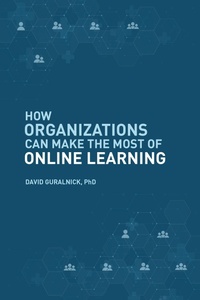
How Organizations Can Make the Most of Online Learning
Description

In HOW ORGANIZATIONS CAN MAKE THE MOST OF ONLINE LEARNING, Dr. David Guralnick describes what organizations need to know about learning and technology in order to create a successful culture of growth and performance - today, tomorrow, and in the future.
Online learning has the potential to change an organization's culture and performance - if the organization employs technology in the right ways. In HOW ORGANIZATIONS CAN MAKE THE MOST OF ONLINE LEARNING, Dr. David Guralnick describes what organizations need to know about learning and technology in order to create a successful culture of growth and performance - today, tomorrow, and in the future.
In this book, Dr. Guralnick describes the current world of online learning, lays out his vision of the future, and discusses how organizations can make the best use of technology to improve job performance, including how to best combine the work and skills of an organization's internal team and outside consultants and vendors.
Too much online learning today focuses on memorizing information. HOW ORGANIZATIONS CAN MAKE THE MOST OF ONLINE LEARNING shifts this paradigm to focus on learning key skills that are meaningful to an employee and relevant to their work. Organizations will learn how to create and deliver online learning and performance experiences that can take their employees' performance to the next level.
More details
Other editions
Additional editions

Person
Dr. David Guralnick is an internationally known keynote speaker, author, professor, and consultant. His work leverages learning theory, cognitive science, advanced technology and artificial intelligence, and creative, entertaining storytelling to create enjoyable learning experiences that help people learn to think critically, reflect, and make thoughtful decisions.
Dr. Guralnick's roles in the industry include President and CEO of New York-based Kaleidoscope Learning, an award-winning online learning company; President of the International E-Learning Association (IELA), a non-profit organization; founding chair of the International E-Learning Awards program; Adjunct Professor at Columbia University; founder and chair of The Learning Ideas Conference; and Editor-in-Chief of the International Journal on Advanced Corporate Learning (iJAC).
His work has been featured in Wired magazine, in Training magazine, and on the television show The Balancing Act, and he has been the recipient of numerous e-learning design awards.
Content
- Cover
- Halftitle
- Title
- Copyright
- Description
- Contents
- Preface
- Acknowledgments
- Chapter 1: Introduction: Using Technology to Improve Performance
- Chapter 2: Types of Online Learning
- Chapter 3: Learning Technology: Courses, Content, and Experiences
- Chapter 4: Learning Technology: Learning Management and Administration
- Chapter 5: Custom Courses and Content: Working With Outside Vendors and Contractors
- Chapter 6: Maximizing Your Online Learning Strategy
- Chapter 7: Creating Successful Online Learning: The Research
- Chapter 8: When Do You Need Help From an Outside Consultant?
- Chapter 9: New and Upcoming Learning Technologies
- Chapter 10: The Future of Corporate E-Learning
- Appendix: For Further Exploration
- References
- About the Author
- Index
- Adpage
- Backcover
