

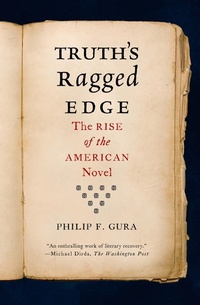
Truth's Ragged Edge
Description

From the acclaimed cultural historian Philip F. Gura comes Truth's Ragged Edge, a comprehensive and original history of the American novel's first century. Grounded in Gura's extensive consideration of the diverse range of important early novels, not just those that remain widely read today, this book recovers many long-neglected but influential writers-such as the escaped slave Harriet Jacobs, the free black Philadelphian Frank J. Webb, and the irrepressible John Neal-to paint a complete and authoritative portrait of the era. Gura also gives us the key to understanding what sets the early novel apart, arguing that it is distinguished by its roots in "the fundamental religiosity of American life." Our nation's pioneering novelists, it turns out, wrote less in the service of art than of morality. This history begins with a series of firsts: the very first American novel, William Hill Brown's The Power of Sympathy, published in 1789; the first bestsellers, Susanna Rowson's Charlotte Temple and Hannah Webster Foster's The Coquette, novels that were, like Brown's, cautionary tales of seduction and betrayal; and the first native genre, religious tracts, which were parables intended to instruct the Christian reader. Gura shows that the novel did not leave behind its proselytizing purpose, even as it evolved. We see Catharine Maria Sedgwick in the 1820s conceiving of A New-England Tale as a critique of Puritanism's harsh strictures, as well as novelists pushing secular causes: George Lippard's The Quaker City, from 1844, was a dark warning about growing social inequality. In the next decade certain writers-Hawthorne and Melville most famously-began to depict interiority and doubt, and in doing so nurtured a broader cultural shift, from social concern to individualism, from faith in a distant god to faith in the self. Rich in subplots and detail, Gura's narrative includes enlightening discussions of the technologies that modernized publishing and allowed for the printing of novels on a mass scale, and of the lively cultural journals and literary salons of early nineteenth-century New York and Boston. A book for the reader of history no less than the reader of fiction, Truth's Ragged Edge-the title drawn from a phrase in Melville, about the ambiguity of truth-is an indispensable guide to the fascinating, unexpected origins of the American novel.
More details
Other editions
Additional editions

