

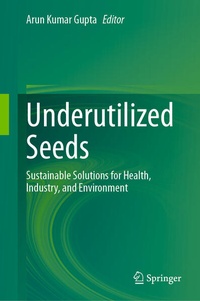
Underutilized Seeds
Description

This book explores the often-overlooked potential of underutilized seeds in addressing global challenges related to health, environmental sustainability, and industrial innovation. It highlights seed crops that are typically neglected in mainstream agriculture but possess exceptional nutritional, functional, and ecological properties. Many of these seeds are native to specific regions and hold significant promise for diversifying diets, developing eco-friendly industrial materials, and promoting sustainable agricultural practices.
The book consolidates current knowledge on the nutritional and bioactive properties of underutilized seeds, their role in enhancing human health and well-being, and their diverse applications across industries such as food, cosmetics, pharmaceuticals, and renewable energy. By bridging gaps between research, industry, and policy, this work aims to promote the integration of these seeds into global food systems, encourage their cultivation, and safeguard their biodiversity. It also emphasizes how the valorization of such seeds can contribute to a circular economy, fostering sustainable production and consumption practices while addressing critical global issues such as carbon footprint reduction and agroecological restoration.
More details
Other editions
Additional editions
Person
Dr. Arun Kumar Gupta earned his M.Sc. (Food Science & Technology) degree from Pondicherry University, Puducherry, India, and his Ph.D. in Food Engineering and Technology from the Tezpur University, Assam, India. He is currently serving as an Assistant Professor in the Department of Food Process Technology at Sardar Vallabhbhai Patel University of Agriculture and Technology, Meerut, India. Dr. Gupta's research interests include citrus debittering, novel biopolymers, and the valorization of underutilized fruits and vegetables, highlighting his strong potential for future contributions to these fields.
Content
Chapter 1. Introduction.- Chapter 2. Artocarpus seeds.- Chapter 3.Avocado seeds (Persea americana).- Chapter 4. Bambara groundnut (Vigna subterranea).- Chapter 5. Karanja Seeds (Pongamia pinnata).- Chapter 6. Lotus Seeds (Nelumbo nucifera).- Chapter 7. Lychee/Litchi (Litchi chinensis).- Chapter 8. Passion fruit (passiflora edulis).- Chapter 9. Roselle (Hibiscus sabdariffa L.) Seeds.- Chapter 10. Sacha inchi Seeds (Plukenetia volubilis).- Chapter 11. Teff Seeds (Eragrostis tef).
