

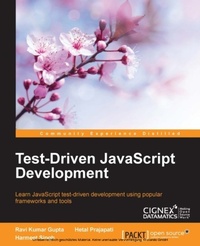
Test-Driven JavaScript Development
Learn JavaScript test-driven development using popular frameworks and tools
Published on 13. January 2025
240 pages
978-1-78528-874-6 (ISBN)
Description

Learn JavaScript test-driven development using popular frameworks and tools
Key Features
[*] Learn the life cycle of TDD and its importance in real-world application
[*] Gain knowledge about popular tools and analyze features, syntax, and how they help in JavaScript testing
[*] Implement test-driven programming exercises using the practical code examples
Book DescriptionInitially, all processing used to happen on the server-side and simple output was the response to web browsers. Nowadays, there are so many JavaScript frameworks and libraries created that help readers to create charts, animations, simulations, and so on. By the time a project finishes or reaches a stable state, so much JavaScript code has already been written that changing and maintaining it further is tedious. Here comes the importance of automated testing and more specifically, developing all that code in a test-driven environment. Test-driven development is a methodology that makes testing the central part of the design process - before writing code developers decide upon the conditions that code must meet to pass a test. The end goal is to help the readers understand the importance and process of using TDD as a part of development. This book starts with the details about test-driven development, its importance, need, and benefits. Later the book introduces popular tools and frameworks like YUI, Karma, QUnit, DalekJS, JsUnit and goes on to utilize Jasmine, Mocha, Karma for advanced concepts like feature detection, server-side testing, and patterns. We are going to understand, write, and run tests, and further debug our programs. The book concludes with best practices in JavaScript testing. By the end of the book, the readers will know why they should test, how to do it most efficiently, and will have a number of versatile tests (and methods for devising new tests) to get to work immediately.What you will learn
[*] Basic TDD fundamentals, life cycle, and benefits
[*] Become acquainted with the concepts and elements of unit testing and writing basic unit tests for JavaScript
[*] Understand the way JsUnit, Qunit, Karma and DalekJs work
[*] Use the Jasmine framework
[*] Interpret feature detection and devise tests specific to cross-browser compatibility
[*] Integrate jsTestDriver with Eclipse and run tests with jsTestDriver
[*] Explore re-factoring, adding and notifying observers
[*] Understand test-driven development in case of server-side JS
Who this book is forIf you have an intermediate knowledge of HTML, CSS, and JavaScript and want to learn how and why the test-driven development approach is better for your assignments, then this book is for you.
Key Features
[*] Learn the life cycle of TDD and its importance in real-world application
[*] Gain knowledge about popular tools and analyze features, syntax, and how they help in JavaScript testing
[*] Implement test-driven programming exercises using the practical code examples
Book DescriptionInitially, all processing used to happen on the server-side and simple output was the response to web browsers. Nowadays, there are so many JavaScript frameworks and libraries created that help readers to create charts, animations, simulations, and so on. By the time a project finishes or reaches a stable state, so much JavaScript code has already been written that changing and maintaining it further is tedious. Here comes the importance of automated testing and more specifically, developing all that code in a test-driven environment. Test-driven development is a methodology that makes testing the central part of the design process - before writing code developers decide upon the conditions that code must meet to pass a test. The end goal is to help the readers understand the importance and process of using TDD as a part of development. This book starts with the details about test-driven development, its importance, need, and benefits. Later the book introduces popular tools and frameworks like YUI, Karma, QUnit, DalekJS, JsUnit and goes on to utilize Jasmine, Mocha, Karma for advanced concepts like feature detection, server-side testing, and patterns. We are going to understand, write, and run tests, and further debug our programs. The book concludes with best practices in JavaScript testing. By the end of the book, the readers will know why they should test, how to do it most efficiently, and will have a number of versatile tests (and methods for devising new tests) to get to work immediately.What you will learn
[*] Basic TDD fundamentals, life cycle, and benefits
[*] Become acquainted with the concepts and elements of unit testing and writing basic unit tests for JavaScript
[*] Understand the way JsUnit, Qunit, Karma and DalekJs work
[*] Use the Jasmine framework
[*] Interpret feature detection and devise tests specific to cross-browser compatibility
[*] Integrate jsTestDriver with Eclipse and run tests with jsTestDriver
[*] Explore re-factoring, adding and notifying observers
[*] Understand test-driven development in case of server-side JS
Who this book is forIf you have an intermediate knowledge of HTML, CSS, and JavaScript and want to learn how and why the test-driven development approach is better for your assignments, then this book is for you.
All prices
More details
Edition
Digital original
Language
English
Place of publication
Birmingham
United Kingdom
Target group
US School Grade: College Graduate Student
Edition type
Digital original
File size
2,40 MB
ISBN-13
978-1-78528-874-6 (9781785288746)
Copyright in bibliographic data and cover images is held by Nielsen Book Services Limited or by the publishers or by their respective licensors: all rights reserved.
Schweitzer Classification
Other editions
Additional editions
Ravi Kumar Gupta | Harmeet Singh | Hetal Prajapati
Test-driven JavaScript Development
Book
12/2015
Packt Publishing
€50.50
Shipment within 3-4 weeks
Persons
Kumar Gupta Ravi :
Ravi Kumar Gupta is an author, reviewer, and open source software evangelist. He pursued an MS degree in software system at BITS Pilani and a B.Tech at LNMIIT, Jaipur. His technological forte is portal management and development. He is currently working with Azilen Technologies, where he acts as a Technical Architect and Project Manager. His previous assignment was as a lead consultant with CIGNEX Datamatics. He was a core member of the open source group at TCS, where he started working on Liferay and other UI technologies. During his career, he has been involved in building enterprise solutions using the latest technologies with rich user interfaces and open source tools. He loves to spend time writing, learning, and discussing new technologies. His interest in search engines and that small project on crawler during college time made him a technology lover. He is one of the authors of Test-Driven JavaScript Development, Packt Publishing. He is an active member of the Liferay forum. He also writes technical articles for his blog at TechD of Computer World (http://techdc.blogspot.in). He has been a Liferay trainer at TCS and CIGNEX, where he has provided training on Liferay 5.x and 6.x versions. He was also a reviewer for Learning Bootstrap, Packt Publishing. He can be reached on Skype at kravigupta, on Twitter at @kravigupta, and on LinkedIn at https://in.linkedin.com/in/kravigupta.
Ravi Kumar Gupta is an author, reviewer, and open source software evangelist. He pursued an MS degree in software system at BITS Pilani and a B.Tech at LNMIIT, Jaipur. His technological forte is portal management and development. He is currently working with Azilen Technologies, where he acts as a Technical Architect and Project Manager. His previous assignment was as a lead consultant with CIGNEX Datamatics. He was a core member of the open source group at TCS, where he started working on Liferay and other UI technologies. During his career, he has been involved in building enterprise solutions using the latest technologies with rich user interfaces and open source tools. He loves to spend time writing, learning, and discussing new technologies. His interest in search engines and that small project on crawler during college time made him a technology lover. He is one of the authors of Test-Driven JavaScript Development, Packt Publishing. He is an active member of the Liferay forum. He also writes technical articles for his blog at TechD of Computer World (http://techdc.blogspot.in). He has been a Liferay trainer at TCS and CIGNEX, where he has provided training on Liferay 5.x and 6.x versions. He was also a reviewer for Learning Bootstrap, Packt Publishing. He can be reached on Skype at kravigupta, on Twitter at @kravigupta, and on LinkedIn at https://in.linkedin.com/in/kravigupta.
Content
Table of Contents
Overview of TDD
Testing Concepts
Testing Tools
Testing with Jasmine
jsTestDriver
Feature Detection
Observer Design Pattern
Testing with Server Side JS
Best Practices
Overview of TDD
Testing Concepts
Testing Tools
Testing with Jasmine
jsTestDriver
Feature Detection
Observer Design Pattern
Testing with Server Side JS
Best Practices

