

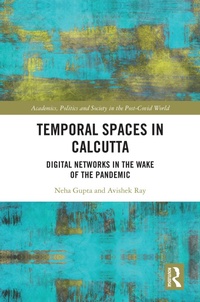
Temporal Spaces in Calcutta
Digital Networks in the Wake of the Pandemic
1st Edition
Published on 26. November 2025
112 pages
978-1-040-44507-5 (ISBN)
Description

This book explores how the COVID-19 pandemic has reshaped urban spatialities through the rise of digitally mediated "temporal spaces" in Calcutta. Focusing on Uber-enabled mobility, cycling pathways, and cafes, it examines how digital infrastructures and human practices intersect to create fluid, dynamic urban experiences. Challenging fixed notions of place-making, the book interrogates what it means to "return to normal" and how digitality reconfigures urban life, sociality, and imagination. By foregrounding the entanglement of digital and material realms, it offers a critical framework for understanding contemporary urban transformations in the wake of crisis and technological mediation.
Part of the Academics, Politics and Society in the Post-Covid World series, this book will be useful for scholars and researchers of sociology, social anthropology, media and cultural studies, digital humanities, human geography, political sociology and postcolonial studies, and those interested in the coronavirus pandemic.
Part of the Academics, Politics and Society in the Post-Covid World series, this book will be useful for scholars and researchers of sociology, social anthropology, media and cultural studies, digital humanities, human geography, political sociology and postcolonial studies, and those interested in the coronavirus pandemic.
Reviews / Votes
Temporal Spaces in Calcutta: Digital Networks in the Wake of the Pandemic offers a timely provocation for questioning how we understand the dynamics of urban space. Neha Gupta and Avishek Ray's exploration of the role of human-digital interface in the conceptualization and navigation of cities helps us understand critical shifts in urban placemaking. The remit of their innovative approach is far-reaching. It urges us to bring the traditional repertoire of political theory in conversation with emergent publics and public spaces, and it asks urban historians and theorists to unlearn the frameworks of representation that we use for analyzing cities.Swati Chattopadhyay, Professor, History of Art and Architecture, University of California, Santa Barbara; Author of Unlearning the City: Infrastructure in a New Optical Field (2012).
The impact of digital cultures on the urban experience in India has brought about profound transformations, reshaping how people navigate, interact, and construct their environments. For digital humanities in India, this pioneering study presents vivid case studies of urban mobility, establishing itself as a groundbreaking contribution to the field. Through the analytic lens of digitality and drawing on extensive fieldwork conducted before and during the pandemic, Neha Gupta and Avishek Ray explore emerging connections in the city of Kolkata, where place-making unfolds at the intersection of online platforms and physical spaces. Their research offers a compelling and thought-provoking examination of how digital mediation is fundamentally redefining the contours of 21st-century urban life in India.
Maya Dodd, Director, FLAME Centre for Legislative Education and Research, FLAME University; Co-editor of Practices of Digital Humanities in India: Learning by Doing (2024).
More details
Series
Edition
1. Auflage
Language
English
Place of publication
London
United Kingdom
Publishing group
Taylor & Francis Ltd
Target group
College/higher education
Illustrations
30 Halftones, black and white; 30 Illustrations, black and white
File size
4,61 MB
ISBN-13
978-1-040-44507-5 (9781040445075)
Copyright in bibliographic data and cover images is held by Nielsen Book Services Limited or by the publishers or by their respective licensors: all rights reserved.
Schweitzer Classification
Other editions
Additional editions
Book
approx. 11/2025
1st Edition
Routledge India
€159.90
Not yet published
Persons
Neha Gupta is a postdoctoral research fellow at the Tata Institute of Social Sciences, Mumbai. She is an urban researcher who focuses on urban information systems and digital infrastructures.
Avishek Ray teaches at the National Institute of Technology Silchar. He is the author of The Vagabond in the South Asian Imagination: Representation, Agency & Resilience (Routledge, 2022) and editor of Decolonial Travel: Vernacular Mobilities in India (Routledge, 2025). In 2021, his academic excellence was recognized with the Fulbright-Nehru Academic and Professional Excellence Fellowship.
Avishek Ray teaches at the National Institute of Technology Silchar. He is the author of The Vagabond in the South Asian Imagination: Representation, Agency & Resilience (Routledge, 2022) and editor of Decolonial Travel: Vernacular Mobilities in India (Routledge, 2025). In 2021, his academic excellence was recognized with the Fulbright-Nehru Academic and Professional Excellence Fellowship.
Content
Chapter 1: Introduction Chapter 2: Uber Spaces: Regimes of Legibility Chapter 3: Cycling Spaces: Local Provisioning, Networks, and Jugaad Chapter 4: Cafe Spaces: "Personal Touch", Mediated Digitally Conclusion
