

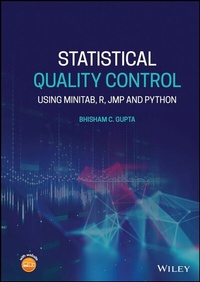
Statistical Quality Control
Description

Provides a basic understanding of statistical quality control (SQC) and demonstrates how to apply the techniques of SQC to improve the quality of products in various sectors
This book introduces Statistical Quality Control and the elements of Six Sigma Methodology, illustrating the widespread applications that both have for a multitude of areas, including manufacturing, finance, transportation, and more. It places emphasis on both the theory and application of various SQC techniques and offers a large number of examples using data encountered in real life situations to support each theoretical concept.
Statistical Quality Control: Using MINITAB, R, JMP and Python begins with a brief discussion of the different types of data encountered in various fields of statistical applications and introduces graphical and numerical tools needed to conduct preliminary analysis of the data. It then discusses the basic concept of statistical quality control (SQC) and Six Sigma Methodology and examines the different types of sampling methods encountered when sampling schemes are used to study certain populations. The book also covers Phase 1 Control Charts for variables and attributes; Phase II Control Charts to detect small shifts; the various types of Process Capability Indices (CPI); certain aspects of Measurement System Analysis (MSA); various aspects of PRE-control; and more. This helpful guide also
* Focuses on the learning and understanding of statistical quality control for second and third year undergraduates and practitioners in the field
* Discusses aspects of Six Sigma Methodology
* Teaches readers to use MINITAB, R, JMP and Python to create and analyze charts
* Requires no previous knowledge of statistical theory
* Is supplemented by an instructor-only book companion site featuring data sets and a solutions manual to all problems, as well as a student book companion site that includes data sets and a solutions manual to all odd-numbered problems
Statistical Quality Control: Using MINITAB, R, JMP and Python is an excellent book for students studying engineering, statistics, management studies, and other related fields and who are interested in learning various techniques of statistical quality control. It also serves as a desk reference for practitioners who work to improve quality in various sectors, such as manufacturing, service, transportation, medical, oil, and financial institutions. It's also useful for those who use Six Sigma techniques to improve the quality of products in such areas.
More details
Other editions
Additional editions
Person
Bhisham C. Gupta, PhD, is Professor Emeritus of Statistics at the University of Southern Maine, where he has taught for 31 years. Prior to coming to USM as a full professor in 1985, Dr. Gupta served for 21 years at various institutions in Canada, Brazil, and India. He is the co-author of Statistics and Probability with Applications for Engineers and Scientists, First Edition and Second Edition, as well as the accompanying solutions manuals, all published by Wiley. He is also co-author of three books published by American Society for Quality (ASQ).
Content
Preface xiii
About the Companion Website xix
1 Quality Improvement and Management 1
1.1 Introduction 1
1.2 Statistical Quality Control 1
1.2.1 Quality and the Customer 2
1.2.2 Quality Improvement 3
1.2.3 Quality and Productivity 5
1.3 Implementing Quality Improvement 6
1.3.1 Outcomes of Quality Control 7
1.3.2 Quality Control and Quality Improvement 7
1.3.2.1 Acceptance Sampling Plans 7
1.3.2.2 Process Control 8
1.3.2.3 Removing Obstacles to Quality 8
1.3.2.4 Eliminating Productivity Quotas 9
1.3.3 Implementing Quality Improvement 9
1.4 Managing Quality Improvement 10
1.4.1 Management and Their Responsibilities 10
1.4.2 Management and Quality 11
1.4.3 Risks Associated with Making Bad Decisions 11
1.5 Conclusion 12
2 Basic Concepts of the Six Sigma Methodology 13
2.1 Introduction 13
2.2 What Is Six Sigma? 13
2.2.1 Six Sigma as a Management Philosophy 13
2.2.2 Six Sigma as a Systemic Approach to Problem Solving 14
2.2.3 Six Sigma as a Statistical Standard of Quality 15
2.2.3.1 Statistical Basis for Six Sigma 16
2.2.4 Six Sigma Roles 18
2.3 Is Six Sigma New? 19
2.4 Quality Tools Used in Six Sigma 20
2.4.1 The Basic Seven Tools and the New Seven Tools 20
2.4.2 Lean Tools 21
2.4.2.1 Eight Wastes 21
2.4.2.2 Visual Management 22
2.4.2.3 The 5S Method 23
2.4.2.4 Value-Stream Mapping 24
2.4.2.5 Mistake-Proofing 24
2.4.2.6 Quick Changeover 24
2.5 Six Sigma Benefits and Criticism 25
2.5.1 Why Do Some Six Sigma Initiatives Fail? 25
Review Practice Problems 26
3 Describing Quantitative and Qualitative Data 27
3.1 Introduction 27
3.2 Classification of Various Types of Data 27
3.3 Analyzing Data Using Graphical Tools 29
3.3.1 Frequency Distribution Tables for Qualitative and Quantitative Data 29
3.3.1.1 Qualitative Data 30
3.3.1.2 Quantitative Data 31
3.4 Describing Data Graphically 33
3.4.1 Dot Plots 33
3.4.2 Pie Charts 34
3.4.3 Bar Charts 36
3.4.4 Histograms 41
3.4.5 Line Graphs 43
3.4.6 Measures of Association 45
3.5 Analyzing Data Using Numerical Tools 49
3.5.1 Numerical Measures 49
3.5.2 Measures of Centrality 49
3.5.2.1 Mean 50
3.5.2.2 Median 51
3.5.2.3 Mode 53
3.5.3 Measures of Dispersion 54
3.5.3.1 Range 54
3.5.3.2 Variance 55
3.5.3.3 Standard Deviation 56
3.5.3.4 Empirical Rule 58
3.5.3.5 Interquartile Range 60
3.5.4 Box-and-Whisker Plot 61
3.6 Some Important Probability Distributions 63
3.6.1 The Binomial Distribution 63
3.6.1.1 Binomial Probability Tables 64
3.6.2 The Hypergeometric Distribution 65
3.6.2.1 Mean and Standard Deviation of a Hypergeometric Distribution 68
3.6.3 The Poisson Distribution 69
3.6.3.1 Mean and Standard Deviation of a Poisson Distribution 71
3.6.3.2 Poisson Probability Tables 71
3.6.4 The Normal Distribution 73
Review Practice Problems 80
4 Sampling Methods 89
4.1 Introduction 89
4.2 Basic Concepts of Sampling 89
4.2.1 Introducing Various Sampling Designs 91
4.3 Simple Random Sampling 93
4.3.1 Estimating the Population Mean and Population Total 94
4.3.2 Confidence Interval for the Population Mean and Population Total 98
4.3.3 Determining Sample Size 99
4.4 Stratified Random Sampling 100
4.4.1 Estimating the Population Mean and Population Total 100
4.4.2 Confidence Interval for the Population Mean and Population Total 103
4.4.3 Determining Sample Size 105
4.5 Systematic Random Sampling 107
4.5.1 Estimating the Population Mean and Population Total 107
4.5.2 Confidence Interval for the Population Mean and Population Total 109
4.5.3 Determining the Sample Size 109
4.6 Cluster Random Sampling 112
4.6.1 Estimating the Population Mean and Population Total 112
4.6.2 Confidence Interval for the Population Mean and Population Total 114
4.6.3 Determining the Sample Size 116
Review Practice Problems 117
5 Phase I Quality Control Charts for Variables 123
5.1 Introduction 123
5.2 Basic Definition of Quality and Its Benefits 123
5.3 Statistical Process Control 124
5.3.1 Check Sheets 126
5.3.2 Pareto Chart 128
5.3.3 Cause-and-Effect (Fishbone or Ishikawa) Diagrams 129
5.3.4 Defect-Concentration Diagrams 130
5.3.5 Run Charts 131
5.4 Control Charts for Variables 133
5.4.1 Process Evaluation 133
5.4.2 Action on the Process 133
5.4.3 Action on the Output 133
5.4.4 Variation 133
5.4.4.1 Common Causes (Random Causes) 134
5.4.4.2 Special Causes (Assignable Causes) 134
5.4.4.3 Local Actions and Actions on the System 134
5.4.4.4 Relationship Between Types of Variation 134
5.4.5 Control Charts 135
5.4.5.1 Preparation for Using Control Charts 136
5.4.5.2 Benefits of Control Charts 137
5.4.5.3 Rational Samples for control Charts 137
5.5 Shewhart X and R Control Charts 141
5.5.1 Calculating Sample Statistics 141
5.5.2 Calculating Control Limits 141
5.5.3 Interpreting Shewhart X and R Control Charts 146
5.5.4 Extending the Current Control Limits for Future Control 147
5.6 Shewhart X and R Control Charts When the Process Mean and Standard Deviation are Known 149
5.7 Shewhart X and R Control Charts for Individual Observations 150
5.8 Shewhart X and S Control Charts with Equal Sample Sizes 154
5.9 Shewhart X and S Control Charts with Variable Sample Sizes 157
5.10 Process Capability 161
6 Phase I Control Charts for Attributes 173
6.1 Introduction 173
6.2 Control Charts for Attributes 173
6.3 The p Chart: Control Charts for Nonconforming Fractions with Constant Sample Sizes 174
6.3.1 Control Limits for the p Control Chart 175
6.3.2 Interpreting the Control Chart for Nonconforming Fractions 176
6.4 The p Chart: Control Chart for Nonconforming Fractions with Variable Samples Sizes 179
6.5 The np Chart: Control Charts for the Number of Nonconforming Units 182
6.5.1 Control Limits for np Control Charts 183
6.6 The c Control Chart - Control Charts for Nonconformities per Sample 184
6.7 The u Chart 188
Review Practice Problems 193
7 Phase II Quality Control Charts for Detecting Small Shifts 201
7.1 Introduction 201
7.2 Basic Concepts of CUSUM Control Charts 202
7.2.1 CUSUM Control Charts vs. Shewhart X and R Control Charts 202
7.3 Designing a CUSUM Control Chart 205
7.3.1 Two-Sided CUSUM Control Charts Using the Numerical Procedure 206
7.3.2 The Fast Initial Response (FIR) Feature for CUSUM Control Charts 212
7.3.3 One-Sided CUSUM Control Charts 216
7.3.4 Combined Shewhart-CUSUM Control Charts 216
7.3.5 CUSUM Control Charts for Controlling Process Variability 217
7.4 Moving Average (MA) Control Charts 218
7.5 Exponentially Weighted Moving Average (EWMA) Control Charts 223
Review Practice Problems 229
8 Process and Measurement System Capability Analysis 237
8.1 Introduction 237
8.2 Development of Process Capability Indices 238
8.3 Various Process Capability Indices 239
8.3.1 Process Capability Index: Cp 239
8.3.2 Process Capability Index: Cpk 244
8.3.3 Process Capability Index: Cpm 247
8.3.4 Process Capability Index: Cpmk 249
8.3.5 Process Capability Index: Cpnst 250
8.3.5.1 Comparing Cpnst with Cpk and Cpm 252
8.3.5.2 Other Features of Cpnst 253
8.3.6 Process Performance Indices: Pp and Ppk 254
8.4 Pre-control 255
8.4.1 Global Perspective on the Use of Pre-control - Understanding the Color-Coding Scheme 257
8.4.2 The Mechanics of Pre-control 258
8.4.3 The Statistical Basis for Pre-control 259
8.4.4 Advantages and Disadvantages of Pre-control 259
8.4.4.1 Advantages of Pre-control 260
8.4.4.2 Disadvantages of Pre-control 260
8.5 Measurement System Capability Analysis 261
8.5.1 Evaluating Measurement System Performance 262
8.5.2 The Range Method 262
8.5.3 The ANOVA Method 268
8.5.4 Graphical Representation of a Gauge R&R Study 272
8.5.5 Another Measurement Capability Index 275
Review Practice Problems 275
9 Acceptance Sampling Plans 283
9.1 Introduction 283
9.2 The Intent of Acceptance Sampling Plans 283
9.3 Sampling Inspection vs. 100% Inspection 284
9.4 Classification of Sampling Plans 284
9.4.1 Formation of Lots for Acceptance Sampling Plans 285
9.4.2 The Operating Characteristic (OC) Curve 285
9.4.3 Two Types of OC Curves 288
9.4.4 Some Terminology Used in Sampling Plans 288
9.5 Acceptance Sampling by Attributes 292
9.5.1 Acceptable Quality Limit (AQL) 292
9.5.2 Average Outgoing Quality (AOQ) 292
9.5.3 Average Outgoing Quality Limit (AOQL) 293
9.5.4 Average Total Inspection (ATI) 293
9.6 Single Sampling Plans for Attributes 296
9.7 Other Types of Sampling Plans for Attributes 296
9.7.1 Double-Sampling Plans for Attributes 296
9.7.2 The OC Curve 297
9.7.3 Multiple-Sampling Plans 301
9.7.4 Average Sample Number 301
9.7.5 Sequential-Sampling Plans 301
9.8 ANSI/ASQ Z1.4-2003 Sampling Standard and Plans 305
9.8.1 Levels of Inspection 306
9.8.2 Types of Sampling 308
9.9 Dodge-Romig Tables 309
9.10 ANSI/ASQ Z1.9-2003 Acceptance Sampling Plans by Variables 309
9.10.1 ANSI/ASQ Z1.9-2003 - Variability Known 310
9.10.2 Variability Unknown - Standard Deviation Method 311
9.10.3 Variability Unknown - Range Method 313
9.11 Continuous-Sampling Plans 314
9.11.1 Types of Continuous-Sampling Plans 315
9.11.2 Dodge's Continuous Sampling Plans 315
9.11.3 MIL-STD-1235B 315
Review Practice Problems 316
10 Computer Resources to Support SQC: Minitab, R, JMP, and Python 339
Appendix A Statistical Tables 341
Appendix B Answers to Selected Practice Problems 357
Bibliography 361
Index 365
Preface
This is an introductory textbook on statistical quality control (SQC), an important part of applied statistics that is used regularly to improve the quality of products throughout manufacturing, service, transportation, and other industries. The objective of this book is to provide a basic but sound understanding of how to apply the various techniques of SQC to improve the quality of products in various sectors. Knowledge of statistics is not a prerequisite for using this text. Also, this book does not assume any knowledge of calculus. However, a basic knowledge of high school algebra is both necessary and sufficient to grasp the material presented in this book.
Various concepts of the Six Sigma methodology are also discussed. Six Sigma methodology calls for many more statistical tools than are reasonable to address in one book; accordingly, the intent here is to provide Six Sigma team members with some basic statistical concepts, along with an extensive discussion of SQC tools in a way that addresses both the underlying statistical concepts and their applications.
Audience
This book is written for second-year or third-year college/university students who are enrolled in engineering or majoring in statistics, management studies, or any other related field, and are interested in learning various SPC techniques. The book can also serve as a desk reference for practitioners who work to improve quality in sectors such as manufacturing, service, transportation, medical, oil, and financial institutions, or for those who are using Six Sigma techniques to improve the quality of products in such areas. This book will also serve those who are preparing for certification in Six Sigma training, such as the Six Sigma Green Belt. In the Western world, these kinds of certifications are very common, particularly in the manufacturing, service, transportation, medical, and oil industries.
Topics Covered in This Book
In Chapter 1, we introduce the basic concept of quality, as discussed by various pioneer statisticians, engineers, and practitioners. A few important pioneers in this area are W. Edwards Deming, Joseph M. Juran, Philip B. Crosby, and Armand V. Feigenbaum. Concepts of quality control and quality improvements are discussed. Finally, we discuss how management can help improve product quality.
In Chapter 2, we introduce the Six Sigma methodology. In the current era, Six Sigma methodology is considered the statistical standard of quality. During the past three decades, Six Sigma methodology has become an integral part of many manufacturing and service companies throughout the world. The benefits of Six Sigma methodology are also discussed.
In Chapter 3, we introduce the different types of data that we encounter in various fields of statistical applications, and we define some terminology, such as population, sample, and different measures. We then introduce various graphical and numerical tools needed to conduct preliminary analyses of data. We introduce the statistical software packages Minitab version 19, Rx64 3.6.0. Finally, some discrete and continuous probability distributions commonly encountered in the application of SQC are discussed.
In Chapter 4, we study different types of sampling methods - simple random sampling, stratified random sampling, cluster random sampling, and systematic random sampling - that are encountered whenever we use sampling schemes to study specific populations. Then we discuss how estimates of various population parameters are derived under different sampling methods.
In Chapter 5, we discuss Phase I control charts for variables. Phase I control charts are used to detect large shifts in a given process in any manufacturing or service industry. Large shifts usually occur when a process is either brand-new or has undergone drastic changes: for example, a new industry is started and/or new machines are installed in an established industry. This also occurs when a significant new technology is introduced. These kinds of changes can also usually occur whenever a high level of administration is changed: for example, a new CEO or CTO (Chief Technical Officer) is hired.
In Chapter 6, we discuss Phase I control charts for attributes. Control charts for attributes are used whenever we collect a set of counted data. Again, Phase I control charts are used to detect significant shifts in a given process established in any manufacturing or service industry.
In Chapter 7, we discuss Phase II control charts to detect small shifts. Small shifts usually occur when a well-established process has just experienced small changes. Some examples include workers having gone through some kind of training or specific machines having had their annual checkups, calibrations, or renovations, etc.
In Chapter 8, we discuss various types of process capability indices (PCIs). PCIs are used when a process is well established and the manufacturer or a service provider wants to ensure that they can deliver a product that meets the consumer's requirements. In this chapter, we discuss how to use PCIs to help any given industry avoid the severe consequences of heavy losses. Then we discuss various aspects of pre-control, which is an important tool in SQC. As we discuss later, in Chapter 9, different sampling schemes are used to sort out the defective parts from shipments. Pre-control is a mechanism to reduce the amount of sampling and inspection required to validate that a process is producing products consistent with customer's expectations. In the last part of this chapter, we discuss aspects of measurement system analysis (MSA). Sometimes a measurement system is responsible for the bad quality of a product; proper MSA can avoid a measurement system that may become the root cause of a product's failure.
In Chapter 9, we discuss various kind of acceptance sampling schemes that are still in use in some places in the world. These schemes were used frequently in the United States during World War II, when armaments and ammunitions were being produced in huge quantities. However, these sampling schemes are currently not very popular since they are sometimes very expensive to use and are often not very effective. The methods discussed in the previous chapters are more effective in achieving processes that produce better-quality products. Finally, we discuss some sampling standards and plans: ANSI/ASQ Z1.4-2003, ANSI/ASQ Z1.9-2003, Dodge's Continuous Sampling Plans and MIL-STD-1235B.
Chapter 10 is available for download on the book's website: www.wiley.com/college/gupta/SQC. This chapter presents more detail about the statistical software packages used in this text. In Chapter 3, we introduce the statistical software packages Minitab and R; but due to lack of space, certain basic concepts of these packages are not discussed. In Chapter 10, we discuss these additional aspects of Minitab and R. We also discuss two other statistical packages: JMP and Python. Then, using JMP and Python, we study SQC techniques using examples handled earlier in the book with Minitab and R. After going through the material presented in this chapter, you will be able to analyze different data situations using Minitab, R, JMP, and/or Python; cover all of the SQC techniques discussed in this book; and implement them in various sectors whenever and wherever high-quality products are desired.
Approach
In this text, we emphasize both theory and application of SQC techniques. Each theoretical concept is supported by a large number of examples using data encountered in real-life situations. Further, we illustrate how the statistical packages Minitab® version 19, R® version 3.6.0, JMP® Pro-15, and Python® version 3.7 are used to solve problems encountered when using SQC techniques.
Hallmark Features
As indicated, we incorporate the statistical packages Minitab and R throughout the text and discuss JMP and Python examples in Chapter 10. Our step-by-step approach with these statistical packages means that no prior knowledge of their use is required. After completing a course that includes this book, you will be able to use these statistical packages to analyze statistical data in quality control. Familiarity with the quality control features of these packages will further aid you as you learn additional features pertaining to other related fields of interest.
Student Resources
- Data sets with 20 or more data points in examples and exercises are saved as Minitab, CSV (ANSI), and JMP files and available on the book's website: www.wiley.com/college/gupta/SQC. The CSV (ANSI) files can easily be imported into the R and Python software discussed in this book.
- Solutions to all of the odd-numbered review practice problems presented in this text are available to students on the book's website: www.wiley.com/college/gupta/SQC.
Instructor Resources
- Data sets with 20 or more data points in examples and exercises are saved as Minitab, CSV (ANSI), and JMP files and made available on the book's website: www.wiley.com/college/gupta/SQC. The CSV (ANSI) files can easily be imported into the R and Python software discussed in this book.
- Solutions to all review practice problems presented in this text are available to instructors on the book's website:...
