

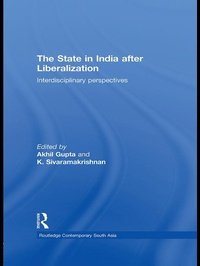
The State in India after Liberalization
Interdisciplinary Perspectives
1st Edition
Published on 4. October 2010
256 pages
978-1-136-93720-0 (ISBN)
Description

This book assesses the impact of liberalization on practices of government and relations between state and society. It is clear that liberalization as state policy has complex forms of regulation and deregulation inbuilt, and these policies have resulted in dramatic increases in productivity and economic wealth but also generated spectacular new forms of inequality between social groups, regions, and sectors.
Through a detailed examination of the Indian state, the contributors - all experts in their respective fields - explore questions such as:
Have the new inequalities resulted in greater social unrest and violence?
How has the meaning of citizenship changed?
What will the long-term effects of regional economic imbalances be on migration, employment, and social welfare?
Will increasing federalism result in new problems?
Will smaller governments be more effective in providing basic necessities such as clothing, housing, food, water, and sanitation to citizens?
What does liberalization mean to Indians in cities and villages, in small towns, and metropolises, in poor, middle class, or wealthy homes?
Are concepts like social capital, decentralization, private enterprise, and grass-roots globalization effective in analyzing the post-liberalization state, or are new concepts needed?
By focusing on what specifically has changed about the state after liberalization in India, this volume will shed light on comparative questions about the process of neoliberal restructuring across the world. As such, it will be of interest to scholars of a variety of disciplines, including sociology, anthropology, political science, geography, international studies, public policy, environmental studies and economics.
Through a detailed examination of the Indian state, the contributors - all experts in their respective fields - explore questions such as:
Have the new inequalities resulted in greater social unrest and violence?
How has the meaning of citizenship changed?
What will the long-term effects of regional economic imbalances be on migration, employment, and social welfare?
Will increasing federalism result in new problems?
Will smaller governments be more effective in providing basic necessities such as clothing, housing, food, water, and sanitation to citizens?
What does liberalization mean to Indians in cities and villages, in small towns, and metropolises, in poor, middle class, or wealthy homes?
Are concepts like social capital, decentralization, private enterprise, and grass-roots globalization effective in analyzing the post-liberalization state, or are new concepts needed?
By focusing on what specifically has changed about the state after liberalization in India, this volume will shed light on comparative questions about the process of neoliberal restructuring across the world. As such, it will be of interest to scholars of a variety of disciplines, including sociology, anthropology, political science, geography, international studies, public policy, environmental studies and economics.
Reviews / Votes
"The contributions to this volume provide a colourful panorama of life in 'liberalized' India. The state is not always directly visible in these contributions, but the changed conditions of political life in the 'new' India are well illustrated by all those who have summed up their interesting field work in this publication." - Dietmar Rothermund, H-Soz-u-Kult, 2011More details
Series
Edition
1. Auflage
Language
English
Place of publication
London
United Kingdom
Publishing group
Taylor & Francis Ltd
Target group
College/higher education
Illustrations
2 s/w Abbildungen, 6 s/w Tabellen, 2 s/w Zeichnungen
6 Tables, black and white; 2 Line drawings, black and white; 2 Illustrations, black and white
File size
1,74 MB
ISBN-13
978-1-136-93720-0 (9781136937200)
Copyright in bibliographic data and cover images is held by Nielsen Book Services Limited or by the publishers or by their respective licensors: all rights reserved.
Schweitzer Classification
Other editions
Additional editions
Akhil Gupta | Kalyanakrishnan Sivaramakrishnan
The State in India after Liberalization
Interdisciplinary Perspectives
Book
05/2012
1st Edition
Routledge
€71.50
Shipment within 15-20 days
Akhil Gupta | Kalyanakrishnan Sivaramakrishnan
The State in India after Liberalization
Interdisciplinary Perspectives
Book
09/2010
1st Edition
Routledge
€231.80
Shipment within 15-20 days
Persons
Akhil Gupta is Professor of Anthropology at the University of California in Los Angeles. His research interests lie in political anthropology, cultural theory and cultural geography, postcolonial studies, development, and food and the environment.
K. Sivaramakrishnan is Professor of Anthropology at Yale University. An environmental historian and political anthropologist, his research interests include colonial and contemporary forest and nature conservation in South Asia, rural and regional development, comparative social theory, and the cultural geography of migration in India.
K. Sivaramakrishnan is Professor of Anthropology at Yale University. An environmental historian and political anthropologist, his research interests include colonial and contemporary forest and nature conservation in South Asia, rural and regional development, comparative social theory, and the cultural geography of migration in India.
Content
Introduction: The State in India After Liberalization Part 1: The Indian State as Moral and Political Economy 1. On the Enchantment of the State 2. An Institutional Perspective on the Post-liberalization State in India Part 2: Citizens, Sociality, and Association 3. States of Empowerment 4. 'New Politics' and the Governmentality of the Post-liberalization State in India: An Ethnographic Perspective Part 3: Liberalization, the State, and the Experience of Poverty 5. Poverty Knowledge and Poverty Action in India 6. 'Money Itself Discriminates': Obstetric Crises in the Time of Liberalization Part 4: Law, Identity, and Rights 7. Normative Vision, Cultural Accommodation and Muslim Law Reform in India 8. The Rule of Law and the Rule of Property: Law-Struggles and the Neo-Liberal State in India Part 5: Enterprising Citizens 9. The Terms of Trade: Competition and Cooperation in Neoliberal North India 10. Becoming Entrepreneurial Subjects: Neoliberalism and Media
