

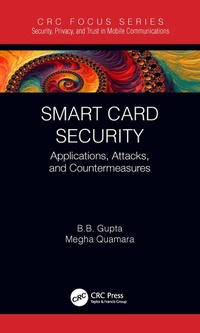
Smart Card Security
Applications, Attacks, and Countermeasures
1st Edition
Published on 8. August 2019
138 pages
978-1-000-69835-0 (ISBN)
Description

Smart Card Security: Applications, Attacks, and Countermeasures provides an overview of smart card technology and explores different security attacks and countermeasures associated with it. It covers the origin of smart cards, types of smart cards, and how they work. It discusses security attacks associated with hardware, software, data, and users that are a part of smart card-based systems.
The book starts with an introduction to the concept of smart cards and continues with a discussion of the different types of smart cards in use today, including various aspects regarding their configuration, underlying operating system, and usage. It then discusses different hardware- and software-level security attacks in smart card-based systems and applications and the appropriate countermeasures for these security attacks. It then investigates the security attacks on confidentiality, integrity, and availability of data in smart card-based systems and applications, including unauthorized remote monitoring, communication protocol exploitation, denial of service (DoS) attacks, and so forth, and presents the possible countermeasures for these attacks.
The book continues with a focus on the security attacks against remote user authentication mechanisms in smart card-based applications and proposes a possible countermeasure for these attacks. Then it covers different communication standards for smart card-based applications and discusses the role of smart cards in various application areas as well as various open-source tools for the development and maintenance of smart card-based systems and applications. The final chapter explains the role of blockchain technology for securing smart card-based transactions and quantum cryptography for designing secure smart card-based algorithms.
Smart Card Security: Applications, Attacks, and Countermeasures provides you with a broad overview of smart card technology and its various applications.
The book starts with an introduction to the concept of smart cards and continues with a discussion of the different types of smart cards in use today, including various aspects regarding their configuration, underlying operating system, and usage. It then discusses different hardware- and software-level security attacks in smart card-based systems and applications and the appropriate countermeasures for these security attacks. It then investigates the security attacks on confidentiality, integrity, and availability of data in smart card-based systems and applications, including unauthorized remote monitoring, communication protocol exploitation, denial of service (DoS) attacks, and so forth, and presents the possible countermeasures for these attacks.
The book continues with a focus on the security attacks against remote user authentication mechanisms in smart card-based applications and proposes a possible countermeasure for these attacks. Then it covers different communication standards for smart card-based applications and discusses the role of smart cards in various application areas as well as various open-source tools for the development and maintenance of smart card-based systems and applications. The final chapter explains the role of blockchain technology for securing smart card-based transactions and quantum cryptography for designing secure smart card-based algorithms.
Smart Card Security: Applications, Attacks, and Countermeasures provides you with a broad overview of smart card technology and its various applications.
More details
Series
Edition
1. Auflage
Language
English
Place of publication
London
United Kingdom
Publishing group
Taylor & Francis Ltd
Target group
College/higher education
Professional and scholarly
Illustrations
15 Tables, black and white
ISBN-13
978-1-000-69835-0 (9781000698350)
Copyright in bibliographic data and cover images is held by Nielsen Book Services Limited or by the publishers or by their respective licensors: all rights reserved.
Schweitzer Classification
Other editions
Additional editions
Book
08/2022
1st Edition
CRC Press
€29.90
Shipment within 10-20 days
Book
08/2019
1st Edition
CRC Press
€80.90
Shipment within 15-20 days
Persons
Dr. Brij B. Gupta received PhD degree from Indian Institute of Technology Roorkee, India in the area of Information and Cyber Security. In 2009, he was selected for Canadian Commonwealth Scholarship awarded by Government of Canada. He published more than 175 research papers in International Journals and Conferences of high repute including IEEE, Elsevier, ACM, Springer, Wiley, Taylor & Francis, Interscience, etc. He has visited several countries, i.e. Canada, Japan, Malaysia, Australia, China, Hong Kong, Italy, Spain, etc. to present his research work. His biography was selected and published in the 30th Edition of Marquis Who's Who in the World, 2012. Dr. Gupta also received Young Faculty research fellowship award from Ministry of Electronics and Information Technology, Government of India in 2017. He is also working as principal investigator of various R&D projects. He is serving as associate editor of IEEE Access, IEEE TII, Associate editor of IJICS, Interscience and Executive editor of IJITCA, Interscience, respectively. He is also serving as reviewer for journals of IEEE, Springer, Wiley, Taylor & Francis, etc. He is also serving as guest editor of various reputed Journals. He was also visiting researcher with University of Murcia (UMU), Spain, Deakin University, Australia and Yamaguchi University, Japan in 2018, 2017 and 2015, respectively. At present, Dr. Gupta is an Assistant Professor in the Department of Computer Engineering, National Institute of Technology, Kurukshetra, India. His research interest include information security, cyber security, Cloud computing, Web security, intrusion detection, and phishing.
Ms. Megha Quamara received her Master of Technology (M. Tech.) degree specialized in cyber security from National Institute of Technology (NIT), Kurukshetra, India, in 2018, and Bachelor of Technology (B. Tech.) degree in Computer Science and Engineering from University Institute of Engineering and Technology (UIET), Kurukshetra University, India, in 2015. Her research interests include security in Internet of Things (IoT) and Cloud computing, authentication in smart card technology, and data privacy.
Ms. Megha Quamara received her Master of Technology (M. Tech.) degree specialized in cyber security from National Institute of Technology (NIT), Kurukshetra, India, in 2018, and Bachelor of Technology (B. Tech.) degree in Computer Science and Engineering from University Institute of Engineering and Technology (UIET), Kurukshetra University, India, in 2015. Her research interests include security in Internet of Things (IoT) and Cloud computing, authentication in smart card technology, and data privacy.
Content
List of Figures
List of Tables
Preface
Acknowledgment
About the Authors
1 Smart Cards: Evolution, Statistics, and Forecasts
2 Classification of Smart Cards and How They Work
3 Hardware-Level Security Attacks and Logical Threats in Smart Cards
4 Data Security in Smart Cards
5 Remote User Authentication Mechanisms in Smart Card-Based Applications
6 Smart Card Communication Standards, Applications, and Development Tools
7 Blockchain Integration and Quantum Smart Cards
Index
List of Tables
Preface
Acknowledgment
About the Authors
1 Smart Cards: Evolution, Statistics, and Forecasts
2 Classification of Smart Cards and How They Work
3 Hardware-Level Security Attacks and Logical Threats in Smart Cards
4 Data Security in Smart Cards
5 Remote User Authentication Mechanisms in Smart Card-Based Applications
6 Smart Card Communication Standards, Applications, and Development Tools
7 Blockchain Integration and Quantum Smart Cards
Index
