

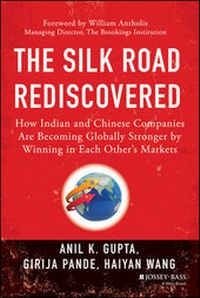
The Silk Road Rediscovered
Description

More details
Other editions
Additional editions
Persons
Content
Foreword
Are India and China natural rivals? Do their deeply different and contrasting histories, cultures, institutions, and economies lead them to compete in a zero-sum manner? Or can these near reverse-image giants complement and attract one another, building a common future? The fate of one-third of humanity lies in the balance of these questions.
For nearly a half century, the dominant view of American political and economic leaders has been that Asia's two great civilizations are destined to clash. Asia's two giants have given little reason for foreigners to believe that they are capable of forging a common future.
I have experienced the pessimistic view first hand-in America, and in both India and China. My first glimpse was in Washington, DC. In November 2011, before departing for my own five-month study tour across Asia, I met with a senior U.S. government official responsible for policy toward China. In the center of his coffee table was one book, and only one book. It was Robert Kaplan's latest: Monsoon: The Indian Ocean and the Future of American Power. Kaplan's compelling travelogue explored strategic investments by Chinese state-owned companies in ports surrounding India and also examined India's emerging strengths as a democracy and market economy.
Many senior U.S. officials bought Kaplan's argument, sharing his view that the U.S. should take advantage of the tension between Chinese state-driven capitalism and India's emerging high-tech democracy. For the United States, stronger ties with India could serve as a counterweight to China. This asymmetric treatment of the world's two largest nations would become a centerpiece of the Obama administration's "pivot to Asia."
Seeing Indian and Chinese differences as the basis for a rivalry to be exploited is a time-tested tradition in U.S. foreign policy. Senior officials in the Truman, Eisenhower, and Kennedy administrations all saw democratic India as a bulwark against communist China. President Nixon's détente with China turned those tables around. America soon became fascinated with a more open and capitalistic China, and began to compare it to a sclerotic India, mired in an archaic caste system and endemic corruption. It took another two decades for the pendulum to swing back toward India, only after the Tiananmen Square event and China's growing export prowess began to steer American leaders toward a more wary assessment. Presidents Clinton and Bush began to explore a deeper relationship with a more liberal and resurgent India as a like-minded ally.
Regardless of which way these American officials leaned, they were all inclined to focus on the differences between China and India. And who can blame them? Anyone who has spent time in India and China immediately focuses on the contrasts, and tries to assess them. Many have sided with the enormous economic success of China. When travelling with my family in 2012, my eight-year-old daughter seemed to take this perspective. As we arrived in Beijing after nine weeks in India, and sped down a modern freeway toward our steel-and-glass service apartment, she said approvingly, "Daddy, this looks more like America." The Chinese emphasis on manufacturing, infrastructure, and social order make China's leading cities appear to be modern, Asian versions of Western cities.
By contrast, Indian cities appear more chaotic, interspersing glimpses of modernity with cows wandering aimlessly through city traffic. Slums jostle right alongside downtown business districts. Driving down an Indian road is multitasking for the senses-with a panorama of colors, a cacophony of horns and bells, smells of sewage and incense, and the grit and dust of roads in transition.
Still, for all of India's chaos, there is much for an American to admire, if not love. The country's deep commitment to democracy, freedom of speech and press, protection of religious minorities, and attention to the rural poor remain its long-term strength. China's far more hierarchical, authoritarian culture, with little public debate, seems opaque to most Americans. When that system seemed to work, many foreigners were willing to dismiss its moral failings. But in recent years, its ineffectiveness has begun to shine through. China's economic growth has slowed and it also has left in its wake staggering air pollution, toxic rivers, unsafe food, and rampant corruption.
But do these stark differences automatically lead to rivalry for the world's two most populous countries? Or are they an opportunity for greater cooperation? At its most basic level, international trade and investment have been all about making matches when two nations have complementary assets.
That is the starting point for Anil Gupta, Girija Pande, and Haiyan Wang's terrific volume. In seeing Chinese and Indian differences as an opportunity, they have been careful to stay away from misty-eyed optimism. A major strength of this book is that Gupta, Pande, and Wang start with what works. Whether it is Indian tech instructors helping Chinese universities or Chinese manufacturers working on the ground in India, the specific details show that cooperation is real-and really valuable.
These successes, in turn, speak to broader common themes emerging in both countries. Throughout this volume, the authors remind the reader of deeper trends and histories in both countries that potentially bind them together. Several of those themes are worth noting upfront.
First and foremost, each in their own way, both countries have made a basic commitment to private enterprise. That commitment is not to be taken lightly. Resistance to capitalism lingers in these two nations that still, on paper, call themselves communist and socialist. Still, it is the growing role of the private sector that is expanding cooperation between both countries.
Gupta, Pande, and Wang's work is so critical because, for that commitment to succeed, these nations need to reinforce in one another the centrality of market forces to economic growth. Much in the same way that France and Germany learned to make their market economies complement one another as the anchor for a Europe whole and free, China and India will need to match their market economies if growth is going to bind Asia.
Similarly, both countries are committed to technological modernization-even if they often are getting there via very different paths. That joint commitment means that both countries value science and technology as a driver of commerce. As any businessperson knows, successfully commercializing a scientific breakthrough involves taking the insights of any particular technologist and building repetitive processes that are then sold at scale to a wide range of consumers. That requires a trained workforce-whether in refining that technology or simply using advanced manufacturing inputs. India and China each have national strengths in that life-arch. India brings terrific technology schools, an aspiration of its top companies toward world-class intellectual property protection, and a history of large corporate investments. China's enormous strengths are almost perfectly complementary: logistics, mass manufacturing, strategic focus, and marketing.
The word convergence appears regularly in this volume. In technical terms, that marks China's shift away from investment and manufacturing and toward services and consumption.
And for India, that means the exact opposite. But more broadly, the real convergence that seems to underline this trend is one about values. For China, the switch to a consumption-oriented, service economy has meant allowing its people to enjoy the fruits of their labor and to be more open in expressing a range of views and opinions. For instance, my entire family noted with fascination the enormous interest in Buddhism-and with religion in general-among the rising generation of Chinese. In India, the attention to manufacturing and infrastructure means harnessing a swirling, spiritually heterogeneous society, and bringing a greater discipline in the pursuit of material success. While attachment to religious identities remains strong in India, the new focus on materialism has certainly begun to erode some ancient institutions, such as the caste system.
That convergence is taking place as both countries struggle with major social upheaval. In both countries, a small handful of cities and provinces/states has produced the lion's share of wealth in the last three decades. Hundreds of millions of poor have flocked toward major cities in search of work. As both countries have tried to create jobs-both for migrants and for those left behind in their hinterlands-taking advantage of local resources has been critical. These enormous social forces are taking place across vast human populations-where in both China and India, a medium-sized province or state is often as large as a major European country.
One of the great lessons of The Silk Road Rediscovered is how much these local characteristics come into play in the strategic decisions and actions of companies, in both directions. Gupta, Pande, and Wang provide a business-oriented look at unique local flavors when it comes to doing business in each place. They dispel the notion that a single approach will work in the world's two most populous countries. The emerging company-to-company, city-to-city, and state-to-province connections are crisscrossing the Himalayas, connecting...
