

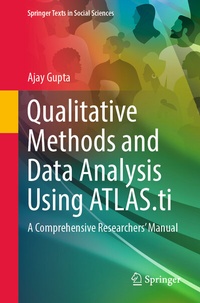
Qualitative Methods and Data Analysis Using ATLAS.ti
Description

This book provides an in-depth roadmap for qualitative research methods and data analysis across disciplines using ATLAS.ti. It encompasses and rationalizes key qualitative research concepts and methods with innovative frameworks to enrich the reader's understanding of qualitative research methods and data analysis. The book contains multiple real-world projects that assist readers in developing conceptual and theoretical knowledge, as well as gaining insights from fieldwork, visualizing data collection, analysis, and methodological interpretations.
This easy to use book provides a pragmatic approach to qualitative methods, proficiency in capturing field observations, user-friendly steps to data analysis starting from transcription, preparation of data, reading and identification of quotations, coding, memoing, commenting, code groups, creating smart codes and groups using set, semantic, and proximity operators resulting in generating numerous insightful thematic reports in avariety of formats.
More notable features:
- Demonstrates systematic roots to research from begin to end
- Provides practical advice on how to overcome field challenges during data collection, ethical considerations, and step-by-step procedures for gaining access to participants and capturing holistic data
- Includes numerous numerical arguments, interpretations, and explanations for concepts, themes, variables, networks, and emerging concepts
- Includes several research frameworks and data analysis guideposts on real-world research projects with thorough procedures covering 267 images and 38 tables
- Compelling for quantitative research and mixed methods approaches
The book's straightforward and user-friendly format makes it simple and easy to use, comprehend, and interpret for anyone working with ATLAS.ti.
More details
Other editions
Additional editions
Person
Dr. Ajay Gupta is a Professor of Human Resource Management and Organisational Behavior, Business Ethics, and Business Research Methods at VES Business School, India. He is Erasmus Mundus Fellow from the University of Milan, Italy. He holds a Ph.D. in Organisational Psychology from the Tata Institute of Social Sciences and a Master in Management from the Asian Institute of Management in Manila, Philippines. He has extended experience in business management teaching and research and is Professional ATLAS.ti, Senior Trainer, and Consultant. His research interests include organizational psychology, employee morale, organizational culture, and management practices across industries, disciplines, and hierarchies.
Content
Chapter 1. Introduction.- Chapter 2. Types of Data, Data Collection, and Storage Methods.- Chapter 3. Challenges in Data Collection.- Chapter 4. Codes and Coding.- Chapter 5. Data Analysis Methods.- Chapter 6. Using Networks and Hyperlinks.- Chapter 7. Discovering Themes in ATLAS.ti.- Chaper 8. Generating Themes from Smart Codes & Smart Groups.- Chapter 9. Group Creation for Entities and Report Generation.- Chapter 10. Survey Data Analysis.- Chapter 11. Social Netword Comments and Twitter Data Analysis.- Chapter 12. Analysis of Focus Group Data.- Chapter 13. Multimedia and Geo Data Analysis.- Chapter 14. Team Projects in ATLAS.ti.- Chapter 15. Literature Review and Referencing.
