

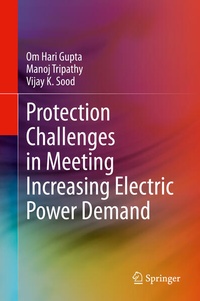
Protection Challenges in Meeting Increasing Electric Power Demand
Description

This reference book provides a detailed discussion on the protection challenges that arise due to technological improvements in transmission and distribution systems to supply increasing power demand. The primary focus of this book is transmission line protection with FACTS devices connected to the line and islanding detection in an active distribution system i.e., microgrids.
First, a literature review on the protection of transmission lines in the presence of switching devices is presented. The following chapters then present commonly proposed modifications required in the power system to meet increasing power demands, commonly used existing protection schemes and their limitations in the presence of switching devices, and solutions to these limitations in protection schemes. Results from fault simulations using PSCAD/EMTDC and MATLAB are also included.
This book will be valuable to graduate students and practicing engineers alike for dealing with protection issues in transmission and distribution systems incorporating FACTS devices.
- Provides thorough knowledge of trends in transmission networks for the enhancement of power flow, control and protection
- Presents an analysis of requirements of microgrids in the future
- Highlights challenges in the protection of active distribution systems or microgrids against islanding in the presence of distributed generation
More details
Other editions
Additional editions
Persons
Manoj Tripathy received his BE degree in electrical engineering from Nagpur University, Nagpur, India, in 1999, the M.Tech degree in instrumentation and control from Aligarh Muslim University, Aligarh, India, in 2002, and the PhD degree from the Indian Institute of Technology Roorkee, Roorkee, India, in 2008. He is currently working as Associate Professor in the Department of Electrical Engineering, Indian Institute of Technology Roorkee, Uttarakhand, India. His fields of interest are wavelets, neural network, optimization techniques, content-based image retrieval, digital instrumentation, digital protective relays and digital speech processing. Dr Tripathy is a reviewer for various international journals in the area of power systems and speech.
Vijay Sood obtained his Ph.D. from the University of Bradford, England. From 1976-2007, he was employed as a Senior Researcher at IREQ (Research Institute ofHydro-Québec) in Montreal. Since 2007, he is an Associate Professor at Ontario Tech University, Oshawa, Canada. His research interests are in the monitoring, control and protection of HVDC and FACTS power systems. He has published widely on HVDC and FACTS transmission systems. He is a member of the Professional Engineers of Ontario, a Life Fellow of the IEEE, Fellow of the Engineering Institute of Canada and Emeritus Fellow of Canadian Academy of Engineers.
Content
Introduction.- Changes in Conventional Power Systems.- Existing Protection and Challenges.- Solutions to the Protection Challenges.- Conclusions and Future Scope.
