

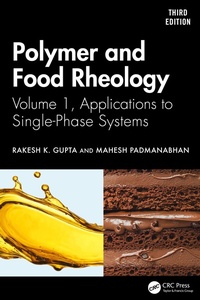
Polymer and Food Rheology
Volume 1, Applications to Single-Phase Systems
3rd Edition
Published on 26. February 2026
208 pages
978-1-040-71641-0 (ISBN)
Description

The science of rheology and its applications have grown steadily. Although polymers dominated in the past, the applications to foods have become increasingly important over the last four decades. The complexity of food rheology has not only generated increased interest among academics, but it has also led to an increased recognition of its importance in the food industry. Emphasizing physics rather than mathematics, Polymer and Food Rheology: Volume 1, Applications to Single-Phase Systems focuses on rheological characteristics and properties of single substances and homogeneous mixtures. It introduces fundamental principles, types of flows, types of instruments, their theory, capabilities, limitations, and sources of error. Both sophisticated rheometers and simple devices and their uses are considered.
Discusses the types of material functions (properties) obtained from the different types of measurements and techniques: shear viscosity, normal stress differences, dynamic mechanical properties, and extensional viscosity
Uses selected data of polymers and foods to illustrate the types of behaviors one could expect from these materials
Shows the effect of polymer structure, such as molecular weight, molecular weight distribution, long chain branching, temperature, pressure, and deformation rate on the material properties, using published data on LDPE, HDPE, and LLDPE; the applicability of these relationships to foods is also discussed
Links the measurement techniques to practical applications such as the choice, processing, and design of polymers and foods
Explains concepts such as entanglement, shear thinning, extensional strain hardening, melt strength, time-temperature superposition, among others and their relevance to practical applications
Describes the theory behind selected constitutive equations, their utility in modeling, and applications
This text is aimed at researchers, scientists, engineers, chemists, and industrial practitioners in materials, polymers, and foods.
Discusses the types of material functions (properties) obtained from the different types of measurements and techniques: shear viscosity, normal stress differences, dynamic mechanical properties, and extensional viscosity
Uses selected data of polymers and foods to illustrate the types of behaviors one could expect from these materials
Shows the effect of polymer structure, such as molecular weight, molecular weight distribution, long chain branching, temperature, pressure, and deformation rate on the material properties, using published data on LDPE, HDPE, and LLDPE; the applicability of these relationships to foods is also discussed
Links the measurement techniques to practical applications such as the choice, processing, and design of polymers and foods
Explains concepts such as entanglement, shear thinning, extensional strain hardening, melt strength, time-temperature superposition, among others and their relevance to practical applications
Describes the theory behind selected constitutive equations, their utility in modeling, and applications
This text is aimed at researchers, scientists, engineers, chemists, and industrial practitioners in materials, polymers, and foods.
More details
Edition
3rd edition
Language
English
Place of publication
London
United Kingdom
Publishing group
Taylor & Francis Ltd
Target group
Professional and scholarly
Product notice
Reflowable
Illustrations
8 Tables, black and white; 99 Line drawings, black and white; 20 Halftones, black and white; 119 Illustrations, black and white
File size
20,69 MB
ISBN-13
978-1-040-71641-0 (9781040716410)
Copyright in bibliographic data and cover images is held by Nielsen Book Services Limited or by the publishers or by their respective licensors: all rights reserved.
Schweitzer Classification
Other editions
Additional editions
Rakesh K. Gupta | Mahesh Padmanabhan
Polymer and Food Rheology
Volume 1, Applications to Single-Phase Systems
Book
approx. 02/2026
3rd Edition
CRC Press
€148.90
Not yet published
Persons
Rakesh K. Gupta is Professor and George B. & Carolyn A. Berry chair in the Department of Chemical and Biomedical Engineering at West Virginia University (WVU), where he has been teaching since 1992. He received his Ph.D. degree from the University of Delaware in 1980 and his B. Tech. degree from the Indian Institute of Technology, Kanpur, India in 1975, both in chemical engineering. Before coming to WVU, he taught at the State University of New York at Buffalo for almost 11 years. He has also worked briefly for Monsanto, DuPont and Braskem America. His research is focused on the processing and rheology of polymers and foods and also on polymer composites and nanocomposites. He has authored or coauthored over 135 journal papers, 80 conference proceedings papers, and 22 book chapters on these topics. He also holds four U.S. patents. He is the coauthor of the textbook Fundamentals of Polymer Engineering (now in the third edition) and coeditor of Handbook of Polymer Nanocomposites and Graphite, Graphene and their Polymer Nanocomposites. While his polymer rheology research has been supported by a variety of Federal, State and private sources, his food rheology research has primarily been funded by Kraft Foods and Mondelez International. He is a member of the Editorial Board of the Journal of Vinyl and Additive Technology, and he is a Fellow of the Society of Plastics Engineers.
Mahesh Padmanabhan is Research Fellow in the areas of Rheology, Texture, and Physical Sciences at Mondelez International, based in East Hanover, New Jersey; he also holds an Adjunct Professor of Chemical Engineering appointment at West Virginia University, Morgantown, West Virginia. He has been with Mondelez (previously Kraft Foods and Nabisco Foods) for over 28 years, applying the principles of rheology and physical sciences, developing methods and insights for a range of industrial problems and food systems: from ingredients, formulation, structure-property relations, processing, manufacturing, quality, to product texture related to consumer perception. Before joining Mondelez, Dr. Padmanabhan led the Rheology Lab of the Adhesives Division at the National Starch & Chemical Company, Bridgewater, New Jersey, following a postdoctoral fellowship in chemical engineering at the University of Minnesota. He received his B.Tech. (Hons.) degree (1985) from the Indian Institute of Technology, Kharagpur, India, M.S. (1989) and Ph.D. (1992) degrees from the University of Minnesota (St. Paul) all in agricultural engineering and an M.S. (1993) in chemical engineering, also from the University of Minnesota (Minneapolis).
Mahesh Padmanabhan is Research Fellow in the areas of Rheology, Texture, and Physical Sciences at Mondelez International, based in East Hanover, New Jersey; he also holds an Adjunct Professor of Chemical Engineering appointment at West Virginia University, Morgantown, West Virginia. He has been with Mondelez (previously Kraft Foods and Nabisco Foods) for over 28 years, applying the principles of rheology and physical sciences, developing methods and insights for a range of industrial problems and food systems: from ingredients, formulation, structure-property relations, processing, manufacturing, quality, to product texture related to consumer perception. Before joining Mondelez, Dr. Padmanabhan led the Rheology Lab of the Adhesives Division at the National Starch & Chemical Company, Bridgewater, New Jersey, following a postdoctoral fellowship in chemical engineering at the University of Minnesota. He received his B.Tech. (Hons.) degree (1985) from the Indian Institute of Technology, Kharagpur, India, M.S. (1989) and Ph.D. (1992) degrees from the University of Minnesota (St. Paul) all in agricultural engineering and an M.S. (1993) in chemical engineering, also from the University of Minnesota (Minneapolis).
Content
Chapter 0. Front Matter. Chapter 1. Introduction to Rheology. Chapter 2. Instruments for Shear Rheology. Chapter 3. Shear Viscosity of Polymeric Melts. Chapter 4. Shear Viscosity of Polymer Solutions. Chapter 5. Normal Stress Differences in Polymers During Shear Flow. Chapter 6. Dynamic Mechanical Properties. Chapter 7. Extensional Viscosity. End Matter I. Appendix: Alveograph analysis.
