

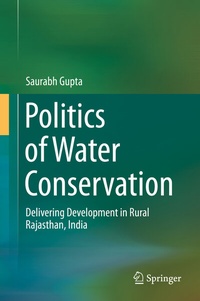
Politics of Water Conservation
Description

This book examines the politics of rural development with special reference to watershed development interventions in the desert province of Rajasthan in India. Watershed development (and rainwater harvesting) is one of the most significant rural development interventions in rainfed areas of India since the early 1990s. A range of developmental actors including the state watershed department, international donors, NGOs and grassroots organisations are involved in sponsoring watershed development projects. Using multi-sited ethnography and conversational interviews with the deliverers as well as recipients of development, the book compares and contrasts the watershed interventions of the state and two different kinds of NGOs in Rajasthan. While conventional studies on watershed development have focused on the evaluation of 'success' or 'failure' of particular projects, whether implemented by the state or NGOs, the book moves beyond this narrow analytical gaze to look at the roles, agendas and interests of multiple development agencies, often partnering together and sometimes competing with each other as part of, what the author calls, the 'watershed development regime'.
Taking cue from watershed development and water conservation projects over the last two decades, the book engages with the larger question of 'how' of delivering development. It examines the complex processes of cooperation, competition, negotiations, contestations and conflicts between different stakeholders, including the agents of development and differently positioned rural social groups in the context of Rajasthan. The book demonstrates that the recent interventions in watershed development and rainwater harvesting have considerably shaped the politics of development in Rajasthan in a number of ways: by becoming a site for the remaking of the 'state' and its internal relations, by disturbing the local hegemony in the countryside, by creating new relations of
patronage between diverse agents and recipients of development, by increasing the associational capacity as well as creating new conflicts (intra and inter village) and by initiating competition and cooperation between the various agents of development over control of local resources and power.More details
Other editions
Additional editions
Content
Introduction.- Understanding the Politics of Watershed Development.- Rajasthan: The Land of Rajas (Kings) and Droughts.- National Goals, International Agenda and Local Needs.- Development Specialists and Grassroots Workers.- 'Village Republics' and People's Movement.- Notes on the Politics of Rural Development in Rajasthan.
