

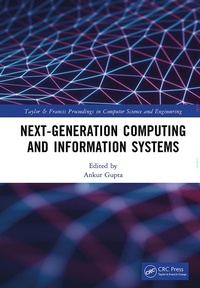
Next-Generation Computing and Information Systems
1st Edition
Published on 13. May 2026
294 pages
978-1-040-93500-2 (ISBN)
Description

This book compiles the proceedings of the Third International Conference on Next-Generation Computing and Information Systems (ICNGCIS 25). It combines high-quality research, practical insights, and scholarly debate spanning traditional domains like distributed computing, networks, and cybersecurity, alongside emerging areas such as AI, IoT, quantum security, and edge computing.
The proceedings include papers addressing currently relevant research issues such as smart contract security, interoperability in the metaverse, AI applications in healthcare, agriculture and related domains. The proceedings present findings with real-world implications for modern computing and information systems, addressing key challenges in design, deployment, operations, performance optimization, and limitation mitigation.
This book targets researchers from academia and industry, practitioners, students, technology enthusiasts, and general audiences seeking to understand cutting-edge applications, practical use cases, and core principles of modern computing and information systems.
The proceedings include papers addressing currently relevant research issues such as smart contract security, interoperability in the metaverse, AI applications in healthcare, agriculture and related domains. The proceedings present findings with real-world implications for modern computing and information systems, addressing key challenges in design, deployment, operations, performance optimization, and limitation mitigation.
This book targets researchers from academia and industry, practitioners, students, technology enthusiasts, and general audiences seeking to understand cutting-edge applications, practical use cases, and core principles of modern computing and information systems.
More details
Series
Edition
1. Auflage
Language
English
Place of publication
London
United Kingdom
Publishing group
Taylor & Francis Ltd
Target group
College/higher education
Professional and scholarly
File size
92,50 MB
ISBN-13
978-1-040-93500-2 (9781040935002)
Copyright in bibliographic data and cover images is held by Nielsen Book Services Limited or by the publishers or by their respective licensors: all rights reserved.
Schweitzer Classification
Other editions
Additional editions
Book
05/2026
1st Edition
CRC Press
€154.50
Shipment within 15-20 days
Person
Ankur Gupta is currently serving as Director at the Model Institute of Engineering and Technology, Jammu (India), besides being a Professor at the Dept. of Computer Science and Engineering. He has 25+ years of experience spanning industry and academia. Prior to joining MIET, he worked as a Team Leader at Hewlett-Packard, India at Bengaluru. He has over 100 published research papers in international journals/conferences. He holds B.E (Hons.) CS and MS degrees from BITS, Pilani and PhD from NIT, Hamirpur. He has 24 patents granted and 75 patents filed at the Indian Patents Office. He is the inventor of the Performance Insight 360, quality analytics framework for higher education which has received several accolades. He has received the DSFT-FIST Grant in 2012, first in the private sector in J&K and received competitive grants over Rs. 2.5 Crore from various funding agencies. He is a recipient of the AICTE Career Award, faculty awards from IBM, EMC and Rs. 2 crores in funding from Govt. agencies. He is also Senior member IEEE and ACM and founder of the International Journal of Next-Generation Computing. His research interests are in cloud computing, P2P networks, network management, artificial intelligence and metaverse.
Content
Section 1 Keynote addresses Record linkage; Multiobject tracking: Challenges, opportunities and applications; The future computational camera; AI for applications using Python language; Computing concepts for enhancing artificial intelligence at the edge; LazyAI: Learning how and when not to act; Section 2 Regular papers Post-quantum security for Fog computing-based IoT systems against eavesdropping attacks; Intelligent traffic violation detection using deep learning and YOLOv8n: System design and performance analysis; Cross-device behavioral fusion in personal IoT for early stress detection: A blockchain-enabled, privacy-preserving architecture; Real-time hybrid AI framework for anomaly detection in GraphQL APIs under nested-query attacks; Lightweight anomaly detection using TinyML models on simulated IoT networks; Synergising fog and cloud computing: Intelligent task offloading for real-time IoT applications; A learning-based traffic-sensitive optimal route selection method in SDNs; Congestion-aware multi-agent path planning for smart healthcare; Performance analysis of MFCC-GMM and MFCC-CNN approaches for isolated word recognition in Dogri language; A privacy-preserving federated meta-learning framework for rare disease histopathology; Machine learning framework for diabetes mellitus classification; Deep learning-based multichannel model for human activity recognition technology from wearable devices; A hybrid SWIN transformer and Model-Agnostic Meta-Learning framework for corticobasal degeneration detection; Temporal-spatial deep learning models for multi-class DDoS detection: A comparative evaluation; Mach Zehnder interferometer-based photonic matrix multiplication for AI acceleration devices; Hybrid imitation learning framework for optimizing decision-making in consumer electronics using lightweight AI; Hybrid AI framework for real-time traffic violation detection and road safety enhancement; Leveraging the machine learning models to predict the impact of rising electricity bill and its expense on the customers' annual disbursement; Cancer diagnosis prediction using borderline-SMOTE balanced RNA-Seq data; Detection of lumpy skin disease using machine learning-based approaches; Synergising fog and cloud computing: Intelligent task offloading for real-time IoT applications; A learning-based traffic-sensitive optimal route selection method in SDNs; Congestion-aware multi-agent path planning for smart healthcare; Performance analysis of MFCC-GMM and MFCC-CNN approaches for isolated word recognition in Dogri language; A privacy-preserving federated meta-learning framework for rare disease histopathology; Machine learning framework for diabetes mellitus classification; Deep learning-based multichannel model for human activity recognition technology from wearable devices; A hybrid SWIN transformer and Model-Agnostic Meta-Learning framework for corticobasal degeneration detection; Temporal-spatial deep learning models for multi-class DDoS detection: A comparative evaluation; Mach Zehnder interferometer based photonic matrix multiplication for AI acceleration devices; Hybrid imitation learning framework for optimizing decision-making in consumer electronics using lightweight AI; Hybrid AI framework for real-time traffic violation detection and road safety enhancement; Leveraging the machine learning models to predict the impact of rising electricity bills and its expense on customers' annual disbursement; Cancer diagnosis prediction using borderline-SMOTE balanced RNA-Seq data; Detection of lumpy skin disease using machine learning-based approaches; DWT- and PCA-based color image watermarking using genetic algorithm; Ensemble transfer learning framework for early autism identification using structural MRI; A novel approach for citrus greening disease severity assessment: Hybrid deep learning using autoencoder and random forest; Deep learning in digital pathology for prostate cancer: A comprehensive review of detection, segmentation, and grading methodologies; DenCeptionNet-PD: A transfer learning-based ensemble framework for early prediction of Parkinson's disease; A review of automatic pronunciation mistake detector; DANN-based harmonization of multi-center fMRI for ASD classification using ABIDE I and II; Early detection of lung cancer using convolutional neural networks and DNA methylation biomarker analysis; Deep learning pipeline for precise autoimmune disease prediction; AI-driven legal assistant for legal empowerment in India: Leveraging Indian legal datasets to promote access to justice
