

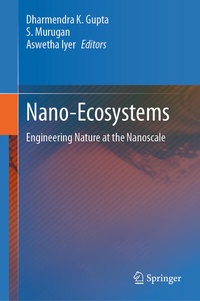
Nano-Ecosystems
Description

The book introduces the concept of using nanotechnology to support and restore natural ecosystems. It explains how tiny materials and devices can be designed to work like parts of nature, helping to solve problems related to energy, pollution, soil health, and climate change.
The book begins by defining what nano-ecosystems are and the principles behind engineering them. It then discusses the practical applications, such as using nanomaterials for energy harvesting and storage, creating bio-inspired structures, and developing nanosensors for environmental monitoring. Other chapters explore how nanotechnology can help in improving soil quality, capture carbon emissions, manage waste, and support biodiversity. The later sections look at the use of artificial intelligence in managing these systems, modelling them at different scales, and considering the ethical and social aspects of their use. The book ends with a discussion on the challenges and future directions of this field.
This book is a useful resource for students, researchers, and professionals in life sciences, environmental science, nanotechnology, and sustainability.
More details
Other editions
Additional editions
Persons
Dr. Dharmendra K. Gupta serves as Director (Scientist-F) at the Ministry of Environment, Forest and Climate Change, New Delhi, India. With prior experience in several international research collaborations, he holds a doctoral degree in plant sciences. His research focuses on phytoremediation, environmental pollution, and plant-microbe interactions. He has been honoured with several international and national awards and has completed multiple interdisciplinary research projects. He has published more than 130 international peer-reviewed original research/review articles/book chapters and 29 books and serves as two book series editors.
Dr. S. Murugan is currently an Associate Professor in the Department of Biotechnology at Karunya Institute of Technology and Sciences, Coimbatore, Tamil Nadu, India. He has over 25 years of academic experience, having previously served in various teaching and mentoring roles. He holds an M.Sc. in Microbiology from ManonmaniamSundaranar University and a Ph.D. in Microbiology from Bharathiar University, both in Tamil Nadu, India. His areas of interest include microbiology, biotechnology, and environmental sustainability. Dr. Murugan has received several recognitions for his contributions to education and research. His scholarly output includes numerous research articles, general science pieces, career-focused writings, and several book chapters.
Ms. Aswetha Iyer is a Research Associate at Karunya Institute of Technology and Sciences, Coimbatore, Tamil Nadu, India. She has focused on environmental microbiology, nanotechnology, and metalloproteomics. She holds a postgraduate degree in life sciences and is passionate about sustainability research. She has received a national-level Best Research Award in 2024. Her academic portfolio includes multiple research articles and book chapters
Content
Chapter 1. The Concept of Nano-Ecosystem and its potential.- Chapter 2. Principles of Nano-Ecosystem Engineering.- Chapter 3. Nano-Engineered Bio-Inspired Structures And Functions.- Chapter 4. Nanomaterials For Energy Harvesting And Storage In Nano-Ecosystems.- Chapter 5. Biomimetic Nano devices For Environmental Sensing And Monitoring.- Chapter 6. Nanotechnology For Carbon Capture and Climate Change Mitigation in Nano-Ecosystems.- Chapter 7. Nanotechnology Novel Trends for Soil Revitalization.- Chapter 8. Nanotechnology In Waste Management: Pyrolysis-Driven Solutions for Transforming Challenges into Opportunities.- Chapter 9. Nano-Eco Systems for Biodiversity Conservation and Habitat Restoration.- Chapter 10. Nanorobotics: A Futuristic Approach to Microplastic Removal.- Chapter 11. Integration Of Artificial Intelligence In Nano-Ecosystems.- Chapter 12. Multiscale Modeling And Simulation of Nano-Ecosystems.- Chapter 13. Ethical And Societal Considerations of Nano-ecosystems.- Chapter 14. Challenges and Future Perspectives of Nano ecosystem Engineering.
