

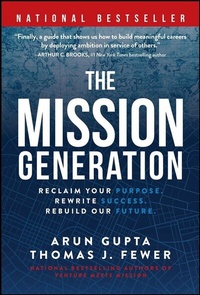
The Mission Generation
Description

"We all seek to build a meaningful career, but that's easier said than done. Finally, we have a guide that shows us how to do it. Read Arun Gupta and Thomas J. Fewer's wonderful The Mission Generation to deploy your ambition in service of others." -Arthur C. Brooks, Harvard Professor and #1 New York Times bestselling author
The Mission Generation isn't defined by age-it's bound by conviction. This book offers a new blueprint for every age and stage, one that doesn't force you to choose between making money and finding meaning.
The old scripts are broken. The average person will now have four to six careers in their lifetime-not jobs, careers! Meanwhile, AI disruption, environmental crisis, political polarization, and geopolitical conflict are fracturing the institutions we once relied on. The ladder has collapsed. The 30-year plan doesn't exist anymore.
Whether you're a first-time job seeker, midlife pivoter, or legacy-minded leader, you're probably asking: Does my work matter? What am I really building? How can I keep contributing?
Inside The Mission Generation you'll discover:
- The four forms of resistance blocking your path to meaningful work-and the specific strategies to move past them
- Compass Capital: Six forms of capital (mission, trust, health, learning, experience, and financial) that compound even in uncertain times-your true competitive advantage when traditional credentials no longer guarantee security
- The Mission Flywheel: A practical model for turning conviction into momentum through small, strategic actions that build on each other and create exponential impact over time
- Real stories from Gen Z tech founders, Millennial innovators, Gen X career switchers, and Boomer legacy builders-proving that mission transcends age, background, and circumstance
The loss of career stability isn't a setback. It's your opportunity to design something better: careers that are impactful, rewarding, and built to adapt. When you join The Mission Generation, you stop asking "What should I do?" and start asking "What needs doing?" Because purpose isn't a detour from achievement. It's the compass.
This is the invitation: Reclaim your purpose. Rewrite success. Rebuild our future-together. The Mission Generation shows you how.
More details
Other editions
Additional editions
Persons
ARUN GUPTA is the CEO of NobleReach Foundation, which focuses on catalyzing and inspiring a renewed spirit of public service through innovation. He is also a Venture Capitalist, national bestselling author, Lecturer at Stanford University, and Adjunct Entrepreneurship Professor at Georgetown University. Arun is a frequent contributor to leading journals, podcasts, and conferences on topics related to emerging technology, public policy, entrepreneurship, and next-generation mission-driven leaders. Arun earned engineering degrees from Stanford University and an MBA from Harvard Business School.
THOMAS J. FEWER is an Assistant Professor of Management at Rutgers University School of Business-Camden whose research examines how businesses, governments, and civic institutions navigate politics, purpose, and public impact.
Content
Prologue: The Call We Couldn't Ignore ix
PART I The Reckoning and the Rebuild 1
Chapter 1 The Illusion of Stability: How to Build Your Compass When the Old Maps Fail 3
Chapter 2 From Crisis to Calling: The Rise of the Mission Generation 17
PART II From Resistance to Resolve 35
Chapter 3 Why We Resist: When Purpose Meets Pushback 37
Chapter 4 Why It Pays to Have Purpose: Aligning Financial and Mission Capital 57
Chapter 5 The Hidden Capitals That Give You Direction When No One's Watching 77
Chapter 6 Investing in the Compass Capitals to Compound Your Impact 93
Chapter 7 Your Big Breakthrough Will Be a Thousand Small Ones: The Mission Flywheel 111
PART III The Dual Citizen Advantage 129
Chapter 8 The Courage to Be Wrong: How Small Early Bets Compound into Big Careers 131
Chapter 9 When Success Stops Being Enough: The Mid-Career Pivot That Preserves You 147
Chapter 10 It's Not Too Late: Start the Most Impactful Chapter of Your Career with a Beginner's Mindset 163
PART IV Designing a Life of Enduring Contribution 183
Chapter 11 Rewriting Success: The Portfolio of You 185
Chapter 12 Civic Platforms: Building a More Perfect Union 205
Epilogue: Mission 2036 231
Notes 233
Acknowledgments 245
About the Authors 247
Index 249
Prologue: The Call We Couldn't Ignore
"Call them the Mission Generation."
Chris Darby's words hung in the quiet Washington restaurant on a humid July evening. The then-CEO of In-Q-Tel had just named something we'd been witnessing but couldn't articulate.
With collective experience across academia, venture capital, government, and technology, we'd found ourselves accidental chroniclers of a cultural shift that began within weeks of our book Venture Meets Mission hitting the shelves in January 2024. We'd written the book to explore how entrepreneurs, investors, and public leaders could align innovation with civic purpose, expecting modest interest from policy and innovation circles. Instead, the narrative struck a broader nerve we never anticipated as early-, mid-, and late-career professionals across sectors began reaching out, not to debate the premise but to share their own quiet doubts about whether their work actually mattered. The months following the book's launch pulled us into a whirlwind of conference talks, campus visits, policy discussions, and boardroom conversations. While the book served to shape the early strategy for launching the NobleReach Foundation-dedicated to rekindling a spirit of national service across all career stages-the response across academia, government, and industry accelerated our work to help build those bridges at scale. Everywhere we went, people across career stages and sectors were asking themselves a single question: How can my skills serve something larger than myself?
"You've clearly tapped into something with the book success," Chris said, "But people don't just want to read about this type of work. They want to participate in it." He paused, then added as a parent, "Especially younger folks. My daughter and her friends are hungry to combine their personal ambition with purpose. They want to contribute to something bigger, but they can't be what they can't see."
Chris articulated something we had already been observing but hadn't yet named: a growing cohort of people who looked to rewrite the definition of success. They spanned industries and life stages, aligning their professional aspirations with a purpose larger than themselves. The Mission Generation wasn't an idea we had to invent. It was a reality we were experiencing.
Three Stories, One Pattern
Three people. Three career stages. One revelation: The traditional script wasn't working. Michael, Tarun, and Charlene had discovered what millions of others were quietly feeling-that professional success without a larger purpose felt hollow. All wondered: Can professional ambition and public impact coexist? And all discovered: Their stories weren't outliers. They were part of an intergenerational shift that was much larger than any one of them.
Michael, whom we met at a networking event in Washington, DC, was thriving by every conventional metric-University of Virginia MBA, top-tier consulting job, marquee clients-yet privately he'd begun to question whether his work actually mattered. When the Department of the Navy called Michael about a deputy CTO role to modernize maritime capabilities, he feared that leaving the consulting world would mean stepping off a carefully planned path. Colleagues warned him the move was risky. It looked reckless on paper, but it felt right in his gut. Michael later told us that receiving Venture Meets Mission from a friend reframed the decision for him. It helped him recognize that moving toward mission-driven public service wasn't abandoning ambition but was amplifying it. He felt a quiet certainty that this was the challenge he'd been seeking all along.
Tarun approached us six months before graduating from Purdue University with an engineering degree, a strong GPA, and phenomenal internships. His future was secure, but it didn't feel right. He'd followed the playbook handed to him, yet wondered if that definition of success would ever feel meaningful. In our brief exchange after a book talk at Purdue, his honesty stood out: He didn't know exactly what he sought, but he knew he would recognize it when he found it. After he heard how mission-driven entrepreneurship could mesh public service with innovation, he finally found what he was looking for. It was the first time he saw a path to combine his desire to serve with his personal ambition and discovered that these paths weren't just viable-they were valuable. Shortly after graduation, Tarun applied and was selected to join the US Space Force for a one-year rotation as a NobleReach Scholar.
Charlene was a seasoned deep-tech entrepreneur who had successfully built multiple companies over two decades. Her reputation made her a natural fit for sought-after board positions. Boards beckoned; she declined. Instead, she joined In-Q-Tel Emerge, guiding first-time research founders in cybersecurity and semiconductors. Charlene saw in them the raw potential to create real impact, and she knew from experience how easily that potential could be derailed without the right guidance. For her, this role was a way to put her skills to work where they could enable public impact.
Michael, Tarun, and Charlene show that professional ambition and public impact don't have to be opposites. Despite the traditional career scripts that push people to choose one or the other, the two can reinforce each other. In the pages ahead, you will meet the Mission Generation: people refusing the false choice between success and service, determined to align their careers with contribution. Sometimes the stories are anonymized, sometimes not, but together they trace an unmistakable shift taking place in the world.
The data confirmed what we were seeing firsthand: 86% of Gen Z and 89% of Millennials consider a sense of purpose as essential to job satisfaction.1 Other research has found that two-thirds of older workers delay retirement specifically to do meaningful work.2 Our own national survey found that four-fifths of people believe that doing purposeful work helps you live longer. The Mission Generation isn't a passing trend; it's a fundamental shift spanning every career stage. Mission has become the new "stock options" for building "holistic net worth"-everyone wants it, few understand its true value. What we were observing was an awakening across generations.
Beneath these shifts ran an undercurrent of unease shaped by a confluence of pressures: the accelerating impact of AI on jobs, the lingering dislocation from a global pandemic, rising geopolitical tensions, and economic volatility. For much of the last century, a steady career meant holding one job for 40 years. Later, it meant sticking to one profession with multiple employers. Today, most of us will navigate five or six careers over an extended work span of nearly 60 years, pushed by necessity as much as by choice. In an environment defined by constant disruption, purpose has become a compass for reinvention. When the ground is stable, it is easy to focus on oneself, but when the ground begins shifting, people reach out to others for stability in hopes of becoming something larger than oneself.
Yet for every Michael, Tarun, or Charlene who finds their path, thousands more quietly disengage, caught in the gap between their ideals and their institutions. Burnout is no longer just personal-it's structural. A generation is wrestling not only with meaning, but with whether meaning still matters in systems that feel extractive, rigid, or obsolete. The risk isn't just lost talent; it's the civic cost when cynicism fills the vacuum where contribution should be.
Building for Interdependence: The Next 250 Years
This book shares what we've learned from the talented people we met in the last several years. It's grounded in conversations-from coffee with recent grads just starting out to dinners with former classmates reflecting back. We don't claim to offer a one-size-fits-all solution. But we do believe there are patterns worth paying attention to: professional barriers that repeat, career scripts that need to be rewritten, and choices that help individuals align their values with their vocation. This growing movement of people seeking to do work that is mission-driven spans sectors and generations-students reconsidering inherited definitions of success, professionals reshaping careers, senior leaders applying decades of experience in new directions. They don't want to choose between "doing good" for the world or "doing well" for themselves. They want both.
The urgency of the Mission Generation is not just personal or professional-it's historical. As we approach the United States' 250th anniversary in 2026, we're being called not just to reflect, but to renew our civic commitments. From the outset, the founders understood that building a society was an ongoing effort, captured in their vision of forming a "more perfect Union"-words that recognized adaptation and renewal as fundamental responsibilities. Today, that work feels more essential than ever.
For the Mission Generation, that means confronting essential questions: Can this democratic experiment endure amid institutional distrust and collective anxiety? What kind of society are we building? And what must we be willing to contribute to sustain it? Questions that, we'd be remiss not to note, are being asked across democracies...
