

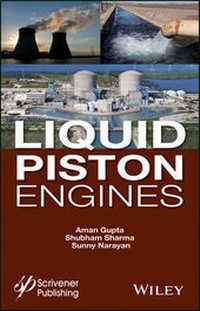
Liquid Piston Engines
Description

More details
Other editions
Additional editions
Persons
Aman Gupta holds a masters degree from Punjab Technical University, and he has written or co-written several books and papers. His areas of research include heat transfer, thermal engineering, and solid mechanics.
Shubham Sharma holds a masters degree from Punjab Technical University. His area of research is in mechanical engineering, and he is a consultant in the field of combustion engines.
Sunny Narayan holds a masters degree from the University of Bristol in the United Kingdom and has several books and papers to his credit. He is a member of SAE, ASME and INCE and is a freelance tutor. His area of research includes combustion engines, focusing on noise and vibration aspects of engines.
Content
Abstract ix
List of Symbols xi
1 Introduction 1
1.1 Background 1
1.2 Types of Stirling Engines 2
1.3 Stirling Engine Designs 4
1.4 Free-Piston Stirling Engines 6
1.5 Gamma Type Engine 18
References 27
2 Liquid Piston Engines 29
2.1 Introduction 29
2.2 Objectives 32
2.3 Brief Overview of Pumps and Heat Engines 33
2.4 Heat Engine 38
2.5 Clever Pumps 42
2.6 History and Development of Stirling Engines 45
2.7 Operation of a Stirling Engine 48
2.8 Working Gas 53
2.9 Pros and Cons of Stirling Engine 53
2.10 Low Temperature Difference Stirling Engine 54
2.11 Basic Principle of a Fluidyne 55
2.12 Detailed Working of a Fluidyne 57
2.13 Role of Evaporation 61
2.14 Regenerator 61
2.15 Pumping Setups 62
2.16 Tuning of Liquid Column 63
2.17 Motion Analysis 64
2.18 Losses 65
2.19 Factors Affecting Amplitude 66
2.20 Performance of Engine 67
2.21 Design 67
2.22 Assembly 70
2.23 Calculation 71
2.24 Experiments 72
2.25 Results 74
2.26 Comparison Within Existing Commercial Devices 76
2.27 Improvements 78
2.28 Future Scope 79
2.29 Conclusion 80
2.30 Numerical Analysis 80
References 83
3 Customer Satisfaction Issues 87
3.1 Durability Issues 87
3.2 Testing of Engines 88
3.3 Design of Systems 88
3.4 Systems Durability 89
References 89
4 Lubrication Dynamics 91
4.1 Background 91
4.2 Friction Features 93
4.3 Effects of Varying Speeds and Loads 94
4.4 Friction Reduction 94
4.5 Piston-Assembly Dynamics 95
4.6 Reynolds Equation for Lubrication Oil Pressure 96
4.7 Introduction 102
4.8 Background 104
4.9 Occurrence of Piston Slap Events 105
4.10 Literature Review 110
4.11 Piston Motion Simulation Using COMSOL 114
4.12 Force Analysis 117
4.13 Effects of Various Skirt Design Parameters 120
4.14 Numerical Model of Slapping Motion 131
4.15 Piston Side Thrust Force 132
4.16 Frictional Forces 133
4.17 Determination of System Mobility 133
4.18 Conclusion 143
5 NVH Features of Engines 145
5.1 Background 145
5.2 Acoustics Overview of Internal Combustion Engine 146
5.3 Imperial Formulation to Determine Noise Emitted from Engine 149
5.4 Engine Noise Sources 151
5.5 Noise Source Identification Techniques 154
5.6 Summary 157
References 158
6 Diagnosis Methodology for Diesel Engines 161
6.1 Introduction 161
6.2 Power Spectral Density Function 162
6.3 Time Frequency Analysis 162
6.4 Wavelet Analysis 163
6.5 Conclusion 164
References 165
7 Sources of Noise in Diesel Engines 167
7.1 Introduction 167
7.2 Combustion Noise 168
7.3 Piston Assembly Noise 168
7.4 Valve Train Noise 170
7.5 Gear Train Noise 170
7.6 Crank Train and Engine Block Vibrations 171
7.7 Aerodynamic Noise 171
7.8 Bearing Noise 171
7.9 Timing Belt and Chain Noise 172
7.10 Summary 174
References 175
8 Combustion Based Noise 179
8.1 Introduction 179
8.2 Background of Combustion Process in Diesel Engines 180
8.3 Combustion Phase Analysis 183
8.4 Combustion Based Engine Noise 184
8.5 Factors Affecting Combustion Noise 186
8.6 In Cylinder Pressure Analysis 187
8.7 Effects of Heat Release Rate 187
8.8 Effects of Cyclic Variations 188
8.9 Resonance Phenomenon 189
8.10 In Cylinder Pressure Decomposition Method 189
8.11 Mathematical Model of Generation of Combustion Noise 192
8.12 Evaluation of Combustion Noise Methods 193
8.13 Summary 199
References 199
9 Effects of Turbo Charging in S.I. Engines 203
9.1 Abstract 203
9.2 Fundamentals 204
9.3 Turbochargers 205
9.4 Turbocharging in Diesel Engines 206
9.5 Turbocharging of Gasoline Engines 207
9.6 Turbocharging 208
9.7 Components of Turbocharged SI Engines 208
9.8 Intercooler 213
9.9 Designing of Turbocharger 213
9.10 Operational Problems in Turbocharging of SI Engines 222
9.11 Methods to Reduce Knock in S.I Engines 223
9.12 Ignition Timing and Knock 223
9.13 Charge Air Cooling 224
9.14 Downsizing of SI Engines 225
9.15 Techniques Associated with Turbo Charging of SI Engines Boosting Systems 225
10 Emissions Control by Turbo Charged SI Engines 231
11 Scope of Turbo Charging in SI Engines 233
12 Summary 235
13 Conclusions and Future Work 237
13.1 Conclusions 237
13.2 Contributions 237
13.3 Future Recommendations 238
References 240
List of Important Terms 243
Bibliography 247
Glossary 249
Index 251
Chapter 1
Introduction
1.1 Background
The Stirling engine system was studied years ago. Such engines have merits the basis of sealings, materials, heat transfer rate, size, and weight issues. During past years the major focus has been on various designs of Stirling engine systems.
This engine is based on a heated reciprocating system. The gas receives heat and expands at constant temperature. Rate of transfer is higher, which is a major drawback of these engines. In contrary the internal combustion (IC) engine is operated by combustion of air-fuel mixture which results in higher heat and pressure rise which is converted to useful work. The temperature varies with the combustion and piston motion. As the heat is supplied externally the following varieties of sources can be used:
- Heat from gaseous, liquid, or solid fuel
- Solar energy
- Recycled Waste heat
Cooling in a Stirling engine cycle can be done in the following ways:
- Convection cooling
- Use of cooling fluids like water, ethylene glycol, or a mixture
Reversible nature of Stirling engine differentiates it from IC engines. Combustion outside results in lower emissions as well as less noise and vibration.
Solar energy may also be harnessed using parabolic dish.
As a smaller number of fuel types or heat sources are available, a Stirling system may be designed as such. This system may use solar heating as the primary heat source, as well as a natural gas burner as an auxiliary unit during nights and cloudy periods.
1.2 Types of Stirling Engines
Using basic concepts of heat engineering many designs of Stirling engines have been proposed over past years. These engines may be classified on the basis of mechanical design features as:
- Kinematic designs: These engines operate on basis of crankshaft and linkage mechanisms in which the motion of the piston is limited by configuration of linkages.
- Free-piston designs: In these engines the oscillatory motion of the piston in a magnetic field generate electric power. Pressure gradient cause tuned spring-mass-damper motion of displacer. Such machines are simple to operate but more complex on basis of dynamics and thermodynamics. For cooling purposes, the piston may be driven by a motor.
Stirling engines may also have alpha, beta, or gamma configurations which are discussed as follows:
Alpha engines which are seen in Figure 1.1 have two separate pistons that are linked and oscillate showing some phase lag. The working gas moves to and fro passing through a cooler, regenerator, and a heater between the cylinders. These engines are kinematic engines which need proper sealings.
Figure 1.1 Alpha engines.
Beta engines that are seen in Figure 1.2 have a displacer-piston arrangement that are in phase with one another. The displacer pushes the gas to and fro between the hot (expansion area) and cold ends (compression area). As the working gas moves, it passes through a cooler, regenerator, and heater. Beta engines can be either kinematic or free-piston engines.
Figure 1.2 Beta engines.
Gamma engines which are shown in Figure 1.3 have a system wherein the displacer and power pistons operate in separate cylinders. The displacer moves the working gas to and fro between the hot and cold ends. The cold area has cold side of the displacer and power piston. As the gas moves, it passes through a cooler, a regenerator, and a heater. These engines can be either kinematic or free-piston type.
Figure 1.3 Gamma engine.
1.3 Stirling Engine Designs
The power piston in the engine is connected to an output shaft by linkages. Kinematic design of the engine has following merits:
- Coordination of various parts for proper motion during start-up, normal operation, and fluctuations of loads.
Some disadvantages of such a design include:
- Need of lubrication due to rotating parts.
- Need of more maintenance.
- Proper sealing needed.
Some of the novel designs of kinematic engines are discussed next.
Wobble-plate Mechanisms
The wobble-plate that is seen Figure 1.4 has a wobble plate which is in a sliding contact with the crankshaft pivoted by connections to pistons as well as connecting rods. This ensures straight travel inside the cylinder with out rotation. The thrust is transferred to the crank at an offset angle to wobble plate which acts as a double-acting engine using the power stroke of one cylinder to compress the cold gas for the adjacent cylinder. The power piston for one cylinder is the displacer piston for another cylinder.
Figure 1.4 Gamma engine.
Figure 1.5 Swash plate engines.
The Z-crank shape that the same to the wobble plate design has pistons connected directly to the crankshaft. Pivot points are made in order to ensure axial motion of the piston in the cylinder. Such design is more compact as compared to a single-piston Stirling engine. However these engines have certain demerits:
- Cyclic load and wear of pivots is quick as they are under compression and bendings.
- Piston-lubrication is a major issue. Oil flow may cause fouling and lesser external heat transfer so reducing the efficiency.
Swash Plate Drive mechanisms - This drive has may same features as wobble plate. Bearings are used to connect the swash plate to the crankshaft and rotates with the crankshaft, but the wobble plate which remains fixed is attached to the shaft. This design has many merits:
- Quiet operation, better sealings with lesser lubrication problems.
- Design of swash plate may be changed for better stiffness and power transfer.
- The balancing of swash plate can be done built by adding additional sets of pistons. This in turn increases the power output and reduces the power-to-weight ratio.
Rhombic Drive - In this mechanism, yokes connect the power piston and the displacer piston. These are linked to twin crankshafts by means of connecting rods, as seen in Figure 1.6. In this drive mechanism power piston and the displacer piston move with constant lag. The rhombic drive has many benefits:
Figure 1.6 Rhombic drive engine.
- The engine has less vibrations due to complete balance of various lateral forces.
- These engines operate at higher power outputs due to higher pressures.
- Many units can move at same time in order to provide power to a multi-cylinder engine.
1.4 Free-Piston Stirling Engines
These engines have two oscillating pistons that are not connected as seen in Figure 1.7. The displacer piston has a smaller mass compared to the power piston. The heavier piston moves undamped. Motion of the displacer is simulated by springs or by the compressible working gas. The springs placed between the displacer and the power piston provide harmonic oscillations of the displacer. These oscillations are maintained by temperature difference, and so the system operates at the natural frequency.
Figure 1.7 Free piston engine.
The power in a free-piston system is generated by a linear alternator. Recently some of the designs have been using a hydraulic drive to run the crankshaft. Use of these hydraulics is good in engines having more torque which reduces the lateral forces in such systems.
Free-piston systems have major advantages:
- Less lateral forces and lubrication needs due to absence of rotating parts.
- Less maintenance.
- Properly sealed units prevent loss of the working gas.
These systems have following disadvantages:
- Need of complex calculations to ensure proper working.
- Lower response time as compared to kinematic and IC engines.
- Piston position is an important parameter to control system as oscillations may become unbalanced.
The Alpha configuration of engine is the simplest form having two pistons and two cylinders connected by a regenerator. Both these cylinders are normal to one another connected by a flywheel. The hot piston is in contact with located high-temperature source while the cold piston is with the low-temperature reservoir. The pistons are arranged in a manner that the linear motion is converted to rotatory motion and a constant phase difference is maintained. The pistons are joined at a common point on flywheel.
As compared to the other basic designs the alpha type engine has greater volume due to higher compression ratios.
Figure 1.8 An Alpha Stirling engine.
WORKING OF ENGINES: working of a Stirling engine can be divided into four operations steps that are similar to I.C. engine. Heat is added and removed at constant temperatures. The working of I.C. Engines occurs on the basis of Otto and Diesel cycles, respectively. Mechanisms of these engines is complex as motion is based on movements of multiple pistons.
Working of an Alpha Stirling can be analyzed as follows:
1. Transfer of working gas from cold side to hotter side:
Flywheel moves clockwise, the hot piston moves towards right hand side towards Dead Centre and the cold piston moves up towards Top Dead Centre (TDC) as seen in Figure 1.9.
Figure 1.9 Alpha engine - Transfer...
