

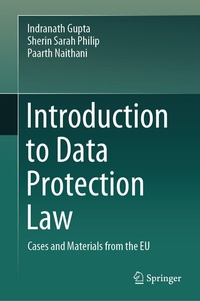
Introduction to Data Protection Law
Description

This textbook considers cases and materials introducing European Union (EU) data protection law to data protection enthusiasts while acting as a reference point for students and practitioners. The book's utility is twofold: the cases and materials can be used as a textbook as well as reference point for research. The book will benefit individuals new to this area and those at an intermediate level of familiarity with data protection law. It includes judgements delivered by the Court of Justice of the European Union (CJEU)/ European Court of Justice (ECJ) and decisions delivered by Data Protection Authorities (DPA) in the EU. While providing an overview of data protection law in the EU, the book introduces basic concepts of data protection law, principles of data protection law and rights and duties and remedies under the data protection law. Students would greatly benefit from the book by using it as an introduction to data protection law and as a reference point for research and assessments. Course instructors would benefit from the book by using it as core reading material.
Reviews / Votes
"Gupta et al.'s Introduction to data protection law: cases and materials from the EU is a timely and meticulously structured primer that successfully demystifies the complex landscape of European data protection law, with the General Data Protection Regulation(GDPR) at its core. . this book is a highly effective, accessible, and practical introduction. It achieves its goal of providing a comprehensive 'cases and materials' guide . ." (Lalit Saxena, Computing Reviews, January 9, 2026)
More details
Other editions
Additional editions
Persons
Indranath Gupta is Professor of Law at Jindal Global Law School and Dean , Office of Data, Innovation and Technology of O.P. Jindal Global University (JGU). He held the Jean Monnet Chair in Multi-dimensional Approaches to the Understanding of the EU Data Protection Framework. He is Director, Jindal Initiative on Research in I.P. and Competition (JIRICO) and Senior Fellow at the Jindal Institute of Behavioural Sciences (JIBS) and International Institute for Higher Education Research and Capacity Building (IIHEd). Prof. Gupta holds a PhD from Brunel University, London, and two LL.M. degrees (taught and research) from the University of Aberdeen, U.K., and the University of East Anglia, U.K. He specializes in technology law and aspects of intellectual property law. Prof. Gupta has published many books on IP Law with Springer and is currently heading the major reference work project titled 'Handbook on Originality in Copyright'.
Sherin Sarah Philip is Assistant Professor at Jindal Global Law School. She acquired her LL.M in International Commercial Law in 2018 from University College of Dublin, Ireland, where she chose corporate governance and white collar crime as an area to work on. She also has a diploma in "Entrepreneurship Administrative and Business Laws". Her interests include corporate law, IP law, and data protection laws.
Paarth Naithani is Lecturer at Jindal Global Law School, O.P. Jindal Global University. Paarth holds an LLM in Intellectual Property and Technology Law. He has an academic interest in data protection law and has published on data protection in journals, including the International Review of Law , Computers & Technology , Tilburg Law Review , European Data Protection Law Review , and the Journal of Data Protection & Privacy . Paarth has been Research Fellow with the Jean Monnet Chair in Multi-dimensional Approaches to the Understanding of the EU Data Protection Framework [2020-2023] at O.P. Jindal Global University.
Content
Chapter 1 - Introduction.- Chapter 2 - Data Protection Framework.- Chapter 3 - Rights of Data Subjects.- Chapter 4 - Duties and Responsibilities of Controller and Processor.- Chapter 5 - Transfer of Personal Data to third countries.- Chapter 6 - Enforceability, Remedies, Liability, and Penalties.- Chapter 7 - GDPR and New Technology.
