

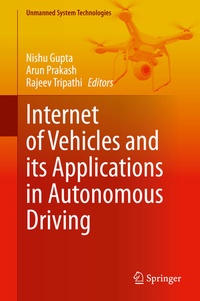
Internet of Vehicles and its Applications in Autonomous Driving
Description

This book provides an insight on the importance that Internet of Vehicles (IoV) solutions can have in taking care of vehicular safety through internetworking and automation. Key features of the book are the inclusion and elaboration of recent and emerging developments in various specializations of intelligent transportation systems and their solutions by incorporating IoT (Internet of Things) and IoV. This book presents to its readers useful IoV applications and architectures that cater to their improved driving requirements and lead towards autonomous driving. The application domains have a large range in which vehicular networking, communication technology, sensor devices, computing materials and devices, IoT communication, vehicular and on-road safety, data security and other topics are included.
More details
Other editions
Additional editions
Persons
Arun Prakash received his PhD from the Department of Electronics and Communication Engineering, Motilal Nehru National Institute of Technology Allahabad, India in 2011. He was a Visiting Research Scholar at the University of Waterloo, Canada during September 2008 to February 2009. At present, he is an Associate Professor in the Department of Electronics and Communication Engineering at Motilal Nehru National Institute of Technology Allahabad, India. His research interests are in the area of wireless and mobile communication, Mobile ad hoc networks, Vehicular Networks (Intelligent Transportation Systems-ITSs), Cognitive Radio Networksand Wireless Sensor Networks. He has published more than 50 papers in international journals and conferences of repute. He is a member of IEEE, IAENG and IETE.
Rajeev Tripathi received his B.Tech, M.Tech., and Ph.D. degrees in Electronics and Communication Engineering from Allahabad University, India. At present, he is working as Director of Motilal Nehru National Institute of Technology, Allahabad, India where he is also a serving Professor in the Electronics and Communication Engineering department. He worked as a faculty member at the University of The West Indies, St. Augustine, Trinidad, WI, during September 2002-June 2004. He was a visiting faculty at School of Engineering, Liverpool John Moorse University, U.K., during May-June 1998 and Nov-Dec 1999. Prof. Tripathi has made pioneering research contributions and has solved a number of open problems. He has published more than 140 papers in international journals and conferences of repute and supervised 18 Ph.D. students till date. He has worked closely with Government as well as industry on various problems and has successfully led and completed large projects and programmes at national and international levels. His research interests are in the area of wireless and mobile communication systems, Mobile ad hoc networks, computer network protocols, sensor networks and others.
